
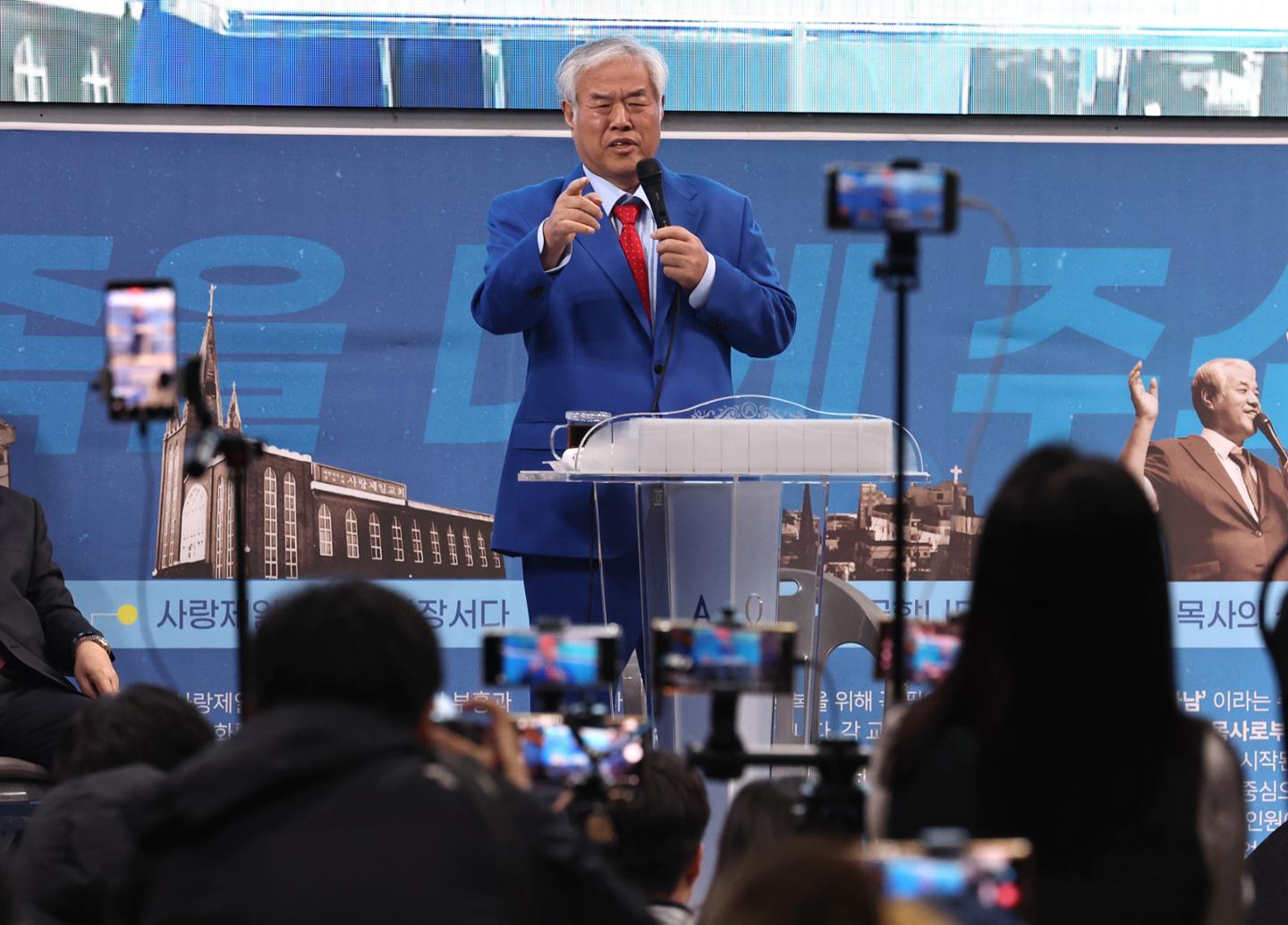
One of the core mobilizing bases behind the “Yoon Again” (the movement seeking reinstatement of former President Yoon Suk-yeol) camp is the Protestant community. The scene at the anti-impeachment rally in Hannam-dong—where hymns rang out like battle songs—symbolizes this alliance. These groups compare former President Yoon to King Cyrus of the Old Testament (the ruler who freed the Jews from Babylonian captivity) and claim they are carrying out “God’s will.” It is a strategy borrowed from segments of the American evangelical right that once elevated Donald Trump as a modern-day Cyrus.
Political leaders have eagerly adopted this rhetoric. Jang Dong-hyeok, leader of the People Power Party, has echoed far-right Protestant language by saying, “Even martial law is part of God’s plan,” and “Those who oppose God’s servant will face God’s judgment.” Even Yoon Suk-yeol—who spent most of his life closer to sool (alcohol) than the Lord—issued a message saying he “prayed earnestly to God, the sovereign of history, and to the Lord Jesus Christ.”
But the reality is quite different. The Protestant church in Korea is rapidly shrinking. According to the Pastoral Data Research Institute, the number of Protestants fell from 10.35 million in 2011 to 8.32 million in 2023. Their share of the total population has dropped to 16.6%. Fewer young people identify as Protestant, and many are so-called “Canaan Christians”—people who say they are Christian but do not regularly attend any church. In new cities, churches wield even less influence. In Suwon’s Yeongtong District (average age 38.2, as of 2023) and in Hwaseong (38.4), there are only 4.6 and 6.5 churches per 10,000 residents. In contrast, older rural counties like Gapyeong (50.7 years) and Yeoncheon (50.3) have 20.3 and 21.8 churches per 10,000 people.
Paradoxically, the contraction of Protestantism has contributed to the rise of far-right Protestant activism. The first driver is an existential crisis—the worldview that they are becoming a social minority. Professor Seo Myung-sam of Sogang University (religious studies) explains, “Before the merger of hard-right politics and Protestantism, there was already the 2024 rally opposing the anti-discrimination law.” Pastors Son Hyun-bo, Yoo Man-seok, Hong Ho-soo, and professor Lee Yong-hee—who led those rallies—went on to found “Save Korea.” In the United States as well, research shows that the decline of evangelicalism fueled Christian nationalism and support for Trump. This is a kind of “defensive identity politics.”
From an individual church’s management perspective, sharp political messaging is a way to gain influence and attract members. It widens the pool of potential “customers” nationwide; even if some leave, those who remain grow more homogeneous and loyal. This allows churches to horizontally expand into various services. Pastor Jeon Kwang-hoon is a prime example—his church offers members credit cards, discount mobile phone plans, and online shopping services. Pastor Son recently opened an alternative school and boldly declared at the entrance ceremony, “Within two years, the government will fully subsidize tuition,” presenting a vision that relies on political leverage to finance operations.
Another important factor is that alternative far-right activism has found pathways into the conservative mainstream. Kang Ki-hoon, a former senior presidential secretary, founded the far-right alternative party “Dawn of Liberty” and later joined the 2022 presidential campaign. Far-right Protestant networks can function as similar “ladders.” Observers pay close attention to the frequent joint appearances at conservative events by Son Hyun-bo’s son, Professor Son Young-kwang, Jo Pyeong-se, head of the 1776 Institute, and Kim Min-ah, CEO of BuildUp Korea—an informal “team” seen as an emerging force.
The problem is that their base is extremely narrow. The proportion of “far-right” Protestants within Protestantism is hardly different from the proportion of far-right respondents among non-Christians. According to a July survey by the Christian Institute for the Study of Social Problems, 21.8% of Protestants fall into the far-right category—almost identical to the 21% found in a nationwide survey using the same methodology by Professor Choi Young-joon of Yonsei University. In the Yeongnam region, Protestantism itself is close to a minority faith. In the March Busan superintendent of education election, candidate Jeong Seung-yun drew criticism for receiving an anointing prayer from Pastor Son and his associates at his campaign launch—and then suffered a crushing defeat. This suggests that far-right Protestantism, and politics relying on it, have limited potential for electoral success.
Posted by Freewhale98
1 Comment
[ context ]
This article explains why Korean evangelicals joined forces with Yoon’s shamans to overthrow democracy. The evangelical churches have quite hostile environment, infested with bullying among members, pressure to pay more “donations” and internal corruption involving embezzlement. This led to many young people leaving churches. This doesn’t mean religion overall in Korea decreased and Buddhist temple and catholic churches saw increase in followers, church decreasing the share of evangelical in the population and religious landscape. So, they think if they overthrow democracy and establish a “Christian state”, their “business” would be revived. That is why many megachurches supported Yoon in his martial law.