
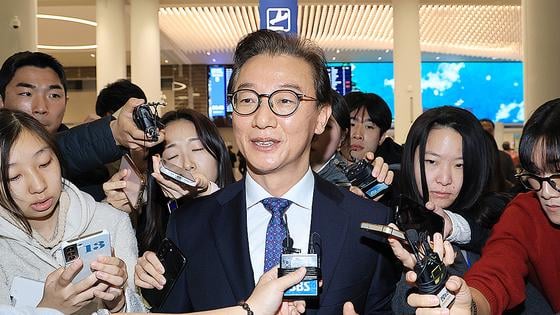
“It wasn’t that we leaned toward one side—we approached both sides.”
This was the claim made in court on the 5th by Yoon Young-ho, former World Headquarters Director of the Unification Church, in connection with allegations of political lobbying. His statement suggests that the Unification Church maintained relationships with both major political parties in South Korea.
Perhaps for that reason, allegations of church–state collusion that once appeared skewed toward the conservative camp—such as the First Lady Kim Keon-hee solicitation case, bribery allegations involving Rep. Kwon Seong-dong, and interference in the People Power Party’s leadership election—have recently spread rapidly into the Democratic Party as well.
The fallout has been significant. Rep. Jeon Jae-soo, widely considered the Democratic Party’s leading prospective candidate for mayor of Busan, resigned from his post as Minister of Oceans and Fisheries. Jeon faces allegations of having received 40 million won (approximately USD 30,000) and a luxury watch from Unification Church figures. Former lawmaker Lim Jong-seong, a member of the pro–Lee Jae-myung “Group of Seven,” is also implicated in allegations of receiving money from the church. Both deny the accusations, calling them “false.”
Why, among many religious groups, did politics become ensnared specifically in a “Unification Church gate”?
Special prosecutors believe the answer lies in the church’s ideology of “church–state unity”, formalized under Han Hak-ja’s leadership, which allegedly justified political outreach. According to indictments against Yoon and others, church members followed the Cheon Il Guk ideology—believing that Sun Myung Moon and Han Hak-ja are the “True Parents” and that the world should be unified as one nation under heaven.
In an October 2018 sermon at a church event, Han reportedly declared,
“Politicians cannot rule this nation. A heavenly sovereign state must be built through the True Parents.”
Inside the church, a different explanation is offered. A recorded 2022 phone call between Jung Won-joo, then chief of Han Hak-ja’s secretariat, and Yoon’s wife suggests an effort to rebrand the church, stating:
“Let’s shed the image of a cult and become a national religion.”
This reflects a belief that state governance should align with Unification Church doctrine.
This rebranding effort was shaped by past failure. In 2007, the Unification Church founded the Family Peace and Unification Party and fielded candidates nationwide in the 18th general election. The party won only 1.1% of the vote, leading to deregistration. According to multiple church insiders, senior figures concluded that direct political participation was doomed to fail, and instead focused on indirect political influence.
Economic pressure also played a role. A church insider noted that after the 2022 assassination of former Japanese Prime Minister Shinzo Abe, the Japanese government moved to dissolve the Unification Church as a religious corporation. As a result, donations from Japan—which had been a major source of funding—declined sharply, making overseas projects difficult.
This financial strain heightened the church’s need for political and governmental support, aligning with the special prosecutor’s claim that requests to First Lady Kim Keon-hee included preferential treatment in Cambodia’s Official Development Assistance (ODA) projects.
From Lee Jae-myung to Yoon Suk-yeol: The Turning Point
Against this backdrop, the Unification Church sought to approach both major parties ahead of the 20th presidential election.
A church official recalled that Kim Hye-kyung, Lee’s wife, was an alumna of Sunhwa Arts High School, affiliated with the Unification Church, creating a sense of familiarity. The official also claimed that Lee treated church pastors respectfully, and that as mayor of Seongnam, he helped resolve financial issues facing the church-affiliated football club Seongnam Ilhwa.
The relationship deteriorated in February 2020, when Lee—then governor of Gyeonggi Province—took a hardline stance against Shincheonji, aggressively enforcing COVID-19 quarantine rules. Church members reportedly viewed this as a warning sign. One Unification Church member said that demands for membership lists during the Shincheonji controversy alarmed the church internally.
Tensions worsened when Shincheonji leader Lee Man-hee attempted to receive a COVID test at Cheongshim Hospital, affiliated with the Unification Church, and Lee Jae-myung blocked the visit. Lee Man-hee was instead sent to a public health center.
A church official said senior leaders felt the church was being “disrespected,” and that Han Hak-ja was furious. When Lee ultimately declined to attend the church-organized Korean Peninsula Peace Summit ahead of the election, the church shifted decisively toward supporting Yoon Suk-yeol.
Yoon met Mike Pence, former U.S. vice president, at the summit. Special prosecutors believe Yoon’s campaign used the event as a form of “pro-U.S. candidate certification.”
“I Can’t Bless the Democratic Party for Another Five Years”
Ultimately, the Unification Church threw its full support behind Yoon Suk-yeol. According to testimony from a regional church leader, on March 2, 2022, one week before the election, Han Hak-ja convened senior officials and said:
“I question whether we should bless the Democratic Party for another five years.”
The remark was widely interpreted as an instruction to support Yoon.
Politicians argue that during election seasons, it is difficult to outright reject approaches from large religious organizations. A Democratic Party official said:
“Politicians benefit from access to large, organized groups, and religious groups gain access to various interests. A natural symbiotic relationship forms. The Unification Church, in particular, refers to its members as ‘family’ through mass weddings, making them ideal for mobilization during campaigns.”
The church’s use of neutral-sounding keywords such as “unification,” “peace,” and “family” also lowers barriers to political engagement. A Democratic Party lawmaker noted that some politicians attend events without realizing they are church-affiliated, while a senior People Power Party lawmaker admitted to being surprised after arriving at what he thought was a benign civic event—only to find it was hosted by the Unification Church.
Posted by Freewhale98
1 Comment
why is this cult allowed to have so much political influence in south korea and japan its so bonkers