
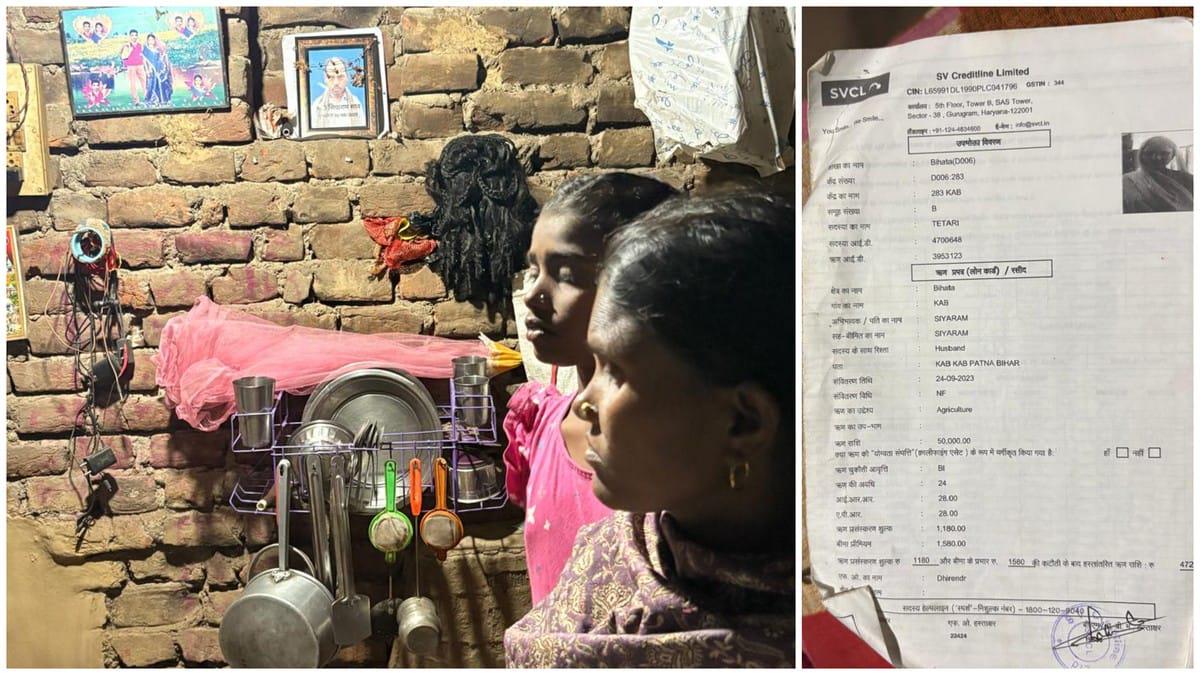
Submission Statement
This article goes into the dark side of microfinance. The people are trapped in vicious debt cycles with the workers in the microfinance having to make quotas, which then percolates down into pressuring people into taking out more debts. The result is that people are committing suicide , debt burdens are increasing. They also exploit the issue of how bihar is poor and does not have a lot of places to build credit or take loans so this is often done.
Posted by ewatta200
2 Comments
**Patna:** Siyaram Saw hadn’t slept all night, dreading the microfinance recovery agent due at dawn. When the door finally rattled, the 48-year-old, paralysed on his left side, could only watch as the agent snarled, “I want the money today, whether you live or die,” family members recounted. Trapped and seeing no way out, Saw ended his own life that day.
This is no longer the old story of greedy sahukars. In Bihar’s new economy of debt, it is the corporate recovery agent who strikes fear. What ails India’s poorest state is a surge of microfinance companies and relentless lending, targeted primarily at women. Once saviours, they have become engines of debt, trapping families in the very loans meant to save them from poverty.
[](https://vdo.ai/contact?utm_medium=video&utm_term=theprint.in&utm_source=vdoai_logo)
In Saw’s case, it was his wife, Tetari Devi, who had taken the loans.
“That agent came back. He saw my father trying to kill himself—he was still alive. He could have saved him,” recalled their daughter, Luchu Kumari, 20, cradling her four-month-old baby at their home in Kab village near Patna. “Instead, the agent ran and told the villagers that a man was taking his own life.”
With 150 microfinance companies operating in Bihar, the third-highest in India after Madhya Pradesh and Tamil Nadu, borrowing is easy, but debt often lurks around the corner. These lenders sell a dream of pucca houses, thriving businesses, and secure lives, but for many borrowers, it remains just that: a dream
What started as a way of helping the poor to get out of the poverty line turned into a game of exploitation. It was like killing the golden goose to get all the gold at one point of time -Rabi Narayan Mishra, RBI Chair Professor at Gokhale Institute of Politics & Economics
Across rural Bihar, families take multiple microfinance loans to cover daily expenses, then borrow again to meet weekly repayments. Many have reached breaking point. Some have died by suicide; others have abandoned their homes under cover of night. Left behind, elderly parents often shoulder the burden, facing threats, abuse, and constant intimidation. Loans and repayments have become permanent guests in their homes — a necessity for survival and a harbinger of ruin rolled into one.
Bihar is now India’s [largest microfinance market](https://www.sa-dhan.net/wp-content/uploads/2025/10/Bharat-Microfinance-Report_FY_2024-25_compressed.pdf), commanding 15 per cent of India’s total loan portfolio. And it also tops all states in both total debt and loan defaults. As of October 2025, total outstanding microfinance loans in the state stood at Rs 51,852 crore across 172 lakh accounts, with an average loan size of Rs 30,167, according to data shared with ThePrint by Sa-Dhan, a Reserve Bank of India-appointed self-regulatory body for microfinance institutions.
Of the 150 micro-lenders, 148 have a presence in rural Bihar, commanding a Rs 33,970 crore portfolio. Together, they serve 112 lakh rural clients, accounting for 65 per cent of the state’s total loan accounts. Behind these numbers are mostly women, who make up 95 per cent of borrowers nationwide, notes the [Sa-Dhan Bharat Microfinance Report 2025.](https://www.sa-dhan.net/wp-content/uploads/2025/10/Bharat-Microfinance-Report_FY_2024-25_compressed.pdf)
It feels as if with any of these new innovations in an old field, we realize we must re-invent the safeguards of old.
Like the [Food Size cycle](https://xkcd.com/1940/), except for finance.