
Why is this important?
Because free trade is the buisness of this sub that has it as its ethos.
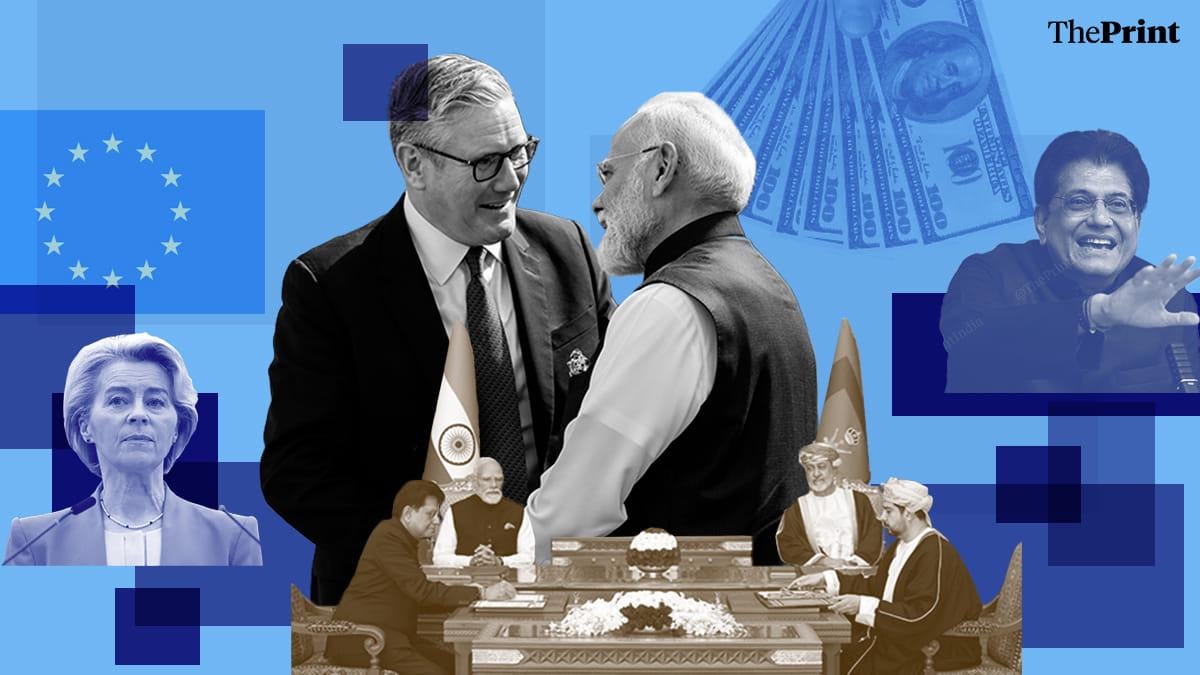
From trade with the UK, Indian exporters will benefit from agriculture, textiles, plastics, marine products, chemicals, and engineering goods. Omani marble for india, New Zealand FTA which will mean a more stable student visa scheme and allows access to the indian market for a number of goods (though not as much agriculture), all the while whats in the pipes includes: India-Eu FTA, India-Canada FTA and a prefertnial trade agreement with Mercosur that will be expanded along with a trade deal with Russia's Eurasian Economic Union, and with isreal
Posted by ewatta200
1 Comment
**New Delhi:** India’s 2025 diplomatic efforts have seen the announcement of three free trade agreements (FTAs) and signing of another two with the United Kingdom and Oman, as New Delhi seeks to expand its trading partnerships with developed markets.
Earlier this month, India announced the conclusion of negotiations with New Zealand for a trade deal that is expected to be signed by the first quarter of next year, while negotiations with the European Union have moved forward at real speed over the last 12 months.For New Delhi, the past 12 months has seen its diplomacy evolve around trade, with its highs and lows in many aspects related to FTA’s or staving off tariffs imposed by US President Donald Trump.
[](https://vdo.ai/contact?utm_medium=video&utm_term=theprint.in&utm_source=vdoai_logo)
At the start of 2025, India had three operational free trade agreements, with the UAE, Mauritius and Australia, while a fourth with the European Free Trade Association (EFTA) had been signed and was awaiting ratification by all member-states of the regional trading organisation.
The year began with two major trade announcements—opening of negotiations for the “first tranche” of a bilateral trade agreement with the US following Prime Minister Narendra Modi’s visit to Washington on 13 and 14 February.
The second announcement came a week later, following the visit of the College of Commissioners of the European Union (EU) led by Commission President Ursula von der Leyen to New Delhi. One of the major outcomes of that visit was the setting of a deadline to conclude negotiations for a FTA within a year.
India and the EU are seemingly on path to achieve that goal with expectations high for an announcement regarding the FTA during von der Leyen’s likely visit to New Delhi next month for the India-EU Summit.
However, the negotiations with the US have stalled, despite early positivity. India has made what it considers as its “final” offer as a part of the negotiations for a “first tranche” of a larger bilateral trade agreement. The lack of agreement so far has seen the US first impose a 25 percent tariff on Indian imports and later an additional penalty of 25 percent duties for New Delhi’s continued purchase of Russian oil.
For India, any part agreement with the US would involve the removal of the additional penalty duties even as New Delhi has to an extent scaled down its purchases of Russian oil, especially after Washington imposed sanctions on two of Moscow’s largest energy companies—Rosneft and Lukoil.
The deals that have been achieved in 2025 are set to see Indian exporters gain a number of benefits, especially in the British market and potentially even expand its footprint in Oceania with the deal with New Zealand. The deal with Oman comes on the backdrop of the challenges India and Türkiye are currently facing in its ties, allowing Indian exporters another source of marble for example.
# India-UK CETA
The first trade agreement to be announced this year is the India-UK Comprehensive Economic and Trade Agreement (CETA). Announced first on 6 May, a day before Operation Sindoor, the deal is India’s first bilateral trade deal with an European nation. New Delhi’s earlier deal with EFTA, is with the trading organisation and its member-states.
Agriculture, textiles, plastics, marine products, chemicals and engineering goods are some of the sectors where [Indian exporters are set to see major gains](https://theprint.in/diplomacy/india-signs-fta-with-uk-today-a-look-at-how-domestic-exporters-will-benefit-from-bilateral-deal/2700694/). Indian goods face an average tariff of roughly 15 percent currently and under the CETA will fall to around 3 percent. The overall potential gain in two-way trade is roughly $33 billion.