
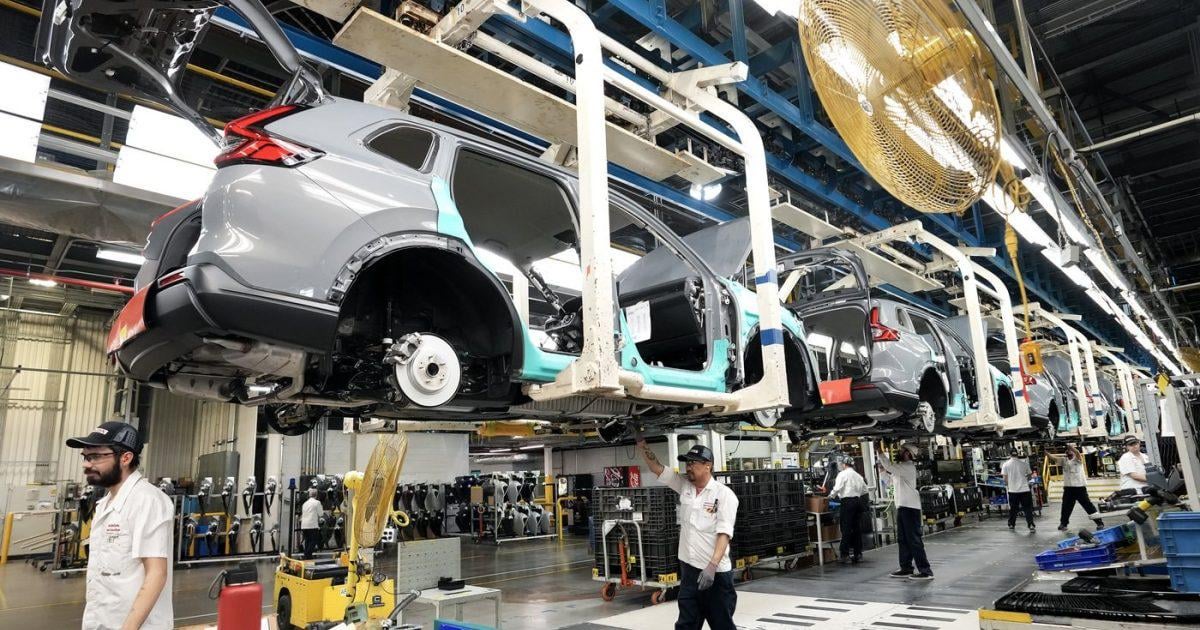
As the profile of Canada's automotive sector shifts dramatically, a new report is pushing the federal government to reward automotive companies that are committed to the country.
The report from the Trillium Network for Advanced Manufacturing notes that the last decade has seen U.S. automakers significantly shrink their Canadian footprint, while Japanese companies have kept production and employment steady.
The diverging trends mean Toyota and Honda accounted for 62 per cent of assembly plant employment in Canada at the end of 2024, up from 40 per cent in 2015. The two Japanese automakers also produced 77 per cent of the vehicles assembled in Canada in 2025, up from 44 per cent a decade ago.
While some of the change is from factors like Ford working to retool its Oakville, Ont., assembly plant, the Detroit-based automaker did also push back EV production slated there for 2025 by two years, only to change plans again and is now working to start production of gasoline-powered pickup trucks later this year.
Trillium says the frequent idling and underuse of U.S. plants have also pushed down productivity in the sector and led to often prolonged layoffs, while Japan-based automakers are leading the way on productivity.
With Ottawa set to release its automotive strategy this month, the group says it should reward and incentivize companies that have consistently invested and grown their Canadian footprint, and encourage the use of Canadian-made production technologies in plants.
Posted by IHateTrains123
2 Comments
>While some of the change is from factors like Ford working to retool its Oakville, Ont., assembly plant, the Detroit-based automaker did also push back EV production slated there for 2025 by two years, only to change plans again and is now working to start production of gasoline-powered pickup trucks later this year.
lol, fucking morons. I hope they never get a red cent of subsidy.
I kind of think we need to move away from auto industry tariffs and subsidies similar to what Australia did in the 2010s. Generally it’s an inefficient reallocation of resources that transfers taxpayer money to already rich domestic producers while adding minimal real value to the economy and total employment. (After Australia phased out its subsidies and provided transitional support to effected workers, net employment and growth actually improved after their auto-industry protections were phased out). Our state support to the auto industry is generally bad for the environment & marginal for the overall economy.
The issue that we face relative to Australia though is that we have a much more active auto-industry lobby, which makes phasing out the protections more difficult. Though I think we could mediate that by throwing the industry a lifeline in other ways (Carney’s EV deal with China that suggests easing tariffs on BYD imports if BYD finances plants here could be a great way to slow the decline of auto-industry employment and stimulate the industry while phasing out our own subsidies etc.)