
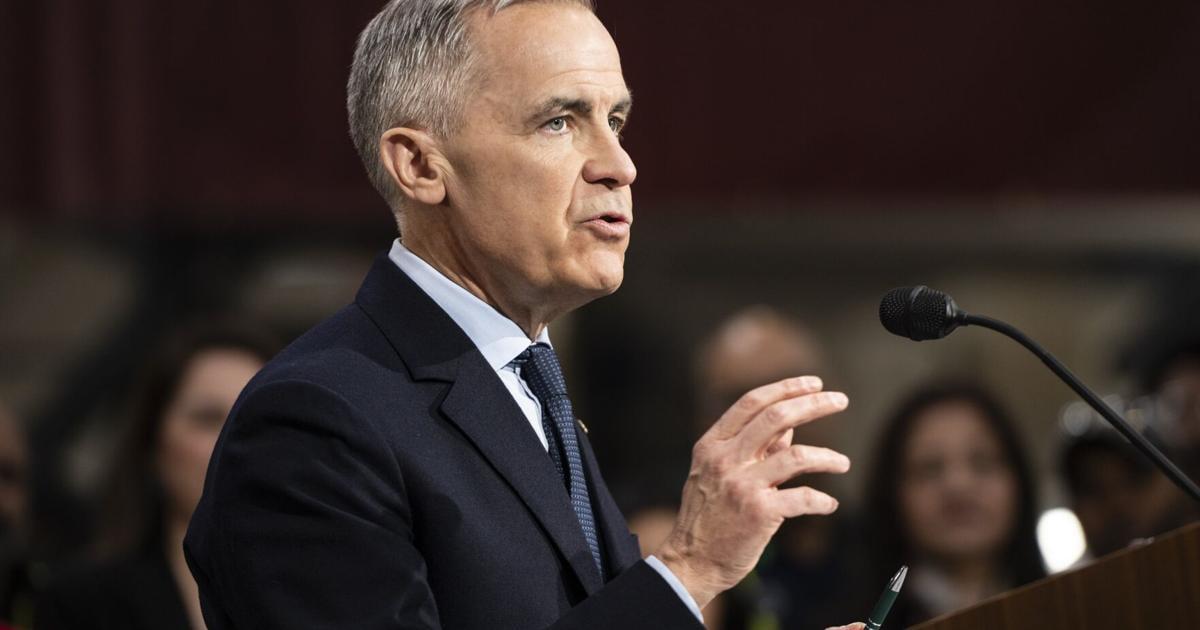
It’s one part of the new strategy the government plans to publish Wednesday. A senior government source said the idea is to help create “anchors” for future growth across the defence sector.
The federal government plans to choose a number of “key strategic partners” from Canada’s defence sector to get special support and access to contracts under the new military industrial strategy that Prime Minister Mark Carney is expected to release on Wednesday, the Star has learned.
A senior government source, who spoke about the unreleased plan on condition of anonymity, said the idea is to help create “anchors” for future growth across the defence sector.
It’s one part of the upcoming “defence industrial strategy” the government intends to publish Wednesday, a plan that is meant to serve as a policy blueprint to maximize the domestic economic benefits of the massive planned increase in defence spending over the coming years.
This last federal budget devoted an extra $81.8 billion in cash spending over the next five years, with tens of billions more promised after that.
The source said the government intends to choose firms from the private sector to act as “strategic partners” who would get access to federal defence contracts and special supports for research and the promotion of exports abroad. The goal would be to build up leading businesses in various areas of the defence sector, the source explained.
The strategy comes as the government tries to navigate how to bolster domestic industries while also rapidly rearming the Canadian military, with major planned purchases in the works from foreign companies.
One of those acquisitions involves a new fleet of advanced fighter jets, with an existing deal to purchase 88 F-35 planes from American firm Lockheed Martin under review.
In the House of Commons on Tuesday, Carney confirmed a report from Radio-Canada that revealed the government has started making additional payments for more F-35 jets, on top of the 16 it has already agreed to purchase.
The prime minister said Ottawa is moving ahead by paying a “small amount” to keep its options open as it weighs whether to buy more F-35s or switch to another provider, such as new fighters from the Swedish company, Saab.
The Prime Minister’s Office did not confirm Tuesday how much additional money has been paid in what the auditor general estimated last year is a $33.2-billion purchase.
“Yes, the government is paying a small amount in order to have options,” Carney said in French on Tuesday. He described the move as “useful” for defence purposes and for ongoing negotiations with the U.S., where President Donald Trump has imposed punishing trade tariffs and repeatedly mused about making Canada the “51st state.”
Bloc Québécois Leader Yves-François Blanchet blasted Carney’s response and urging him to cancel the F-35 purchase until relations with the U.S. improve, noting in particular Trump’s threat this week to block the opening of the new bridge between Windsor, Ont. and Detroit.
Earlier Tuesday, during a briefing on Carney’s upcoming trip to the Munich Security Conference, a senior government official told reporters that even while the review of the F-35 purchase is ongoing, “there are contractual obligations.” The official added that, to their knowledge, the government has not made any commitment to acquire more than 16 of the planes.
Canada’s top soldier, Gen. Jennie Carignan, told the Star last year that the military would prefer more than just 16 F-35s, but did not rule out the possibility of a mixed fleet.
Both Lockheed Martin and Saab have touted industrial benefits for Canada if the government chooses their jets.
The new defence investment strategy, meanwhile, is expected to outline the government’s goals to become more self-reliant in areas of the defence sector. Last year’s budget already devoted $6.6 billion to the strategy, and highlighted areas like critical minerals used for advanced technology, and “sovereign” space launch capabilities, among the priorities. The budget also announced a new program for loans to defence firms through the Business Development Bank of Canada (BDC).
The federal government has been promising to fix procurement and boost Canada’s defence industry for years. In 2024, under prime minister Justin Trudeau, the Liberals published a new defence policy that pledged to overcome “outdated” protocols and speed up major purchases for the military.
Last year, after Carney’s Liberals returned to power on a pledge to protect Canada from how the U.S. under Trump is changing the world, the government rewrote defence spending plans for the coming decade. With an infusion of $9 billion, Carney shifted the country’s timeline to spend the equivalent of two per cent of economic output on defence from 2032 to 2025. The government then signed on to a new pledge through the North Atlantic Treaty Organization (NATO) to spend five per cent of gross domestic product on defence and “defence-related” initiatives by 2035 — a goal that, with 2025 defence spending at around $62 billion, will require tens of billions of dollars in new annual spending.
The government also created the Defence Investment Agency to speed up major purchases. As of this month, the agency had an office open in downtown Ottawa, with 83 employees, including chief executive officer Doug Guzman, a spokesperson for the procurement department told the Star by email.
Beyond the purchase of a new fighter jet fleet, the government is planning to buy up to 12 new submarines to replace its aging fleet from a South Korean company or a firm in Germany, in what the head of the navy has said could be the “largest overseas procurement in Canadian history,” worth tens of billions of dollars.
Among the other gear the government is looking to buy: new air and missile defence systems that could coincide with U.S. President Donald Trump’s envisioned “Golden Dome” for North America; long-range precision strike capabilities; new light armoured vehicles and tanks; tactical helicopters; and drones for surveillance and combat.
While in Munich from Feb. 12 to Feb. 15, Carney is expected to formally sign on to the European Union’s SAFE defence program, allowing Canadian firms to bid on the bloc’s military procurement contracts in its own continent-wide rearmament drive, officials said Tuesday.
As of 2022, Canada’s defence industry included 81,200 jobs and $9.6 billion in gross domestic product (GDP), according to a report from the federal government published in 2024.
Posted by IHateTrains123
4 Comments
Defense is maybe the only sector where “national champions” don’t get lazy and inefficient
Bonjour, Monsieur Dirigisme
The new defence industrial strategy is to be released today, but sources are already describing the contents of the strategy to the Toronto Star. The Star reports:
>The federal government plans to choose a number of “key strategic partners” from Canada’s defence sector to get special support and access to contracts under the new military industrial strategy that Prime Minister Mark Carney is expected to release on Wednesday, the Star has learned.
>A senior government source, who spoke about the unreleased plan on condition of anonymity, said the idea is to help create “anchors” for future growth across the defence sector.
>It’s one part of the upcoming “defence industrial strategy” the government intends to publish Wednesday, a plan that is meant to serve as a policy blueprint to maximize the domestic economic benefits of the massive planned increase in defence spending over the coming years.
>The source said the government intends to choose firms from the private sector to act as “strategic partners” who would get access to federal defence contracts and special supports for research and the promotion of exports abroad. The goal would be to build up leading businesses in various areas of the defence sector, the source explained.
>The strategy comes as the government tries to navigate how to bolster domestic industries while also rapidly rearming the Canadian military, with major planned purchases in the works from foreign companies.
>The new defence investment strategy, meanwhile, is expected to outline the government’s goals to become more self-reliant in areas of the defence sector. Last year’s budget already devoted $6.6 billion to the strategy, and highlighted areas like critical minerals used for advanced technology, and “sovereign” space launch capabilities, among the priorities. The budget also announced a new program for loans to defence firms through the Business Development Bank of Canada (BDC).
>The federal government has been promising to fix procurement and boost Canada’s defence industry for years. In 2024, under prime minister Justin Trudeau, the Liberals published a new defence policy that pledged to overcome “outdated” protocols and speed up major purchases for the military.
Yet the procurement of F-35’s, submarines, IAMDS (Golden Dome) and other projects appear unchanged.
This announcement was delayed because of the shooting, but it was to happen in Halifax, so one of the partners is likely Irving Shipyards