
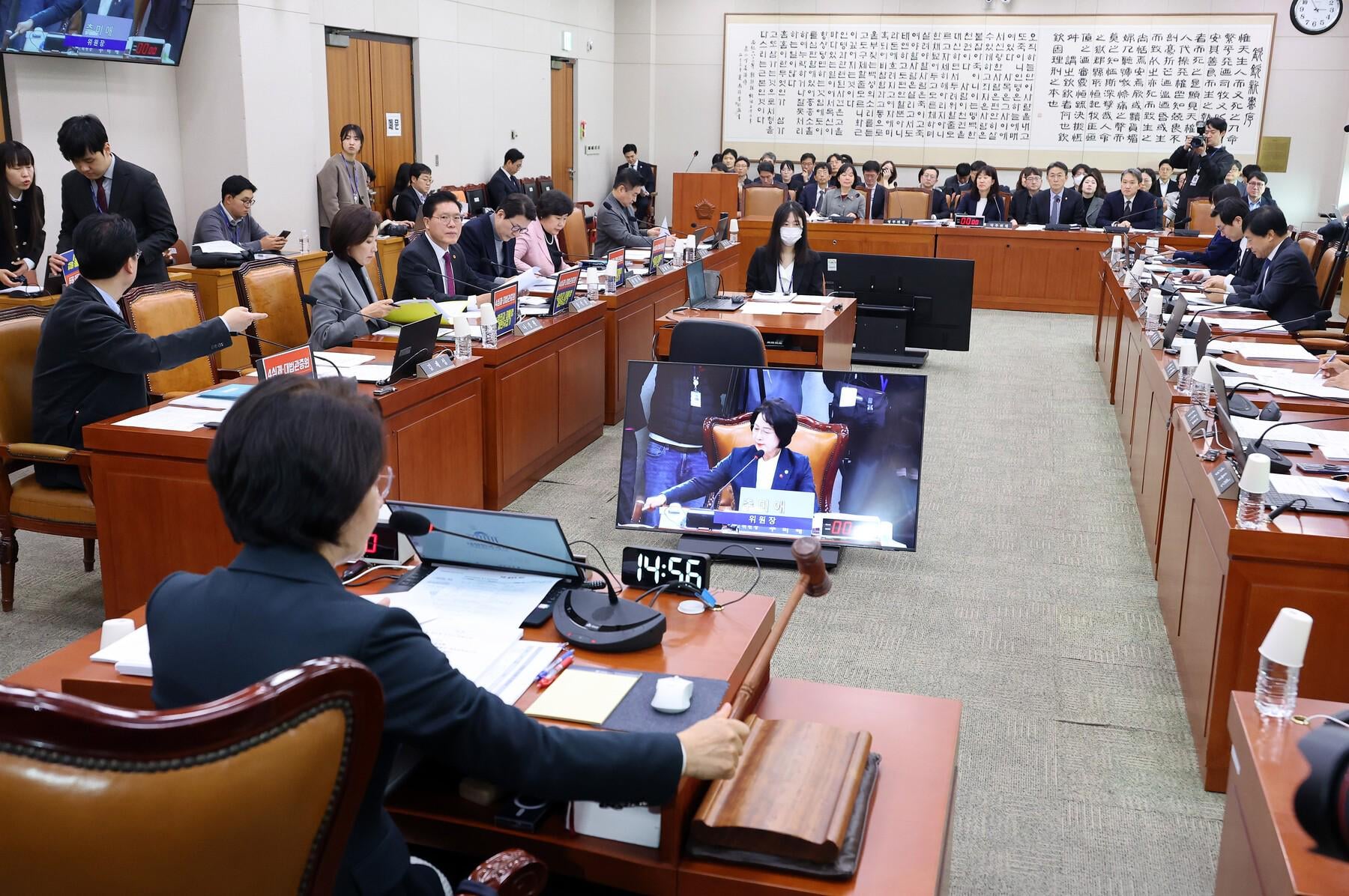
On February 11, amendments to the Constitutional Court Act introducing a constitutional complaint system against court rulings, along with amendments to the Court Organization Act increasing the number of Supreme Court justices, passed the full session of the National Assembly’s Legislation and Judiciary Committee under the leadership of the ruling Democratic Party. Lawmakers from the People Power Party boycotted the vote and left the meeting.
The amendment to the Constitutional Court Act would allow individuals to file constitutional complaints even against Supreme Court rulings if the decision contradicts a ruling of the Constitutional Court or if it violated due process and infringed upon fundamental rights. To enable this, the bill removes the phrase “excluding court judgments” from Article 68(1) of the Constitutional Court Act, thereby permitting constitutional complaints against court decisions.
During the committee session, Park Young-jae, head of the National Court Administration, was asked whether the introduction of what could effectively become a “fourth trial system” might plunge citizens into “litigation hell.” He responded, “I agree.”
The Supreme Court has previously expressed opposition to the bill, arguing that it would effectively introduce a four-tier trial system. In a written opinion submitted to the committee, the Court cited Article 101(1) of the Constitution, which states that “judicial power shall be vested in courts composed of judges,” and Article 101(2), which provides that “the courts shall consist of the Supreme Court and lower courts,” asserting that the amendment would be unconstitutional.
The simultaneously approved amendment to the Court Organization Act increases the number of Supreme Court justices from the current 14 to 26. The Democratic Party proposed the expansion in October last year. Of the 12 additional justices, four would be appointed two years after promulgation of the law, four after three years, and four after four years. If enacted, President Lee Jae-myung would have the authority to nominate 22 Supreme Court justices during his term in office.
Posted by Freewhale98
2 Comments
1. Summary
Democratic Party of Korea passes a bill in judicial committee to expand Supreme Court from 14 to 26. Also, they expanding constitutional complaint to Supreme Court rulings, introducing judicial reviews on Supreme Court decisions by Constitutional Court. Also, expansion of court would solve the issue of judicial bottleneck because there are too few judges in Korea. There are cases that go on for a decade.
2. How is this related to sub
(1) Rule of law :
Judicial review of Constitutional Court on Supreme court decisions have been introduced. Although judicial review power lies on Constitutional Court, the Supreme Court was exception to this review power because of its top position in Korean position.
Also, President Lee Jae-Myung would be appointing 22 new Supreme Court justices with this law.
3. My opinion
There was legal grey area on the status of Constitution Court rulings and Supreme Court rulings. What happens if two rulings contradict each other? It’s problematic because technically both court rulings have same level of authority. This legal area is solved if this bill passes. Also, there more justices in Supreme Court would lessen the “judicial bottleneck” problem.
For the love of god, can we please include the word “Korea” in the title?