
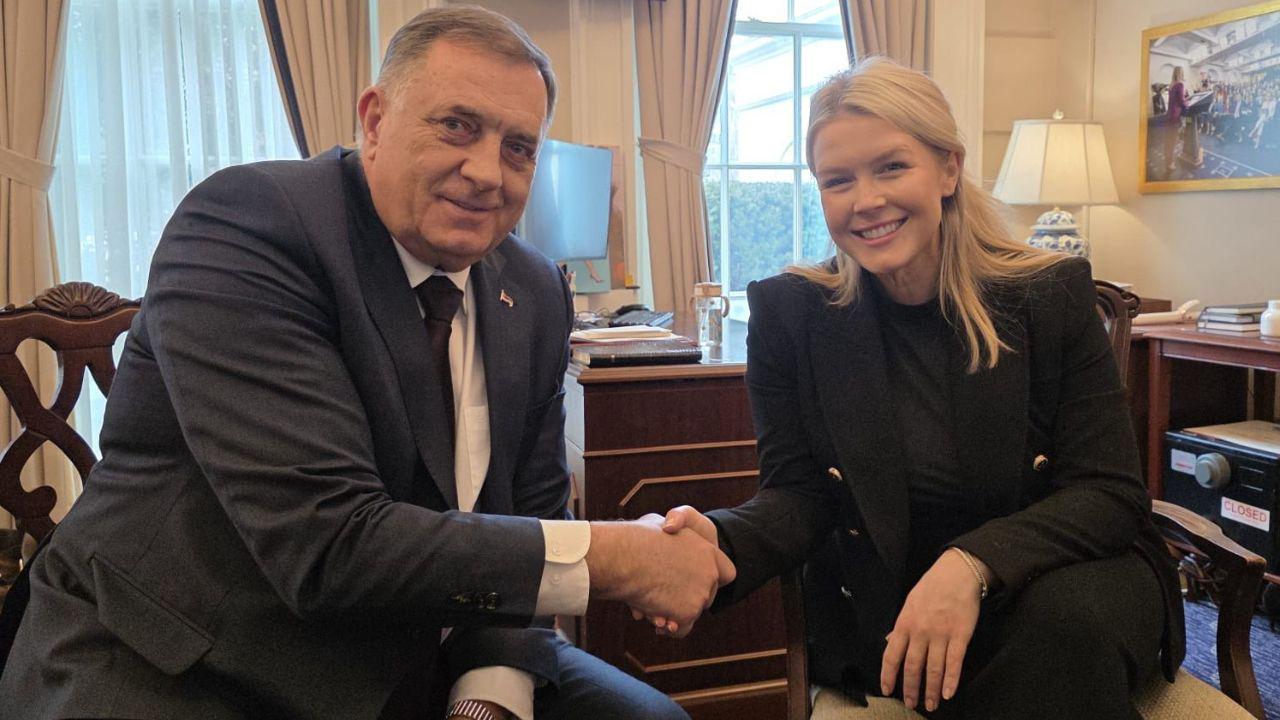
“The right of a nation to self-determination, up to and including independence, is our political goal.”
With that declaration in Banja Luka this week, Milorad Dodik dropped any pretense that his project is about autonomy within Bosnia and made clear that independence is the objective. Bosnia and Herzegovina, he added, has been “irreversibly destroyed.”
Dubbed the “Trump of the Balkans,” Dodik has been formally removed from the presidency of the semi-autonomous Republika Srpska after a court conviction for defying the international High Representative of Bosnia and Herzegovina, the UN-backed official appointed to oversee and enforce the civilian aspects of the 1995 Dayton Peace Agreement, yet he continues to operate as a shadow president.
On February 8, 2026, Siniša Karan, a close Dodik ally and former interior minister, won a repeat snap presidential election as the candidate of Dodik’s Alliance of Independent Social Democrats after a partial rerun triggered by irregularities in the November 2025 ballot. But real authority remains with Dodik and his party, leaving him the de facto shadow president of Republika Srpska. Governing through loyalists and party structures, he is pressing ahead with what has long been a slow-motion project of separation.
The immediate question is whether Bosnia can hold together. The deeper one is whether the United States still intends to defend the peace settlement it once imposed. Dodik is no longer presenting his project simply as Serb nationalism. He is wrapping it in the language of MAGA, casting Republika Srpska as a victim of “globalist” overreach and portraying Bosnian Serbs as Christians under pressure from Muslims.
By echoing Donald Trump’s “America First” rhetoric with his own “Republika Srpska First” message, he is reframing secession not as Balkan fragmentation but as part of a global pushback against the post-Cold War consensus.
Frozen constitution
To understand the stakes, one must return to 1995. The Dayton Peace Agreement, brokered by the United States at an airbase in Ohio, ended a war that killed around 100,000 people and culminated in the Srebrenica genocide, where more than 8,000 Bosniak men and boys were murdered.
Dayton’s Annex 4 became Bosnia’s constitution. It divided the country into two entities: the Federation of Bosnia and Herzegovina, dominated by Bosniaks and Croats, and Republika Srpska, controlled by Serbs. A tripartite presidency represents the three “constituent peoples.” An international Office of the High Representative, armed with sweeping “Bonn Powers,” can impose or annul laws to safeguard the settlement.
The system was never elegant. It was a ceasefire turned into a constitution, designed to prevent renewed war rather than to deliver smooth governance. As analyst Jasmin Mujanović has observed, Bosnia has “a propensity toward constant crisis, driven by a dysfunctional political apparatus that divides power but fails to deliver governance”. That structural fragility is precisely what Dodik has learned to exploit.
Salami secession
Dodik’s strategy has not been dramatic secession but a salami-slice hollowing out. Over recent years, Republika Srpska’s parliament has passed laws refusing to recognize decisions of Bosnia’s Constitutional Court and rejecting the authority of the High Representative, currently Germany’s Christian Schmidt. Schmidt has warned that “failure to implement Constitutional Court decisions is a criminal offence in Bosnia and Herzegovina”, yet enforcement has proved politically fraught.
State-level prosecutors and police have increasingly found their authority blocked inside Republika Srpska. Legislation has sought to bar state investigative bodies from operating on its territory. Plans have been floated for a separate Republika Srpska border guard, a direct challenge to Bosnia’s unified border police. Constitutional amendments aim to establish a parallel judiciary and prosecutorial system under Republika Srpska control.
Security is central to the salami method. Republika Srpska’s police forces have been strengthened and trained, including through cooperation with Hungary. When Bosnia’s court convicted Dodik in February 2025 and later upheld the sentence, banning him from office for six years, state authorities hesitated to attempt an arrest. Foreign Affairs magazine noted that “the Bosnian police have been unable to arrest Dodik because they fear it will lead to a violent confrontation”, and that Republika Srpska’s police have threatened to use force to prevent such an outcome. A state that cannot enforce its own court rulings inside one of its entities begins to look hollow.
Administrative separation has followed. A “foreign-agent” law modelled on Russia’s legislation targets NGOs and media accused of undermining Serb interests. January 9, the “Day of Republika Srpska” continues to be celebrated with military-style parades despite being ruled unconstitutional by Bosnia’s top court. Dodik has called on Serb officials working in state institutions to consider withdrawing. Borders remain as they were on the map, but the machinery of the common state is increasingly contested or absent.
MAGA alignment
For years, Washington imposed sanctions on Dodik for corruption and for undermining the Dayton framework. In October 2025, the Trump administration lifted those sanctions after Dodik agreed to step aside formally from the presidency and rescind certain laws. European officials saw the move as a weakening of the Western front. U.S. Senator Jeanne Shaheen criticized the decision, noting that Dodik “has been using secessionist rhetoric and undermining the integrity of the Dayton Peace Agreement”.
Dodik has not hidden his political alignment. Visiting Washington recently, he spoke of having “high expectations” of President Donald Trump. “When he says America First, that encourages us to say Republika Srpska first,” he told the Financial Times.
He has framed Bosnian Serbs as Christians under threat and portrayed his struggle as resistance to a “globalist liberal elite”. MAGA lobbyists working for Dodik have recast him as a Balkan analogue of Trump, a nationalist leader persecuted by hostile institutions.
Signals from Washington have reinforced that narrative. Deputy Secretary of State Christopher Landau said in a speech marking the 30th anniversary of Dayton that the United States was “not interested in imposing a vision of a society that reflects the preferences of distant bureaucrats and narrow activists,” language widely interpreted in Sarajevo as a retreat from assertive enforcement of the settlement.
The Trump administration’s decision to lift sanctions on Dodik and dozens of his allies, followed by his reception in Washington and meetings with senior Republican figures, has been read in Republika Srpska as evidence that the White House is prepared to treat him as a legitimate partner.
Dodik appears to be betting that a White House skeptical of liberal nation-building and eager to avoid overseas entanglements will not intervene forcefully to uphold a complex power-sharing system in the Balkans.
A dangerous test
Does this mean war? Not necessarily. The EUFOR Althea mission remains on the ground. The European Union has repeatedly insisted that Bosnia’s territorial integrity is non-negotiable, with senior EU officials warning that any attempt to break up the country would be unacceptable. Serbia’s president, Aleksandar Vučić, offers rhetorical backing but has so far avoided endorsing outright secession. A full-scale return to the 1990s is unlikely. The greater risk lies in miscalculation: a street protest that turns violent, a stand off between parallel security forces.
Bosnia and Herzegovina has not collapsed yet. Taxes are collected, the central bank functions, elections are held. Yet parts of its constitutional order no longer operate smoothly across its territory.
Dodik’s latest declaration is a test of whether the post-1995 settlement can be eroded without decisive pushback from America.
Posted by BubsyFanboy
1 Comment
!ping EUROPE
**1. Why is this relevant for** r/neoliberal **?**
This is relevant to Bosnia and Herzegovina, Serbia, populism and nationalism.
**2. What do you think people should discuss about it?**
I think people may discuss the issues of Serb nationalism in Bosnia, Dodik’s history and the current state of Bosnian politics.
**2a. What do you think of the issue at hand?**
How many “Trump of X” politicians are we having to deal with now…