
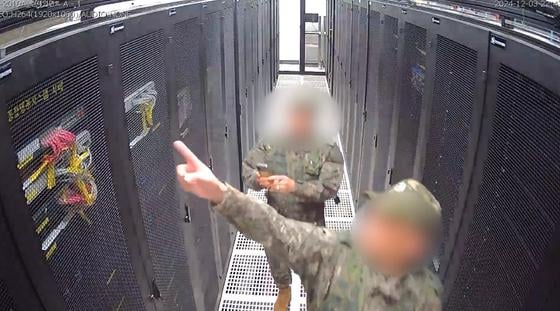
The court determined that the mysterious background behind the military’s deployment to the Central National Election Commission (NEC) building following the December 3 declaration of emergency martial law was to obtain confessions related to election-fraud conspiracy theories held by former President Yoon Suk-yeol and other martial law authorities. It also concluded that Yoon carried out the blockade of the National Assembly despite knowing it was unlawful.
Purpose of Sending Troops to the NEC: “To Guide Confessions on Election Fraud”
According to the 1,133-page ruling confirmed by the JoongAng Ilbo on the 20th, the Seoul Central District Court Criminal Division 25 (Presiding Judge Ji Gwi-yeon) found that one of the missions assigned to 36 agents of the Defense Intelligence Command who were ordered to deploy to the NEC was to “guide confessions related to election fraud,” which the court characterized as a type of conspiracy theory. In other words, the deployment of troops to the NEC was deemed part of an investigation into the so-called election fraud narrative that had spread as a conspiracy theory.
The court also determined that selecting and arresting NEC employees arriving for work in the morning and transferring them to Capital Defense Command facilities was among the Intelligence Command’s objectives. It further found that the Counterintelligence Command’s purpose was “to secure (copy) information stored on servers or to seize (remove) the server equipment itself.”
Previously, Yoon’s legal team had argued that troops were dispatched “to protect the NEC from subversive forces,” but the court rejected this claim. The panel stated, “At the time, there was absolutely no actual or even abstract threat to the NEC as claimed by the defendants.”
The court added that even if there were suspicions of election fraud, “it is a matter to be resolved through investigation, inquiry, or trial—not by declaring martial law and mobilizing troops.” It also noted that most election fraud allegations had already been resolved by a 2022 Supreme Court ruling.
“Ten Armed Soldiers Entering at Night Constitutes Broad Intimidation”
The defense argument that there was no “riot” because there was no physical contact with NEC employees or removal of property was also dismissed. The court stated, “The intrusion into the building itself clearly constitutes the use of force against the will of the building’s administrator,” and added, “Ten armed soldiers entering the premises simultaneously at night is sufficient to instill fear in an average person.”
Photographing the inside of the server room and organizational charts without staff consent, as well as preventing some employees from using their mobile phones, was also deemed an exercise of force. The court stated, “Considering the number of unauthorized troops, their armed status, and the nighttime setting, it is difficult to conclude that the affected parties felt no fear whatsoever.”
The panel further noted, “Even if there was no physical damage to the building itself or bodily injury, and even if no property was removed or seized, such circumstances do not preclude recognition of violence or intimidation in its broadest sense.”
The court thus found that the deployment to the NEC satisfied the legal elements of insurrection, including the “intent to subvert the constitutional order” and the element of “riot.” According to precedent, “riot” requires “violence or intimidation in its broadest sense” and sufficient force to disturb public peace in a given area.
Court: “Yoon Knew the National Assembly Deployment Under Martial Law Was Illegal”
The court stated, “Defendants Yoon Suk-yeol and Kim Yong-hyun appear to have been aware, at least to some degree, that even under a declaration of emergency martial law, blocking the National Assembly was illegal.”
The panel found that the failure to observe procedural requirements when declaring martial law demonstrated that it was from the outset a means to mobilize the military. In the ruling, the court pointed out, “If they had recognized the declaration of emergency martial law as lawful, there would have been no reason to go through Cabinet deliberation merely as a formality, to omit proper discussion, or to notify only some Cabinet members of the meeting.”
Posted by Freewhale98
1 Comment
1. Summary
Korean court ruled that former President Yoon Suk-Yoel illegally stormed National Election Commission buildings and intimidated civil servants working there with armed soldiers. The court recognized that he knew it was illegal but did it anyway.
2. How is this related to the sub
(1) Election Fraud Conspiracy & Online disinformation: According to Korean court ruling, Yoon believed in election fraud conspiracy theory online and stormed election offices to pursue that claim.
3. My opinion
Martial law troops storming NEC building is underreported fact in global media, because the footage of National Assembly being stormed was so shocking but this is important piece on what really happened that night.
Yoon was indeed brainrot into madness because of YouTube algorithm and staged an armed insurrection based on “election fraud conspiracy” and this is confirmed by courts. YouTube and other social media companies should be held accountable for all socioeconomic damage inflicted on Korean society because of this mess.