From cars to batteries to smartphones, India’s biggest conglomerates are signing deals that bring factories home but leave intellectual property in Shanghai, Wuhu, and Hangzhou.
The 630-acre site taking shape outside Aurangabad, in the dry plateau country of western Maharashtra, is built for scale. When complete, it will produce 400,000 vehicles a year, roughly one for every ten cars India currently sells annually. It is the centrepiece of JSW Group’s automotive ambitions, a bet by Parth Jindal that an Indian conglomerate known for steel, cement, and energy can become a serious car manufacturer within the decade.
The ambition is legible in the site’s dimensions. What is less visible is the fine print. The vehicles that will roll off these lines will ride on platforms designed by SAIC of Shanghai. Their EV variants will use technology licensed from Chery of Wuhu. Discussions with Geely of Hangzhou are ongoing.
A single Indian conglomerate is assembling a vehicle manufacturing ecosystem almost entirely from Chinese technological building blocks, each licensed, none owned. JSW will provide the capital, the land, the labour, and the market access. Its Chinese partners will provide the engineering that makes a car a car.
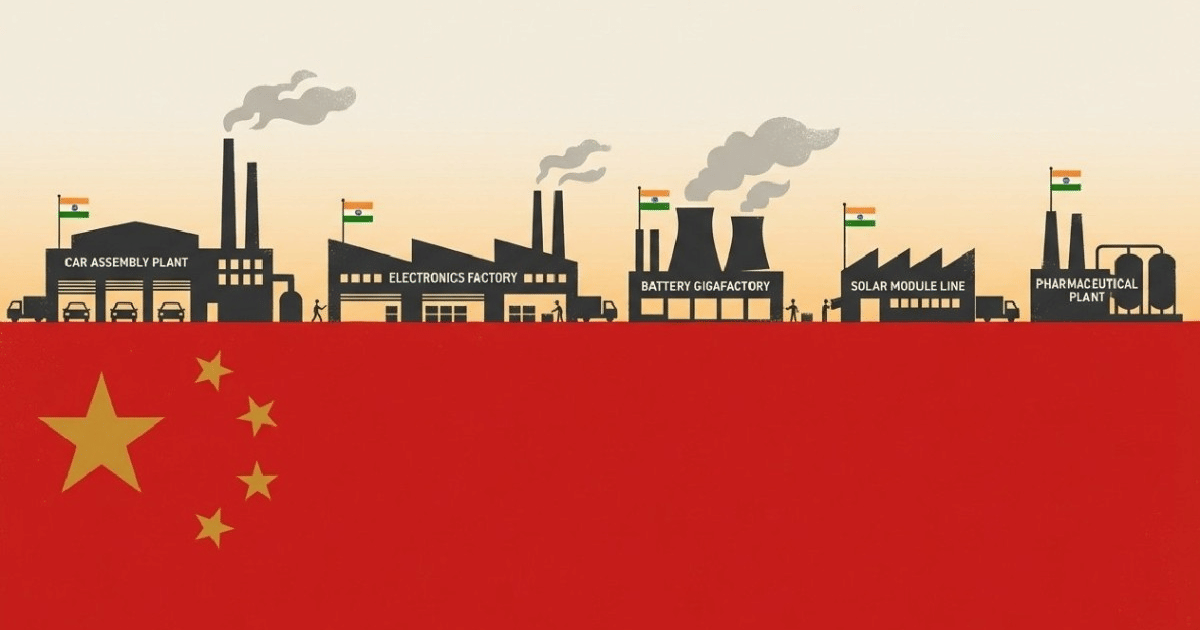
This arrangement, Indian money married to Chinese know-how, is not unique to JSW. Across automobiles, electronics, batteries, solar energy, and pharmaceuticals, Indian companies have spent the years since 2020 signing joint ventures, licensing agreements, and technology partnerships with Chinese firms at an extraordinary pace.
The deals differ in structure, sector, and scale. They share a common architecture: Indian capital and market access exchanged for Chinese technology. And in sector after sector, a common outcome is emerging. India is building factories. It is not, in any meaningful sense, building capability.
The Chery licensing deal that followed in July 2025 went further. Unlike an equity investment, a licensing arrangement requires no approval under Press Note 3, the April 2020 regulation mandating government clearance for foreign direct investment from countries sharing a land border with India. Chery’s technology would power JSW vehicles. Chery’s technology would remain Chery’s.
**This is not, on its face, an unreasonable approach. Japanese and South Korean automakers licensed extensively in their early decades. India’s own Maruti Suzuki partnership, now four decades old, began as a technology transfer arrangement. The question is whether licensing leads to absorption, whether the Indian partner eventually develops the capability to design and improve upon the licensed technology, or becomes a permanent rent arrangement, with the licensor capturing value indefinitely.**

1 Comment
From cars to batteries to smartphones, India’s biggest conglomerates are signing deals that bring factories home but leave intellectual property in Shanghai, Wuhu, and Hangzhou.
The 630-acre site taking shape outside Aurangabad, in the dry plateau country of western Maharashtra, is built for scale. When complete, it will produce 400,000 vehicles a year, roughly one for every ten cars India currently sells annually. It is the centrepiece of JSW Group’s automotive ambitions, a bet by Parth Jindal that an Indian conglomerate known for steel, cement, and energy can become a serious car manufacturer within the decade.
The ambition is legible in the site’s dimensions. What is less visible is the fine print. The vehicles that will roll off these lines will ride on platforms designed by SAIC of Shanghai. Their EV variants will use technology licensed from Chery of Wuhu. Discussions with Geely of Hangzhou are ongoing.
A single Indian conglomerate is assembling a vehicle manufacturing ecosystem almost entirely from Chinese technological building blocks, each licensed, none owned. JSW will provide the capital, the land, the labour, and the market access. Its Chinese partners will provide the engineering that makes a car a car.
This arrangement, Indian money married to Chinese know-how, is not unique to JSW. Across automobiles, electronics, batteries, solar energy, and pharmaceuticals, Indian companies have spent the years since 2020 signing joint ventures, licensing agreements, and technology partnerships with Chinese firms at an extraordinary pace.
The deals differ in structure, sector, and scale. They share a common architecture: Indian capital and market access exchanged for Chinese technology. And in sector after sector, a common outcome is emerging. India is building factories. It is not, in any meaningful sense, building capability.
The Chery licensing deal that followed in July 2025 went further. Unlike an equity investment, a licensing arrangement requires no approval under Press Note 3, the April 2020 regulation mandating government clearance for foreign direct investment from countries sharing a land border with India. Chery’s technology would power JSW vehicles. Chery’s technology would remain Chery’s.
**This is not, on its face, an unreasonable approach. Japanese and South Korean automakers licensed extensively in their early decades. India’s own Maruti Suzuki partnership, now four decades old, began as a technology transfer arrangement. The question is whether licensing leads to absorption, whether the Indian partner eventually develops the capability to design and improve upon the licensed technology, or becomes a permanent rent arrangement, with the licensor capturing value indefinitely.**