
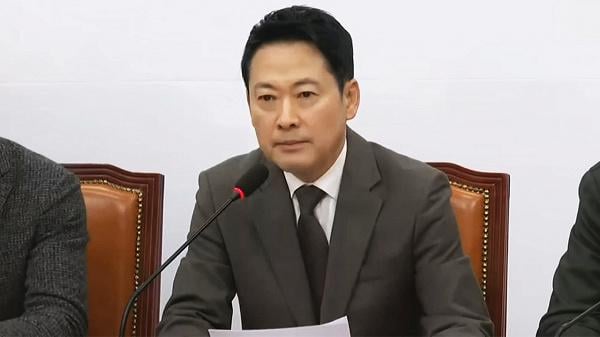
As the global community closely watches the current situation involving Iran, People Power Party leader Jang Dong-hyuk drew attention today with a controversial claim. Arguing that the Lee Jae-myung administration is heading down the path of dictatorship, he suggested that South Korea should take Iran’s Supreme Leader Ayatollah Ali Khamenei as a cautionary example.
[Jang Dong-hyuk / People Power Party Leader: “After witnessing the downfall of Venezuela’s dictator and now the Iranian dictator, the Lee Jae-myung administration is nevertheless attempting to move toward dictatorship at this very moment.”]
Although Jang made the remark while criticizing the ruling party’s push to pass the so-called three judicial reform bills—including the crime of judicial distortion—it has sparked controversy because it appears to compare President Lee with Khamenei.
Anchor: Why make such a comparison? Iran is fundamentally different from us—it is a theocratic state, whereas we are a democracy. We are allied with the United States, whereas Iran is anti-American.
Reporter: Among the so-called “Yoon Again” faction and some far-right groups, there have been provocative claims suggesting that President Lee could be “next” in line after foreign leaders targeted by the United States. Critics argue that Jang may have echoed similar rhetoric publicly. Additionally, lawmaker Na Kyung-won criticized President Lee’s March 1 Independence Day speech yesterday, in which he said the international rules-based order is collapsing due to power politics. She suggested that the remarks were effectively criticism of the United States in connection with the operation targeting Khamenei and expressed discomfort, arguing that the stance diverged sharply from other free-world nations—essentially framing it as anti-American.
However, separate from concerns about Khamenei’s long rule or Iran’s nuclear ambitions, there are also voices expressing concern about U.S. actions. Major media outlets have published commentary warning about a global order increasingly dominated by raw power and an era of aggressive force, indicating that President Lee’s speech cannot necessarily be interpreted as strongly anti-American, contrary to Na’s claims.
Anchor: There is also significant negative public opinion within the United States regarding former President Trump’s decisions. It would not make sense to label American citizens critical of their own government as anti-American, so the argument seems inconsistent.
Reporter: Moreover, while the People Power Party is currently criticizing Iran’s dictatorship, about ten years ago—in 2016—then-President Park Geun-hye made the first state visit by a South Korean head of state to Iran since diplomatic relations were established and met with Khamenei. At the time, the predecessor of the People Power Party, the Saenuri Party, emphasized economic cooperation to spark a “Middle East boom.”
[Kim Kyu-hyun / Then Senior Presidential Secretary for Foreign Affairs and Security (May 2, 2016): “Supreme Leader Khamenei expressed appreciation for President Park’s visit accompanied by a large economic delegation…”]
Iran was under the same Khamenei-led system then as it is now.
Anchor: So in matters of national interest, especially during sensitive international situations, politicians need to be particularly cautious with their words.
Reporter: Earlier this year, when the United States detained Venezuelan President Nicolás Maduro, opposition figures similarly linked the situation to President Lee, drawing controversy. Notably, lawmaker Na Kyung-won suggested that the Lee administration was following a path similar to Venezuela’s and implied that President Lee could be “next.” In other words, whenever the United States takes action against a particular country, similar claims have repeatedly surfaced within and around the People Power Party that the Lee administration could be the next target.
Critics argue that amid rapidly changing international circumstances, the focus should be on safeguarding South Korea’s national interests rather than intensifying domestic political attacks.
Posted by Freewhale98
3 Comments
1. Summary
Iran bombing greatly emboldened Jang Dong-Hyuk, the pro-Yoon PPP chair. His faith in “second foundation war” has greatly enhanced. He preached that Trump will punish Korea to “bring justice” to Lee Jae-Myung for his “left-wing tyranny” such as crackdown on real estate speculation ( he is a home hoarder with 6 properties ) and expansion of Supreme Court.
2. How is this related to the sub
(1) Fascist International: Far-right globalization is in full swing and Trump’s actions are emboldening them.
3. My opinion
Recent Trump’s military adventure is increasing faith among Korea’s far-right on “Second Foundation War”, a prophecy preached by extremist evangelicals. According to this “prophecy”, Trump will launch military operations against Korea to massacre all Korean liberals & leftists and establish Park Chung-hee era military dictatorship again. This prophecy allowed far-right to sustain itself despite most of their leaders imprisoned, but made them repulsive figures among wider public. This led to PPP collapsing to 10% range in recent polls.
“This global event is actually about meeee”
Modern conservatives across the world are spectacularly stupid but this is yet more proof that Korean conservatives take the cake