
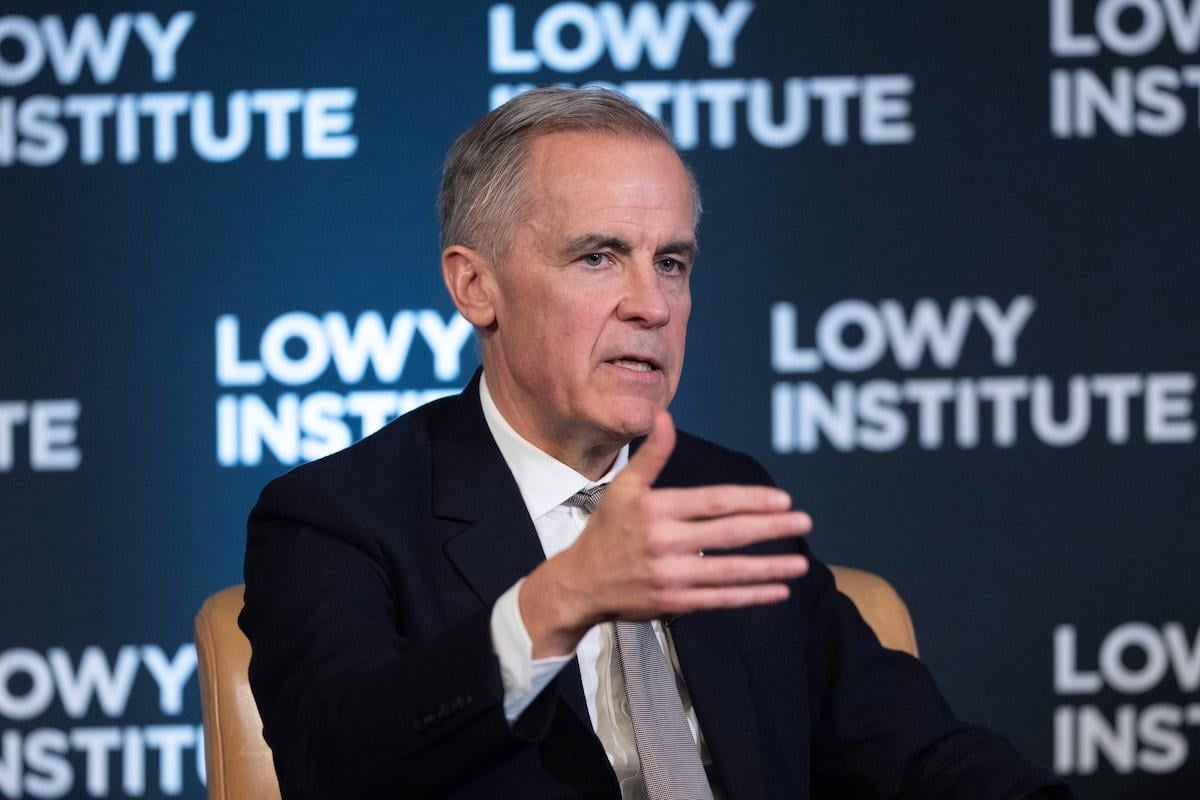
SS: Carney's talk in the Lowy Institute in Australia captures his vision laid out at Davos. Here he says Canada's and Australia's critical minerals alliance will give the democratic world a reliable and plentiful source of critical minerals.
A developing alliance between Canada and Australia on critical minerals, which together produce significant portions of the world’s lithium and uranium, is the kind of coalition-building that middle powers should be undertaking in a fractured global order, Prime Minister Mark Carney says.
His remarks form the latest chapter in the Prime Minister’s call to action for middle powers to work together in an era of great-power bullying.
Speaking to Sydney’s Lowy Institute think tank during a trade and goodwill mission to Australia, Mr. Carney expanded on his January address to the World Economic Forum in Davos where he talked of a rupture in the rules-based international order and how dominant powers such as the United States are weaponizing trade dependence to extract what they want from smaller countries through tools such as tariffs.
"We are building out our critical minerals alliance with Australia, creating the largest minerals reserve held by trusted democratic nations," the Prime Minister said.
Canada and Australia are "abundant in those minerals most in demand and most necessary for our military and economic strength," he said.
The increasingly protectionist presidency of Donald Trump has imposed significant tariffs on its trading partners and Mr. Trump threatens more levies when countries displease him. On Wednesday he threated to cut off all trade with Spain because it would not allow the U.S. military to use its bases for Washington’s war on Iran.
Australia and Canada formalized a strategic alliance on critical minerals with a letter of intent last November, with plans to cooperate on linking mines and minerals processing, on smoothing the way for government investments in projects of mutual interest and promoting private capital investment as well as commercial partnerships and joint research.
Between them, Canada and Australia possess "one of the largest critical minerals reserves in the world," the Prime Minister noted, producing 34 per cent of global lithium, 32 per cent of uranium supply, and 41 per cent of iron ore, all backed by a "$25-billion war chest to fast-track projects" and top-two rankings as mining investment destinations.
He said middle powers have more power than they realize.
"Consider Europe, Australia, Canada, Japan and South Korea," Mr. Carney said. This coalition has a larger Gross Domestic Product than the United States, three times the trade flows of China, the largest research and development spending in the world, 62 of the top 100 universities, and is the largest source of cultural exports globally."
The Prime Minister said Australia and Canada are among the countries seeking to connect the 11-member Trans-Pacific Partnership trade zone and the European Union, which would create a new trading bloc of 1.5 billion people.
"Canada and Australia cannot compel like the great powers; but we can convene, set the agenda, shape the rules, and organize and build capacity through coalitions to deliver results at speed and global scale."
Mr. Carney said middle powers need to develop greater "strategy autonomy" in areas such as energy, food and critical minerals so they can ensure they can feed, fuel, defend and innovate without being held hostage to the demands of great powers. This means enhancing self-sufficiency and independence.
"When the rules no longer protect you, you must protect yourself," he said.
"The nations that invest in their own capabilities across strategic sectors – and partner with likeminded allies – will multiply their strength to form coalitions. They become a more effective bloc to deter aggression, protect their supply chains, and realize their core economic interests."
In the 21st century, the economic security and prosperity of countries extends far beyond food, conventional energy, and defense, "as important as these are," Mr. Carney said.
Today, sovereignty requires reliable access to space-based communications and semiconductors, he said. "It requires unhindered access to artificial intelligence, digital sovereignty, critical minerals, payment systems, clean energy technologies and vaccines."
Mr. Carney said countries such as Canada and Australia can’t let themselves be under the thumb of economic coercion from great powers. "Canada is focused on building a dense web of connections – ad hoc coalitions that work, issue by issue, with partners who share enough common ground to act together."
Separately, Mr. Carney repeated statements he made earlier Wednesday that the current war between Iran and the United States and Israel was a "failure" of the international order."
"The current conflict is another example of the failure of the international order, despite decades of UN Security Council resolutions, the work of the International Atomic Energy Agency in a succession of sanctions and diplomatic frameworks," Mr. Carney told the Lowy Institute.
Asked if he would welcome a change of regime in Iran, which he said has been the main source of instability in the Mid East, Mr. Carney said yes.
"We always would have welcomed a change in regime. In Iran, we’ve broken off diplomatic relations with Iran many years ago. We’ve listed the Islamic Revolutionary Guard as a terrorist organization."
Asked for tips on dealing with Mr. Trump, the Prime Minister said the key is "respect but not obsequiousness."
He said the U.S. President in private conversation does not like people mincing words. "He appreciates, particularly in private, being direct and discussing issues and being clear where your position is."
Mr. Carney said Mr. Trump quizzes guests on their opinions in private conversation, offering an opportunity to build bridges with him. "He is more interested in your viewpoint on various things in private, and that creates an ability to work through things."
He also recounted his first meeting as Prime Minister with Chinese President Xi Jinping last October at the Asia Pacific Economic Cooperation summit.
Mr. Xi "chose to spend the first 10 plus minutes discussing how he wanted the personal interaction to be," Mr. Carney said.
The Chinese leader also advised the Prime Minister to speak to him directly rather than through the press.
He said his takeaway from that first meeting with Mr. Xi was "Don’t lecture me in public. Bring issues to me directly."
Mr. Carney said another thing he learned about dealing with the Chinese Leader was to spell out where Canada and China could collaborate and where they could not, such as defence or critical minerals.
He said China wants Canada "to be very clear about where we’re looking to cooperate and where we’re not."
Recounting his meeting this week with Indian Prime Minister Narendra Modi, Mr. Carney described the scale of supporters that attend event for him. He also used to the occasion to take a jibe at Finance Minister François-Philippe Champagne. "Every weekend he’s out campaigning. He gets 250,000 people at his rallies. You get 25," he said to his minister who was sitting in the audience.
Posted by IHateTrains123
1 Comment
Maybe im doing tricks on it but Carney actually feels like a world leader. Clear and articulate in his vision of the world and a realist.