
National Defence's $48.4-billion represents the biggest ask of the $230.4-billion set to be voted on by MPs, with five more departments seeking approval for more than $10-billion.
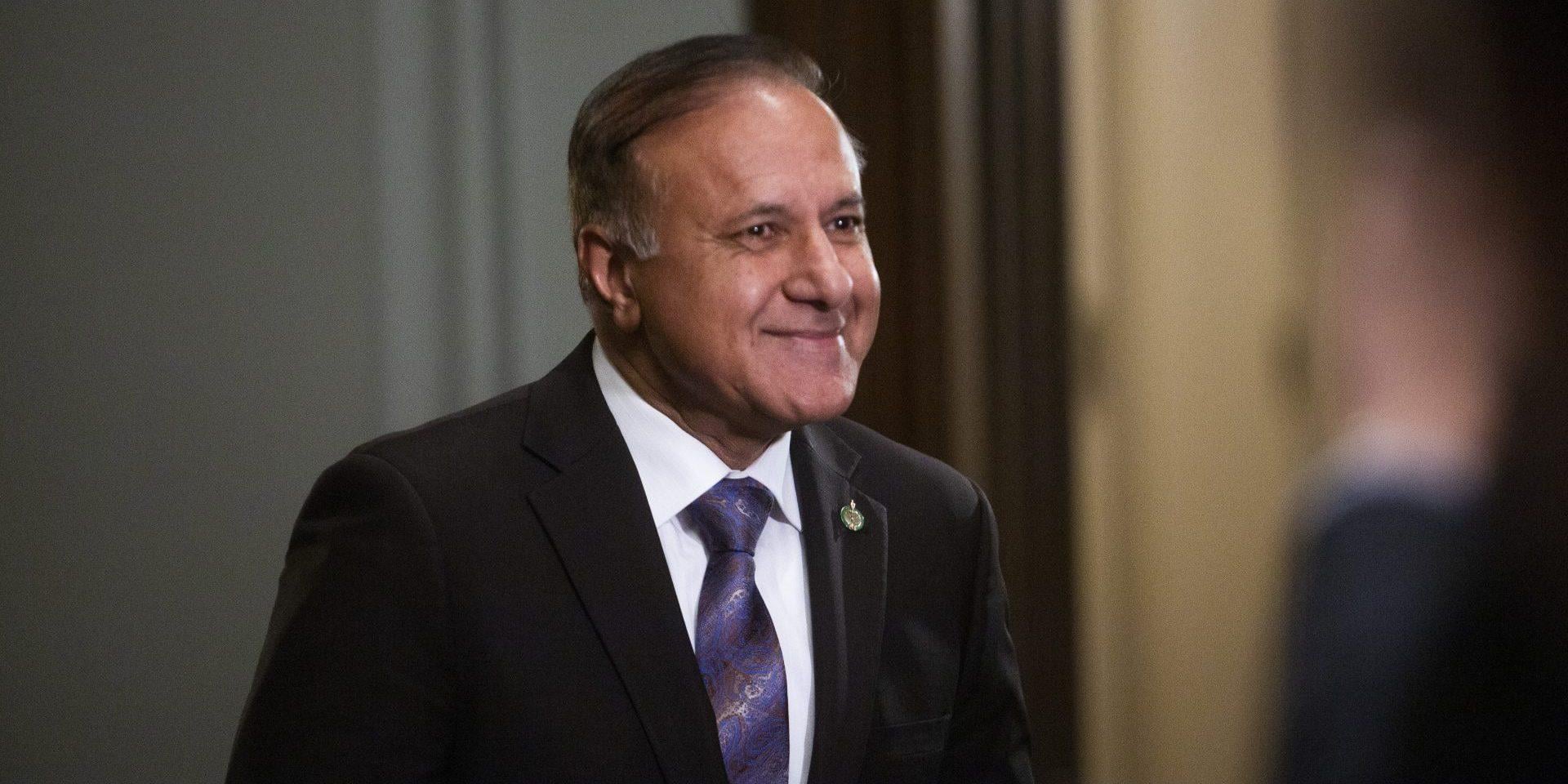
Treasury Board President Shafqat Ali has tabled the Carney government’s main estimates for 2026-27, outlining $502.8-billion in spending, with the Department of National Defence requesting the most funds of the public service’s 130 federal departments.
Six departments are seeking parliamentary approval for over $10-billion in non-statutory funds—money that has yet to be approved by Parliament—with the Department of National Defence (DND) seeking the largest voted sum at $48.4-billion.
Indigenous Services Canada (ISC) is requesting the second-highest non-statutory sum at $23.9-billion, followed by Employment and Social Development's $13.6-billion ask, and Crown-Indigenous Relations and Northern Affairs (CIRNAC) and the Treasury Board Secretariat, which are each asking for $11.8-billion. Health Canada is asking for $10.4-billion.
The funding request comes as Prime Minister Mark Carney (Nepean, Ont.) has signed on to increase Canada’s military investments as part of a NATO pledge to invest five per cent of this country’s GDP in defence last summer. Three-and-a-half per cent of that investment is for “core military capabilities.”
“The main estimates include over $48-billion to strengthen and modernize the Canadian Armed Forces, supporting Canada’s security, Canadians, and economic growth,” Ali (Brampton—Chinguacousy Park, Ont.) is quoted as saying in a Feb. 26 press release, the day the mains were tabled in Parliament.
The feds’ most recent spending boost, too, was focused on defence. In the supplementary estimates C, $2.2-billion of the $5.4-billion requested was for DND, which experts told The Hill Times was “all about” meeting the NATO pledge.
Of the $502.8-billion in budgetary spending outlined in the latest estimates, Parliament will vote on $230.4-billion, as $272.4-billion of the estimates are covered by statutory spending—money that has already been authorized under previous legislation.
The spend is an increase of about 3.3 per cent from the 2025-26 mains from May of last year, where the feds sought $486.9-billion, which was an increase of about 8.4 per cent from the year before that.
The bulk of the spending ask—$300.5-billion, which is about 59.8 per cent of the total funds—is slated for transfer payments. The most notable transfers are for “elderly benefits, the Canada Health Transfer, and fiscal equalization,” reads the document.
The Canada Health Transfer is a federal transfer to provincial and territorial governments. It is the largest major federal transfer of its kind.
An additional $148.6-billion, close to 30 per cent, is for operating and capital expenditures.
The feds are also slating $53.74-billion for servicing public debt—which is about 10.7 per cent of the total spending ask this fiscal year. That’s an increase from the 2025-26 mains, where the feds committed $49.1-billion—just over 10 per cent—of that year’s budget to public debt. The document attributes the increased spend “an increase in interest on unmatured debt.”
An additional $2.9-billion of non-budgetary spending are forecasted for loans, investments, and advances.
Including statutory spends, DND is requesting a total $50.7-billion in federal funding. That means that over 95 per cent of the department’s funds are subject to Parliament’s vote.
Carney’s Liberals don’t yet have a majority in the House, still being three seats shy, despite the prime minister picking up three Conservative MPs through recent floor-crossing deals. In November 2025, Parliament narrowly passed the Liberals’ budget implementation bill, thanks to abstentions from the NDP.
In Carney’s first spending ask—which was delayed because of last April’s election, and tabled at the end of May 2025—DND also sought the highest amount of the some 130 federal departments, requesting $35.7-billion at the time. That places this year’s spending request this year at about 42 per cent higher than last year’s.
The bulk of the department’s $48.4-billion is slated for operating expenditures, coming in at $21.5-billion. About 22 per cent of the funds—approximately $18-billion—are for capital expenditures, with an additional $3.3-billion for grants and contributions, and about $447-million for long-term disability and life insurance plans for Canadian military members.
Broken down by purpose, the largest sum of those funds—about $14.6-billion—is set to be used for “Ready Forces,” with $12.8-billion for procurement of capabilities, $7.3-billion for sustainable bases and IT systems and infrastructure, and $5.4-billion for defence teams. The department is also requesting about $4-billion for operations and $3.6-billion for marine operations and response.
Indigenous Services, Employment and Social Development among top spenders
The majority of ISC’s total $24.1-billion budget is grants and contributions, representing about $20.7-billion or 86 per cent of the voted funding request. About $3.2-billion is being requested for operating costs. Of those grants and contributions, $3.9-billion will go towards prevention and protection services, an additional $3.8-billion will fund infrastructure maintenance and construction, and $2.6-billion will support First Nations and Inuit primary health care. The department also says $1.2-billion will be used to provide income support to Status Indians living on reserves in Yukon.
Employment and Social Development Canada is seeking the third-highest amount for parliamentary approval, but is also set to receive $96.5-billion in statutory funds that have already been approved. Of the $13.6-billion set to be voted on by Parliament, the vast majority—$12.4-billion—is for grants and contributions, and about $1.1-billion for operating costs.
The department’s primary spend is benefits and pensions, amounting to $91.3-billion, about 83 per cent of the total requested funds.
But close to $10-billion is also tied to the purpose of social development, with $7.9-billion for “learning, skills development, and employment,” and an additional $357-million sought for internal services. The department is also seeking $504-million for “information delivery and services for other departments” and $182.3-million for “working conditions and workplace relations.”
CIRNAC—which is often a heavy spender in the public service, due to a series of court-mandated federal payouts on its docket in recent years—is requesting $7.7-billion for grants and contributions, $4-billion for operating expenditures, and $225,000 for capital expenditures out of a total $11.7-billion budget.
Minister of Crown-Indigenous Relations Rebecca Alty. CIRNAC is seeking $11.8-billion in the feds' 2026-27 spending plan, one of six federal departments requesting more than $10-billion for parliamentary approval.
About $10-billion of the department’s requested funds are set to be used by Crown-Indigenous Relations, with $1.2-billion for Northern and Arctic Affairs. About $155-million is tied to the department’s internal services.
The Treasury Board’s main spend is on public service insurance, representing about $5-billion of the total $11.8-billion budget. The board is also requesting $1-billion for defence and security initiatives, as well as $1-billion in government contingency funds. A further $3-billion is for the operating budget’s carry forward. By purpose, the board says $6.4-billion is for spending oversight, $5.1-billion for the employer, and $130.1-million for administrative leadership.
Of the total almost $11-billion being requested by the Department of Health, $4.5-billion is set to go towards operating costs, $5.9-billion for grants and contributions, and $22.5-million for capital expenditures.
The department says $9.8-billion of those funds are for health care systems, $828-million for health protection and promotion, and $333.8-million for its internal services.
Posted by IHateTrains123
2 Comments
Canada has lower spending than I thought
That’s only £200 billion
Further reading:
[2026–27 Estimates – Canada.ca](https://www.canada.ca/en/treasury-board-secretariat/services/planned-government-spending/government-expenditure-plan-main-estimates/2026-27-estimates.html)
Other news:
[Carney’s Liberals climb to 49% and lead by 14 points – Leger](https://leger360.com/in-the-news-carney-liberals-climb-49-percent-14-points-lead-leger-march-202/)
[Eight Charts Show ‘Rupture’ With Canada Under Trump’s Tariffs | Financial Post](https://financialpost.com/pmn/business-pmn/eight-charts-show-rupture-with-canada-under-trumps-tariffs)
[Alberta ‘excessively vulnerable’ to foreign interference, experts warn | CBC News](https://www.cbc.ca/news/canada/calgary/alberta-foreign-interference-9.7114928)
[Carney tells Australian Parliament allies must draw closer as global order is ‘breaking down’ | CBC News](https://www.cbc.ca/news/politics/carney-parliament-address-australia-9.7115104)
[‘Buy Canadian’ policy likely to cost taxpayers $12 billion yearly: study – National | Globalnews.ca](https://globalnews.ca/news/11715786/buy-canadian-policy-report-taxpayers/)
[Poilievre pitches Canada as reliable energy supplier to Germany – The Globe and Mail](https://www.theglobeandmail.com/canada/article-poilievre-germany-lng-energy/)
[Musqueam deal will challenge overlapping Indigenous claims across Canada – The Globe and Mail](https://www.theglobeandmail.com/canada/article-musqueam-deal-will-challenge-overlapping-indigenous-claims-across/)
[National Newswatch | Secretary of state says Canada not looking to split submarine contract](https://nationalnewswatch.com/2026/03/05/secretary-of-state-says-canada-not-looking-to-split-submarine-contract)
!ping Can