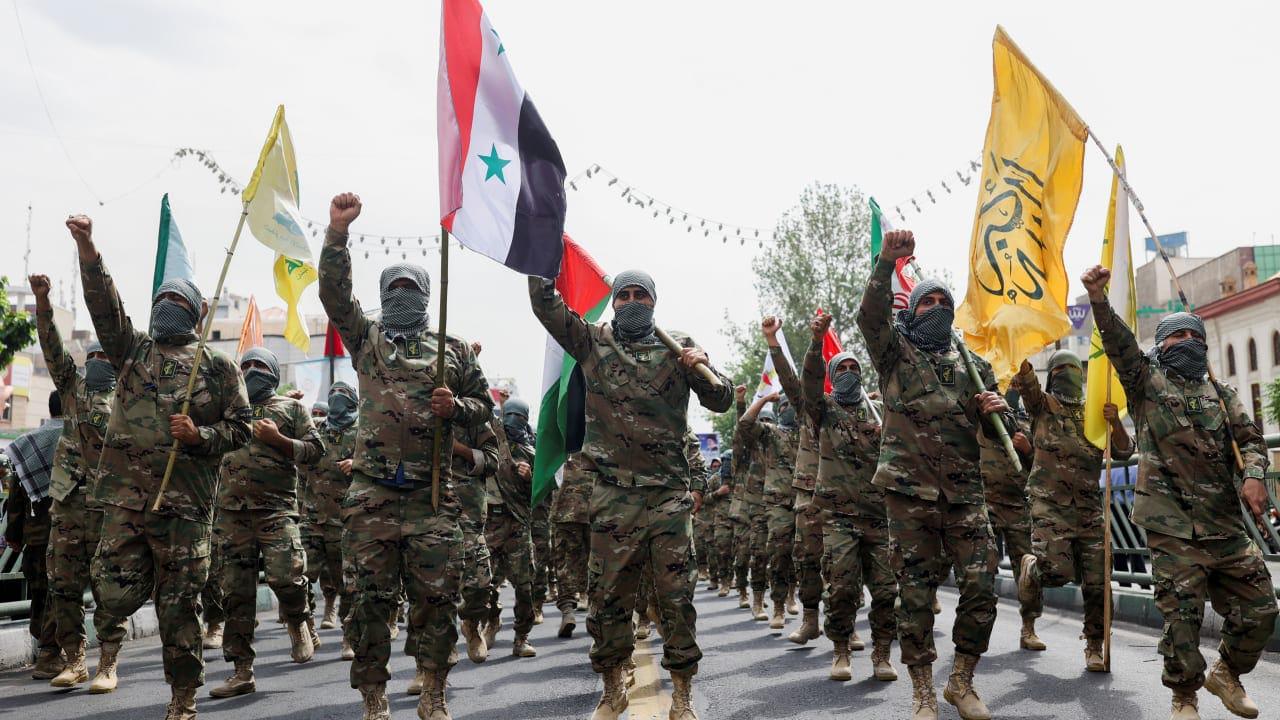
After a week of American and Israeli strikes on the command centers of the Islamic Revolutionary Guard Corps (IRGC), and the elimination of the leader of the Islamic Republic, the figure who served as the nexus linking the IRGC to Iran’s political and economic power structure, there are growing signs that this military organization, which also exerts control over Iran’s economy, may be approaching the point of collapse.
It has no choice but to collapse, these men are sitting ducks and they either surrender or it’s curtains for them. Play over.
Emily Blout, an Iran specialist with policy and research experience at the Pentagon, told TML: “Dispersal of IRGC into these unusual locations, including hospitals and schools, is a core part of their strategy for survival. And the strategy actually makes sense by decentralizing command into local autonomous units and by dispersing munitions across the country, the IRGC aims to maintain control even though its central leadership is eliminated. But hiding in places, especially in hospitals, is a page out of the Hamas playbook.”
If this is the case, then let the Iranian citizens who are not part of this regime, become armed and remove them, all of them. The entire IRGC!
In total, the IRGC has roughly 250,000 personnel, with reserve forces numbering about twice that. Including the Basij, the total number of armed personnel stands at roughly 900,000 nationwide. Yet after one week of war, the IRGC’s internal communications have been severely disrupted, and signs of organizational disorder have become visible.
Sure-Wishbone-4293 on
According to this military source, Iranian protesters could seize the initiative at a decisive moment and enter a phase of armed insurrection. But one weakness in the minds of some people is the prospect of foreign military intervention, along with the pull of nationalism, and the negative perception of an “external leader” once again arriving in the country by airplane under the protection of foreign-backed forces.
One week after the outbreak of war, the IRGC has lost its commander and nearly all of its field commanders. It is said that at least 800 of its members have been killed, and that in terms of military capacity and organizational cohesion, it has reached the terminal phase of its 47-year existence.
Even if the IRGC avoids total collapse in the coming weeks, it is likely to face mounting internal rivalries, the erosion of its vast economic privileges, and the possible rupture of its ties to the wider financial networks on which it has long relied. Together, these pressures could seriously weaken the IRGC’s financial base and, in turn, further destabilize the government.
At present, the only armed force the IRGC appears to regard as a serious threat consists of the thousands of Kurdish peshmerga fighters who, following the Iran-Iraq security agreement, have been compelled to reside in areas of the Kurdistan Region far from the border. These Kurdish parties, which have recently united, enjoy broad support in Iranian Kurdistan.
Shukriya Bradost, a security analyst in the Middle East, stresses that the capacity to mobilize the public is stronger in Kurdistan, and this opportunity can be used for the liberation of all of Iran. She argues that the “Kurdish card” can be used to bring down the Islamic Republic.
Outside_Ad_3888 on
This is a an optimistic though potential take, but something I think is often forgotten is When would the regime collapse. Because as of now the oil situation is becoming more and more threatening with the regime effectively keeping a knife to the oil jugular of the world, of course that comes at an immense cost of the regime itself and it’s long term survival is anything but certain. But until then every day the strait remains blocked is a day where long term damage to oil prices and it’s geopolitical, political and economic consequences become more severe.
I honestly wonder if a better approach wouldn’t be to attempt to deteriorate the Iranian police infrastructure for the next 2 days and then reach a strike truce in the area while leaving the Iranian government to face it’s hostile popoulation. The reasons for the iranian protests have to do with the abyssimal economy, repression and waste of Iranian state resources towards confrontation with Israel. None of this are easily solvable by the regime. At the same time our strikes are able to eliminate a lot of iranian capabilities but not the low level brutal police enforcement which only need a gun, a local commander and a willigness to use the gun.
The hour of truth has to come, once the strikes stop will it have given sufficient breathing space for the Iranian population to revolt or if the regime will come out weakened, suffering but with it’s demise postponed.
If however we continue the standoff, we risk not increasing the odds of a regime transfer but increasing the risks of a global oil crisis which will hurt US interests in Asia, Europe and even some areas of ME.
Of course interception rates of drones, valuable assets still to strike and the potential forced opening of the strait could all change this calculus, with some good signs in this regard.

3 Comments
After a week of American and Israeli strikes on the command centers of the Islamic Revolutionary Guard Corps (IRGC), and the elimination of the leader of the Islamic Republic, the figure who served as the nexus linking the IRGC to Iran’s political and economic power structure, there are growing signs that this military organization, which also exerts control over Iran’s economy, may be approaching the point of collapse.
It has no choice but to collapse, these men are sitting ducks and they either surrender or it’s curtains for them. Play over.
Emily Blout, an Iran specialist with policy and research experience at the Pentagon, told TML: “Dispersal of IRGC into these unusual locations, including hospitals and schools, is a core part of their strategy for survival. And the strategy actually makes sense by decentralizing command into local autonomous units and by dispersing munitions across the country, the IRGC aims to maintain control even though its central leadership is eliminated. But hiding in places, especially in hospitals, is a page out of the Hamas playbook.”
If this is the case, then let the Iranian citizens who are not part of this regime, become armed and remove them, all of them. The entire IRGC!
In total, the IRGC has roughly 250,000 personnel, with reserve forces numbering about twice that. Including the Basij, the total number of armed personnel stands at roughly 900,000 nationwide. Yet after one week of war, the IRGC’s internal communications have been severely disrupted, and signs of organizational disorder have become visible.
According to this military source, Iranian protesters could seize the initiative at a decisive moment and enter a phase of armed insurrection. But one weakness in the minds of some people is the prospect of foreign military intervention, along with the pull of nationalism, and the negative perception of an “external leader” once again arriving in the country by airplane under the protection of foreign-backed forces.
One week after the outbreak of war, the IRGC has lost its commander and nearly all of its field commanders. It is said that at least 800 of its members have been killed, and that in terms of military capacity and organizational cohesion, it has reached the terminal phase of its 47-year existence.
Even if the IRGC avoids total collapse in the coming weeks, it is likely to face mounting internal rivalries, the erosion of its vast economic privileges, and the possible rupture of its ties to the wider financial networks on which it has long relied. Together, these pressures could seriously weaken the IRGC’s financial base and, in turn, further destabilize the government.
At present, the only armed force the IRGC appears to regard as a serious threat consists of the thousands of Kurdish peshmerga fighters who, following the Iran-Iraq security agreement, have been compelled to reside in areas of the Kurdistan Region far from the border. These Kurdish parties, which have recently united, enjoy broad support in Iranian Kurdistan.
Shukriya Bradost, a security analyst in the Middle East, stresses that the capacity to mobilize the public is stronger in Kurdistan, and this opportunity can be used for the liberation of all of Iran. She argues that the “Kurdish card” can be used to bring down the Islamic Republic.
This is a an optimistic though potential take, but something I think is often forgotten is When would the regime collapse. Because as of now the oil situation is becoming more and more threatening with the regime effectively keeping a knife to the oil jugular of the world, of course that comes at an immense cost of the regime itself and it’s long term survival is anything but certain. But until then every day the strait remains blocked is a day where long term damage to oil prices and it’s geopolitical, political and economic consequences become more severe.
I honestly wonder if a better approach wouldn’t be to attempt to deteriorate the Iranian police infrastructure for the next 2 days and then reach a strike truce in the area while leaving the Iranian government to face it’s hostile popoulation. The reasons for the iranian protests have to do with the abyssimal economy, repression and waste of Iranian state resources towards confrontation with Israel. None of this are easily solvable by the regime. At the same time our strikes are able to eliminate a lot of iranian capabilities but not the low level brutal police enforcement which only need a gun, a local commander and a willigness to use the gun.
The hour of truth has to come, once the strikes stop will it have given sufficient breathing space for the Iranian population to revolt or if the regime will come out weakened, suffering but with it’s demise postponed.
If however we continue the standoff, we risk not increasing the odds of a regime transfer but increasing the risks of a global oil crisis which will hurt US interests in Asia, Europe and even some areas of ME.
Of course interception rates of drones, valuable assets still to strike and the potential forced opening of the strait could all change this calculus, with some good signs in this regard.