
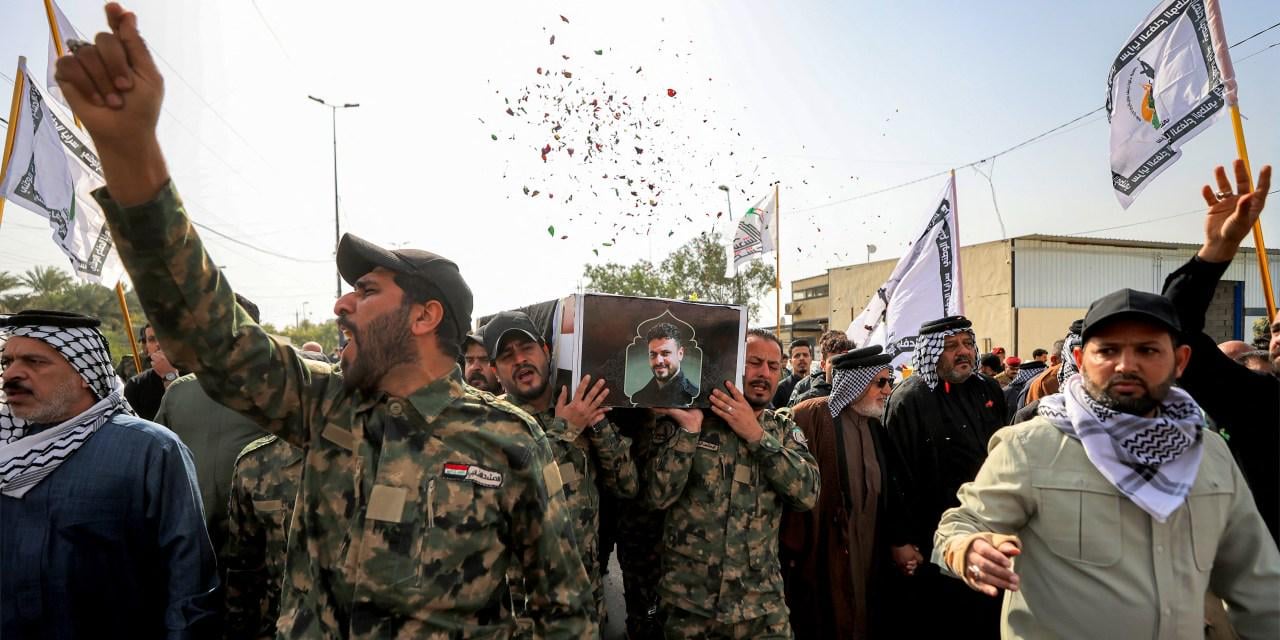
The war in the Middle East is pushing the U.S. military back into combat in Iraq against an old foe—Iran-backed militia groups that two decades ago battled American troops on the streets of Baghdad.
Iraqi militias have attempted dozens of small-scale drone and rocket attacks since the war began in a show of support for Tehran, including against a U.S. military base and consulate in northern Iraq and a State Department facility at the Baghdad International Airport. On Saturday, rockets targeted the U.S. Embassy in Baghdad, which Iraqi Prime Minister Mohammed Shia al-Sudani called a “terrorist act” by “rogue groups.”
The U.S. said Sunday it has been carrying out attacks against the militias, acknowledging that the war in Iran is spilling over into neighboring Iraq and drawing American forces back into a place where they spent years fighting insurgents and endured heavy casualties after the 2003 invasion that deposed Saddam Hussein.
“We have conducted operations in Iraq as part of Operation Epic Fury, but it’s in defense of U.S. troops as they’ve come under attack by Iran-aligned militia groups,” said Capt. Tim Hawkins, a spokesman for U.S. Central Command, which oversees military operations in the region. Epic Fury is the operation name for the Iran campaign.
The tactics are a significant shift for the Pentagon, which has mostly avoided targeting Iraqi militias in recent years, seeking to disengage from a painful conflict once and for all.
Iraqi officials say there have been multiple airstrikes apparently by U.S. warplanes on militia strongholds, including at bases near the towns of Jurf al-Sakhar, south of Baghdad, and al-Qaim, along the Iraqi-Syria border. Both locations have been used for years as depots for weapons supplied by Iran and to launch attacks at U.S. bases in Syria and Jordan.
A March 4 airstrike in Babil, in central Iraq, killed Abu Hassan al-Fariji, a commander of the U.S.-designated terror group Kataib Hezbollah, along with another militia member. Kataib Hezbollah issued a statement the day after Fariji’s death, saying he was one of the group’s commanders for more than two decades. Hawkins said he had no information that the U.S. conducted the attack.
“They are working to decapitate the Iranian-backed infrastructure in Iraq,” said Tamer Badawi, an associate fellow who studies Iraqi militias at the Royal United Services Institute, a London think tank. Since the U.S.-Israeli war against Iran began, there have been at least two dozen reported attacks on Iraqi militias, he said, most likely by U.S. forces or its allies, he said.
Most of the militia attacks appear to have caused minimal damage. But analysts say the Pentagon is seeking to inflict a heavy toll on the Iranian-backed groups, opening an active second front against Iran as well as settling years-old scores.
The longer the war continues, the more sectarian and economic pressures could build in Iraq, exacerbated by interruptions in its oil exports, plunging a country that had shown signs of regaining stability back into upheaval.
Defense Secretary Pete Hegseth has emphasized the difference between the strikes against Iran and the U.S.’s long-running military engagement in Iraq. “This is not Iraq,” he said in a March 2 press conference. “This is not endless.”
For Tehran, the flare-up in fighting next door is one of only a few instances since the war began of militia groups it has funded and armed for years coming to its aid against the U.S. and Israel. In Lebanon, Hezbollah militants have fired barrages of rockets and drones into Israel, which has struck back heavily. Other militant groups across the region have stayed out of the fight, either biding their time or hoping to avoid retaliation.
Tehran and Washington have wrangled for years over influence in Iraq. Iran has significant sway as a fellow Shiite country and Iraq’s biggest neighbor, but the U.S., with its economic and military power, still has major clout in Baghdad. Trump officials in recent weeks have been seeking to block a return of former Prime Minister Nouri al-Maliki, seeing him as too close to Tehran and the Shia militias
Numerous militias were put on the Iraqi government payroll during the fight against ISIS and some still have a formal role in its security forces. Fighters from units designated by the U.S. as terror organizations aren’t supposed to be paid salaries, but in practice there is overlap between official militias and rogue groups.
Since the end of the war against ISIS, Iraq’s most potent militias, including Kataib Hezbollah and Asaib Ahl al-Haq, have forged significant clout within the Iraqi government and are closely aligned with Tehran. In carrying out attacks, they disguise their involvement by using alternative names when claiming credit in an effort to avoid being targeted by the U.S.
The U.S. has largely pulled its troops out of the country after an occupation two decades ago that President Trump has denounced for years. The Pentagon has an undisclosed number of military personnel in Iraq, though.
The U.S. has struck militia targets in Iraq in recent years, including Jurf al-Sakhar, but only in retaliation for Iraqi attacks that killed U.S. soldiers.
Iraq’s government, which seeks to maintain ties with Washington and Tehran, has said little about the wave of attacks against militia groups, though privately officials say there is little doubt in their mind that the U.S. is responsible.
On Saturday, Iraq’s military said that two units in the Popular Mobilization Forces, an umbrella militia group, were attacked in separate aerial strikes. The “treacherous attacks” killed one militia member and wounded three, the statement said. It didn’t identify who was behind the attacks.
The militias have been especially active in northern Iraq since the start of the war, attacking energy facilities, as well as the U.S. base in the city of Erbil in Iraq’s self-governing Kurdish region, where most of the remaining U.S. troops in the country are.
The U.S. Embassy in Baghdad warned in a statement Sunday that “Iran and Iran-aligned militia/terrorist groups continue to pose a significant threat to public safety. There have been calls for attacks against U.S. citizens and U.S. interests in Iraq. Hotels frequented by foreigners and other facilities in the Iraqi Kurdistan Region have been targeted. Critical infrastructure sites throughout Iraq have also been attacked.”
The surge in violence has also sparked confrontations between Iraq’s armed forces and unidentified forces in Iraq.
Iraq lodged a protest with the U.S.-led coalition in Baghdad over an unusual firefight Wednesday that killed one Iraqi soldier and left several others wounded. Iraqi officials said the battle occurred in the desert near the Iraqi city of Najaf, which has a large militia presence.
Iraqi troops sent to investigate were attacked by unknown foreign troops on the ground and by helicopters, said Basim al-Awadi, a government spokesman. “The Iraqi force came under intense and deadly fire,” he said, adding that the attack undermines “trust between Iraq and the coalition” and that U.S. military commanders “denied knowledge of the incident.”
Hawkins, the Central Command spokesman, said there was no indication U.S. forces were involved.
Posted by John3262005
1 Comment
This dumbass admin cannot help but poke as many bee hives as possible. They are in over their heads and the price of peace is their pride.