
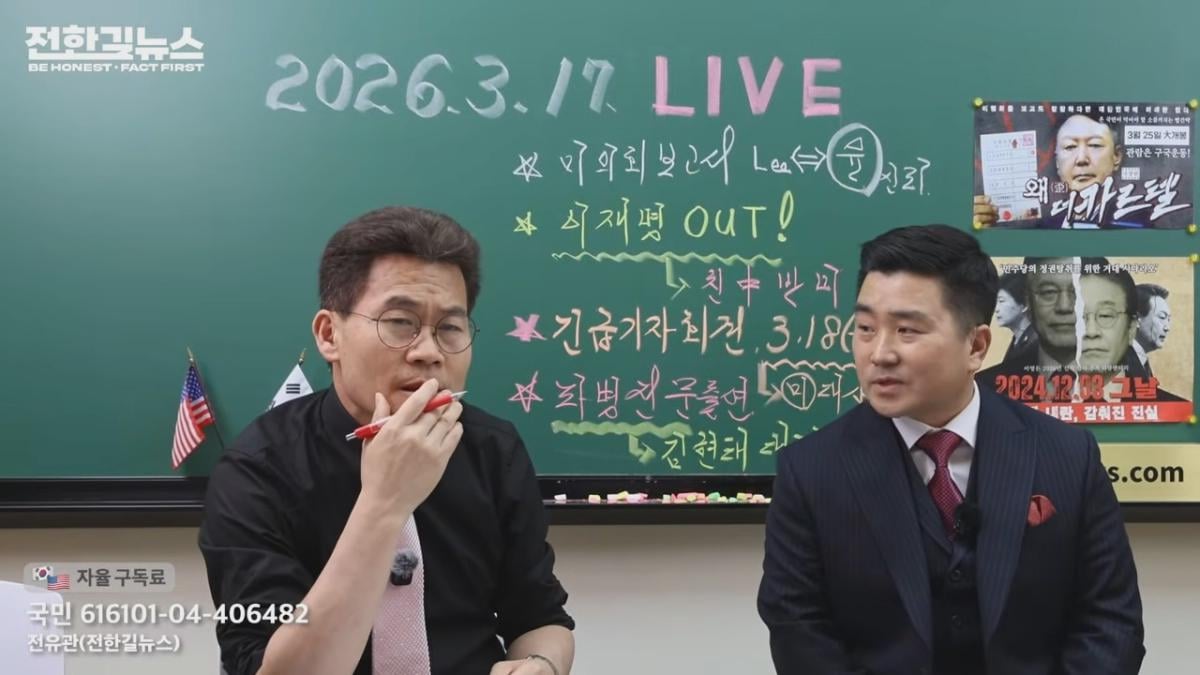
A YouTuber and former Korean history instructor, Jeon Han-gil, who is a strong supporter of former President Yoon Suk Yeol, argued that the South Korean government should comply with the Trump administration’s request to dispatch naval forces to the Strait of Hormuz.
Jeon announced during a live broadcast on his YouTube channel on the 17th that he would hold an emergency press conference in front of the U.S. Embassy in Gwanghwamun, Seoul, on the afternoon of the 18th to urge a decision in favor of deployment.
He stated, “South Korea has enjoyed significant security benefits over the past 70 years through the presence of U.S. Forces Korea,” and emphasized that “responding with action when an ally like the United States faces difficulty is the true posture of the Korea–U.S. alliance.”
He claimed that the government’s cautious stance on the deployment issue stems from concerns about China.
Jeon further argued, “While the Lee Jae-myung government avoids giving a clear answer to the deployment request out of concern for China, left-wing civic groups are protesting in front of the U.S. Embassy against deployment, sending the wrong signal.”
He added that the purpose of the press conference was “to clearly convey to the United States that the majority of the Korean public supports safeguarding the Korea–U.S. alliance.”
Kim Hyun-tae, former commander of the ROK Special Forces 707th Unit, who appeared alongside Jeon in the broadcast, stated, “Deployment would provide our military with real combat experience and elevate national prestige,” adding that “if the scale and mission scope are strategically adjusted, it is possible to ensure troop safety while still contributing to national interests.”
Jeon also said, “If former President Yoon were still in office, he would have immediately discussed deployment in support of the alliance,” and predicted that the current administration would face diplomatic isolation. He called for active participation from residents in the Seoul metropolitan area, emphasizing that the press conference should serve as a starting point for restoring trust in the Korea–U.S. alliance.
On the 14th, U.S. President Donald Trump requested that five countries—South Korea, China, Japan, France, and the United Kingdom—dispatch naval forces to the Strait of Hormuz.
However, Western allies including European countries, Canada, and Australia have already clearly expressed their refusal.
UK Prime Minister Keir Starmer, while mentioning freedom of navigation in the Strait of Hormuz, stated, “Let me be clear: this will not become a NATO mission, nor has it ever been considered as such.” He refrained from giving a definitive answer, maintaining a cautious stance. Major British media outlets interpreted this as a de facto rejection. Starmer also said that “the UK will not be drawn into a broader war.”
Germany, France, Canada, and Australia have also publicly declined, and Poland has likewise stated it will not send troops to Iran.
Luxembourg’s Deputy Prime Minister and Foreign Minister Xavier Bettel remarked, “Threats are not what we want,” adding, “It is quite unusual for someone to create chaos themselves and then ask others to figure out how to help.”
European countries generally argue that the United States and Israel initiated the conflict without prior consultation, and that NATO is fundamentally a defensive alliance, making it difficult to accept Trump’s request.
From the perspective of third countries in this conflict, even if the mission is framed as escorting commercial vessels rather than direct military action against Iran, dispatching naval forces into what is effectively a “kill zone” due to the risk of Iranian naval mines entails significant danger to personnel, making participation difficult to justify.
While managing alliances with the United States is important for national security, there are concerns that, in the absence of clear war objectives from the Trump administration, involvement could draw countries into a broader Middle Eastern conflict with serious consequences.
There is also criticism that the U.S. initiated the conflict without sufficient consultation with allies and is now attempting to shift the burden of risk onto them. Countries such as South Korea and Japan, which face relatively less direct threat from Iran compared to Europe or the Middle East, have maintained a cautious stance.
Compounding the situation, even within the United States, divisions appear to be emerging. Joe Kent, Director of the National Counterterrorism Center (NCTC), has reportedly submitted his resignation, stating he cannot support the war with Iran.
Major U.S. outlets including The New York Times noted that Kent is not a typical anti-war figure but someone previously aligned with pro-Trump positions and conspiracy theories, suggesting that new fractures are emerging within Trump’s support base.
Posted by Freewhale98
2 Comments
1. Summary
“Yoon Again/Second Foundation War” Far-right is rallying around the cause of sending Korean troops to Hormuz. They are accusing the government and mainstream parties in Korea of being “pro-China” for refusing to send Korean troops to Hormuz strait.
2. How is this related to the sub
(1) Globalization of far-right: The cause of Trump’s “Iran War” became a rallying cry for global far-right.
3. My opinion
Every party in National Assembly including right-wing PPP is opposed to sending any soldiers to Hormuz war zones. Most of Koreans think Trump is trying to use them as a meat shield. But, pro-Yoon far-right evangelicals and conspiracy theory YouTubers are greatly emboldened by Trump’s military actions and rallying around his war. This clearly shows how globalized and Trumpifed the cause of far-right has become. We are seeing Fascist International with the US playing the role of USSR in Comintern.
Nothing says being pro China more than keeping troops closer to China.
I do wonder if the Korean far right will either fully collapse, create something new, or remain in this weird cargo cult to the MAGA movement.