
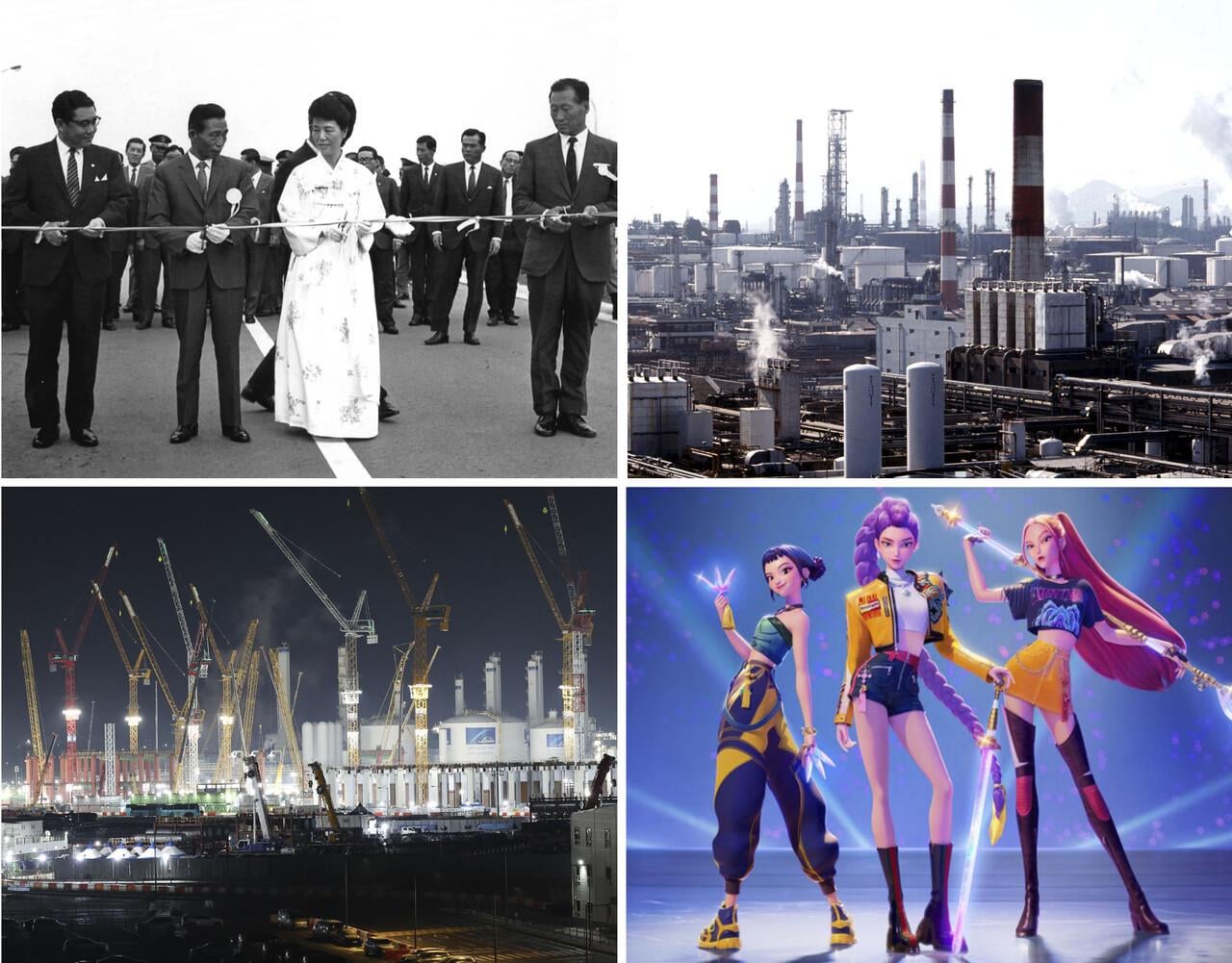
Future historians will likely record the past thirty years in South Korea as an “era of mainstream replacement.” Korea’s first mainstream was forged by industrialization and rapid economic growth — visible to anyone who looked. But over the past thirty years, a very different mainstream quietly emerged and displaced it. The change was so vast that people living day to day could barely perceive it. We grew accustomed to it before we had even found the words to describe it.
A replacement of the mainstream is a rare event. History more commonly shows the dominant class entrenching itself as a permanent establishment. There is a concept known as the “Matthew Effect,” drawn from the Gospel of Matthew: “For whoever has will be given more, and they will have an abundance. Whoever does not have, even what they have will be taken from them.” Imagine a society as a place where a game is played repeatedly. The winner of the previous round starts the next one from a more advantageous position, making victory more likely again. Over many iterations, the gap widens. Eventually, winners powerful enough to do so rewrite the rules in their own favor. This is the entrenchment of privilege.
The conditions that trigger the Matthew Effect are not demanding at all. It does not require the early winners to be unusually greedy or talented. It happens even when people of roughly equal ability play a fair game, again and again. That is what makes it so powerful — and so hard to escape.
You have probably heard at least one explanation for the fall of ancient Rome. Land secured through military conquest was seized by the aristocracy to build vast estates. Small independent farmers lost their competitive footing and sold their land to the great landowners. The most fertile regions of Rome came to be blanketed by latifundia — enormous plantation farms. As the smallholder class weakened, the social foundation crumbled. The same pattern repeated itself in the late Republic and again in the late Empire.
Thirty Years That Matter More Than “A Decade of Political Upheaval”
In modern economics, there is an inequality from Thomas Piketty’s Capital in the Twenty-First Century: r > g. Here, r is the rate of return on capital — the rate at which money makes money. And g is the rate of economic growth — the rate at which people’s incomes rise. Put into words: “The speed at which money earns money is faster than the speed at which people earn money.” The inequality r > g is the Matthew Effect, written in the language of economics.
History and economic modeling are saying the same thing. Success breeds winners; winners build privilege; bloated privilege eventually rigidifies the system. Countless nations and civilizations have declined along this path. In Latin America and Southeast Asia, countries that once outpaced Korea have repeatedly fallen into this trap.
Yet over the past thirty years, Korea did not follow this common path. It did not fall into the trap. Something truly extraordinary happened.
Within the history of global capitalism, Korea is a singular exception — and I do not mean the rapid growth of the twentieth century. I mean the single generation after the 2000s, the very period most Koreans think of as an “era of low growth.” Many countries have grown quickly at the developing-nation stage. But very few have successfully made the structural leap without stalling at the threshold of developed-nation status. Korea is, in a certain sense, a country that achieved high growth and yet — despite it — did not falter at that threshold. And we are living inside that achievement without truly understanding what it means.
The replacement of the mainstream was a structural transformation that swept across the economy and society as a whole. That wave crashed into the political domain in the 2010s. The era of conservative dominance ended, and an era of Democratic Party dominance opened, anchored by the large cohorts of people in their forties and fifties. We will call this “a decade of political upheaval.”
The goal of this series is not political commentary. “The decade of upheaval” matters to us — but only when viewed against the larger backdrop of “thirty years of mainstream replacement.” When people try to explain why the era of Democratic Party dominance arrived by looking only at politics, they reliably reach the wrong conclusions. One interpretation frames it as the historical triumph of pro-democratization forces; another frames it as the entrenchment of a particular generation that seized power through sheer population size and network strength. These readings appear to be opposites, but they share the same limitation: both seek their causes within the narrow domain of politics alone.
“The decade of upheaval” is neither the victory of justice nor the victory of vice. It is the result of structural forces we have not yet been able to explain — the political manifestation of a vast transformation Korean society underwent over thirty years. The problem is that we never properly registered that transformation. Like explaining water to a fish, we are already inside it. That is why the story begins with politics — the most visible change of all.
I have been observing Korean politics professionally since 2008. I know many of the “received wisdoms” that are supposed to be fundamental to reading the field: that Korean politics has an entrenched conservative-dominant structure; that the winner-take-all electoral system suppresses diverse political forces; that social conflict has reached a breaking point. But actual reality kept pointing in a different direction. Election results tilted toward Democratic Party dominance; third parties failed to gain traction even in proportional representation votes; compared to the rest of the world, Korea’s social conflicts were relatively quiet. Since December 3rd, people say a wave of far-right politics has arrived in Korea too — but a key engine of global far-rightism is opposition to free trade. Korea’s far right shows remarkably little interest in this.
Strangely, these received wisdoms did not fade even when they contradicted reality. Even the most vulnerable conventional wisdoms survived by changing shape. The notion that “Korean politics has an entrenched conservative-dominant structure” is the clearest example. Over the ten years since the April 2016 general election, conservatives have won 2 and lost 6 in national elections. Still, the idea was not abandoned — it mutated and lived on. It transformed into something like: “Except in politics, the core structures of the country — the economy, the judiciary, and so on — remain conservative-dominant.”
Why does this happen? Not because any individual explanation is especially powerful. But because together they constitute a worldview. A worldview provides the language and the framework through which we interpret the world. Human beings cannot perceive reality without one. So even when some of its tenets fail to match reality, the worldview as a whole is not easily discarded. Instead, broken ideas are twisted and patched up — and the worldview is maintained.
This is not a question of whether the progressive side or the conservative side is wrong. Both understand Korea through the same historical narrative: “industrialization versus democratization.” Even the younger generation’s backlash is just another variation on that same narrative. Conservatives believe that national founding, anti-communism, and rapid economic development are the pillars of the country. Progressives understand Korean politics as a history of the pro-democratization forces challenging the establishment cartel created by the developmental dictatorship. To younger conservatives, the so-called “386 generation” is a “parasitic establishment generation” — one that contributed less to economic development than its predecessors while seizing power through population size, networks, and seniority. The forms differ, but all are variations on the industrialization-versus-democratization worldview. Different factions clash, yet all stand on the same ideological ground.
Here I see an enormous blind spot — not a problem that is hard to explain in principle, but one that was invisible precisely because it had become too familiar. The “explaining water to the fish” problem. As a result, the gap between explanations of Korean politics and actual reality has grown steadily wider. No matter who wins, reality goes unexplained.
A worldview is, in the end, a story. Which facts from the infinite past we select, and how we weave them into a chain of cause and effect — that determines how a society understands itself. What we need is not more facts. We need a better-functioning story. The closest tool for that work, in my view, is history. Let others write the comprehensive chronicles that carefully document everything that ever happened. My task is to find a better-functioning worldview — and to write the history that supports it.
Posted by Freewhale98