The era of autonomous warfare will not announce itself with robotic armies marching across battlefields. Instead, it is already emerging, quietly and inexorably, in the skies and fields of eastern Ukraine (and to a lesser degree in the Middle East), where missions are increasingly executed by machines at speeds no human can match and electronic warfare is severing the links between operators and their machines. Very soon, autonomous systems will no longer operate individually; over time, they will form platoon- or even battalion-sized units that share information and coordinate without human intervention. And the side that waits for human approval before acting will lose.
This transition demands that militaries rethink not just the nature of command but the fundamental nature of war. The adaptation challenge goes beyond technological and industrial issues, although those aspects are enormously important. Already, Ukrainian engineers are rapidly developing software for autonomous navigation, and Ukrainian military technicians are now assembling first-person-view drones and other types in extraordinary numbers: some 3.5 million last year and a potential seven million this year, compared with 300,000 to 400,000 now assembled annually in the [United States](https://www.foreignaffairs.com/regions/united-states). The U.S. military will have to adapt much faster to manufacture drones in the enormous numbers required and to learn to employ autonomous systems effectively.
But hardware and software will not be enough. It will be just as critical to develop new concepts and doctrine, adjust organizational structures, and institute the new kinds of military education and training that autonomous warfare will demand. These are all areas in which military institutions are often overly deliberate. But which militaries move first to change how they think about command and how the nature of war is evolving will determine which countries win the wars of the future.
MACHINE LEARNING
Unmanned systems in warfare exist on a spectrum, but not all of them are autonomous. At one end are remote-controlled systems: machines piloted or driven continuously by a human operator via a communications link. (Think of a Predator drone operator in Nevada piloting missions over Afghanistan.) Militaries began incorporating remote-controlled systems decades ago: unmanned target aircraft date back to World War I, and guided aerial weapons were operational by World War II. But the modern era of remote control began in 1995, when the Predator first flew reconnaissance missions over Bosnia. By 2015, the U.S. military was operating nearly 11,000 unmanned aerial vehicles, up from 90 in 2001; the Pentagon now plans to field more than 300,000. Today, an estimated 200,000 remote-controlled drones are being launched monthly in Ukraine, alongside unmanned surface vessels that have sunk Russian warships and, in one case, shot down fighter jets over the ocean.
But none of these systems, however impressive, are autonomous. They depend on a human at the controls. Autonomy begins when that human is no longer required—either because electronic warfare severs a system’s command-and-control link and onboard programming takes over or because the system no longer needs remote piloting to complete the mission. The autonomous threshold is already being crossed in [Ukraine](https://www.foreignaffairs.com/regions/ukraine). Unmanned systems fielded by both Kyiv and Moscow increasingly default to onboard programming when jamming severs their communications links, continuing their missions until human control can be restored or the mission is complete.
Kyiv and Moscow alike have pushed the envelope on autonomy because electronic warfare and air defenses have become so pervasive in the operational environment. No commander can count on continuous human control. Ukrainian operators now routinely launch systems knowing that their control links will be jammed or spoofed within minutes. Their success depends on how well they have preprogrammed the onboard software that takes control when communications are cut. In a December 2024 Ukrainian assault on Russian forces near Kharkiv, Ukraine’s 13th National Guard brigade launched what was reported to be the first offensive operation conducted entirely with unmanned systems. Instead of deploying soldiers on the ground, remotely controlled ground vehicles advanced to lay and clear mines and fire on Russian defenses while surveillance, bomber, and suicide drones provided battlefield awareness and air support.
The attack destroyed Russian defensive positions and ultimately enabled Ukrainian infantry to advance and seize ground they still hold today. Not a single soldier was exposed during the initial assault—and careful planning and disciplined communications meant that not a single autonomous system was lost to Russian jamming, either. This coordination was impressive. But it was still controlled by humans. Pilots based in separate locations watched shared video feeds and sequenced their actions manually, and the systems did not communicate with each other.
A much more fundamental shift is on the horizon: autonomy from launch. These systems will execute independently from the start of a mission. This is not the autonomy of a cruise missile or drone following a predetermined flight path to a fixed location. Autonomy from launch means systems that adapt their execution within commander-set constraints: coordinating with other elements in a formation, responding to changing conditions, and selecting among authorized actions when disconnected from human control, although humans will monitor their progress and retain the ability to retask or abort as long as communications remain open.
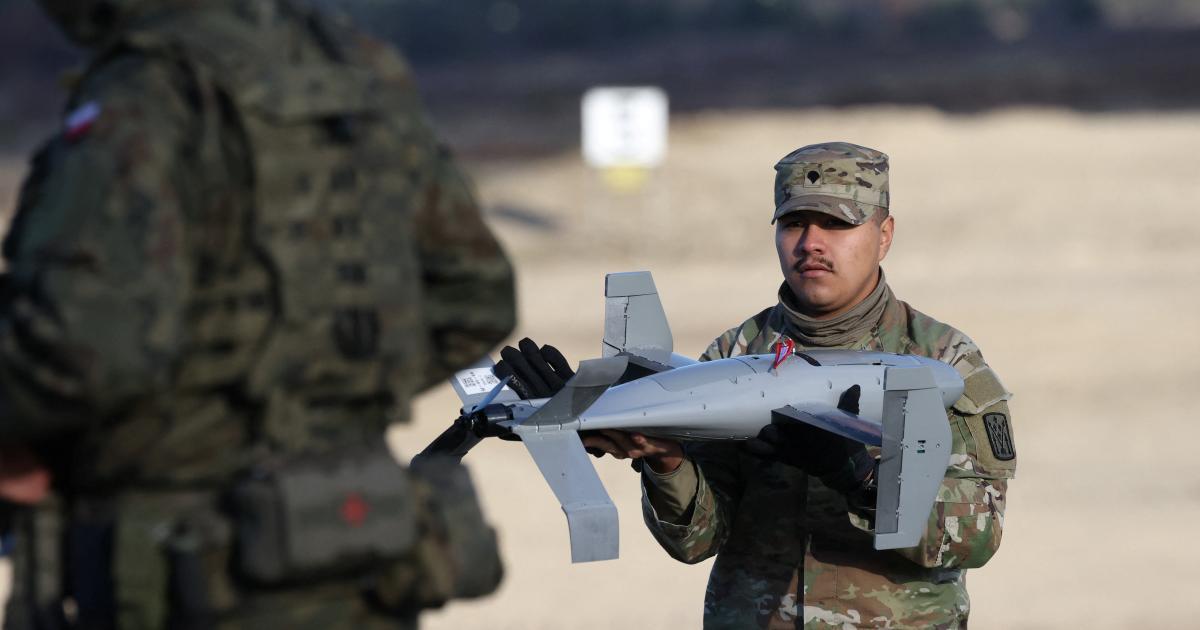
Currently, autonomy from launch exists only in fledgling form. Individual drones equipped with artificial-intelligence-assisted targeting—which can find and strike targets without an operator’s continuous control—number in the thousands among millions of remotely controlled systems. But over time, such machines will not operate as standalone units. Instead, commanders will mass them into formations—air, ground, and maritime systems that include drones, sensors, and targeting elements that direct and coordinate movement and strikes. These formations will execute the commander’s intent and preprogrammed directions even when disconnected.
MECHANICAL WAVE
Militaries worldwide now know that they need to produce many more drones. But they risk missing the deeper point. The advantage in the coming era will not go to the side that assembles the largest fleet of unmanned systems. It will go to the side that first develops the operational concepts to employ them—and then redesigns command-and-control systems, organizations, and training and operations to match. The technology is arriving. But the big ideas, the concepts, must arrive first.
The autonomous formation—whether it is the equivalent of a platoon-sized or battalion-strength fleet of autonomous systems—will integrate air, ground, and maritime systems with sensors, weapons, mobility, and protection. Not only will such formations be able to execute a commander’s intent at a remove and potentially out of contact, but they will also coordinate with each other at machine speed. This will radically change the traditional timing of battles and enable militaries to identify and exploit fleeting tactical windows faster than adversaries can respond—even if those adversaries have also deployed remotely piloted systems.
Consider the advantages: a military that possesses such synchronized systems—and deploys them carefully and effectively—can compress the time it traditionally takes for staff to detail strike options to commanders, for commanders to deliberate and then issue orders to subordinates, and for subordinates to relay orders to the pilots or drivers that are remotely controlling systems. In conventional high-intensity conflicts—the kind currently being waged in Ukraine—autonomous formations will be able to maintain offensive momentum even when electronic jamming severs communication links.
Standard_Ad7704 on
SS:
* A shift from remote-controlled operations to fully autonomous military formations is being driven by pervasive electronic warfare.
* A comprehensive revision of command structures, operational doctrines, and military education is demanded by this technological transition.
* Tactical execution must be delegated to algorithms, while operational boundaries, fail-safes, and permitted actions must be rigorously preprogrammed.
* Catastrophic battlefield defeats will be suffered if new strategic concepts and accelerated procurement processes are not rapidly implemented.

2 Comments
The era of autonomous warfare will not announce itself with robotic armies marching across battlefields. Instead, it is already emerging, quietly and inexorably, in the skies and fields of eastern Ukraine (and to a lesser degree in the Middle East), where missions are increasingly executed by machines at speeds no human can match and electronic warfare is severing the links between operators and their machines. Very soon, autonomous systems will no longer operate individually; over time, they will form platoon- or even battalion-sized units that share information and coordinate without human intervention. And the side that waits for human approval before acting will lose.
This transition demands that militaries rethink not just the nature of command but the fundamental nature of war. The adaptation challenge goes beyond technological and industrial issues, although those aspects are enormously important. Already, Ukrainian engineers are rapidly developing software for autonomous navigation, and Ukrainian military technicians are now assembling first-person-view drones and other types in extraordinary numbers: some 3.5 million last year and a potential seven million this year, compared with 300,000 to 400,000 now assembled annually in the [United States](https://www.foreignaffairs.com/regions/united-states). The U.S. military will have to adapt much faster to manufacture drones in the enormous numbers required and to learn to employ autonomous systems effectively.
But hardware and software will not be enough. It will be just as critical to develop new concepts and doctrine, adjust organizational structures, and institute the new kinds of military education and training that autonomous warfare will demand. These are all areas in which military institutions are often overly deliberate. But which militaries move first to change how they think about command and how the nature of war is evolving will determine which countries win the wars of the future.
MACHINE LEARNING
Unmanned systems in warfare exist on a spectrum, but not all of them are autonomous. At one end are remote-controlled systems: machines piloted or driven continuously by a human operator via a communications link. (Think of a Predator drone operator in Nevada piloting missions over Afghanistan.) Militaries began incorporating remote-controlled systems decades ago: unmanned target aircraft date back to World War I, and guided aerial weapons were operational by World War II. But the modern era of remote control began in 1995, when the Predator first flew reconnaissance missions over Bosnia. By 2015, the U.S. military was operating nearly 11,000 unmanned aerial vehicles, up from 90 in 2001; the Pentagon now plans to field more than 300,000. Today, an estimated 200,000 remote-controlled drones are being launched monthly in Ukraine, alongside unmanned surface vessels that have sunk Russian warships and, in one case, shot down fighter jets over the ocean.
But none of these systems, however impressive, are autonomous. They depend on a human at the controls. Autonomy begins when that human is no longer required—either because electronic warfare severs a system’s command-and-control link and onboard programming takes over or because the system no longer needs remote piloting to complete the mission. The autonomous threshold is already being crossed in [Ukraine](https://www.foreignaffairs.com/regions/ukraine). Unmanned systems fielded by both Kyiv and Moscow increasingly default to onboard programming when jamming severs their communications links, continuing their missions until human control can be restored or the mission is complete.
Kyiv and Moscow alike have pushed the envelope on autonomy because electronic warfare and air defenses have become so pervasive in the operational environment. No commander can count on continuous human control. Ukrainian operators now routinely launch systems knowing that their control links will be jammed or spoofed within minutes. Their success depends on how well they have preprogrammed the onboard software that takes control when communications are cut. In a December 2024 Ukrainian assault on Russian forces near Kharkiv, Ukraine’s 13th National Guard brigade launched what was reported to be the first offensive operation conducted entirely with unmanned systems. Instead of deploying soldiers on the ground, remotely controlled ground vehicles advanced to lay and clear mines and fire on Russian defenses while surveillance, bomber, and suicide drones provided battlefield awareness and air support.
The attack destroyed Russian defensive positions and ultimately enabled Ukrainian infantry to advance and seize ground they still hold today. Not a single soldier was exposed during the initial assault—and careful planning and disciplined communications meant that not a single autonomous system was lost to Russian jamming, either. This coordination was impressive. But it was still controlled by humans. Pilots based in separate locations watched shared video feeds and sequenced their actions manually, and the systems did not communicate with each other.
A much more fundamental shift is on the horizon: autonomy from launch. These systems will execute independently from the start of a mission. This is not the autonomy of a cruise missile or drone following a predetermined flight path to a fixed location. Autonomy from launch means systems that adapt their execution within commander-set constraints: coordinating with other elements in a formation, responding to changing conditions, and selecting among authorized actions when disconnected from human control, although humans will monitor their progress and retain the ability to retask or abort as long as communications remain open.
Currently, autonomy from launch exists only in fledgling form. Individual drones equipped with artificial-intelligence-assisted targeting—which can find and strike targets without an operator’s continuous control—number in the thousands among millions of remotely controlled systems. But over time, such machines will not operate as standalone units. Instead, commanders will mass them into formations—air, ground, and maritime systems that include drones, sensors, and targeting elements that direct and coordinate movement and strikes. These formations will execute the commander’s intent and preprogrammed directions even when disconnected.
MECHANICAL WAVE
Militaries worldwide now know that they need to produce many more drones. But they risk missing the deeper point. The advantage in the coming era will not go to the side that assembles the largest fleet of unmanned systems. It will go to the side that first develops the operational concepts to employ them—and then redesigns command-and-control systems, organizations, and training and operations to match. The technology is arriving. But the big ideas, the concepts, must arrive first.
The autonomous formation—whether it is the equivalent of a platoon-sized or battalion-strength fleet of autonomous systems—will integrate air, ground, and maritime systems with sensors, weapons, mobility, and protection. Not only will such formations be able to execute a commander’s intent at a remove and potentially out of contact, but they will also coordinate with each other at machine speed. This will radically change the traditional timing of battles and enable militaries to identify and exploit fleeting tactical windows faster than adversaries can respond—even if those adversaries have also deployed remotely piloted systems.
Consider the advantages: a military that possesses such synchronized systems—and deploys them carefully and effectively—can compress the time it traditionally takes for staff to detail strike options to commanders, for commanders to deliberate and then issue orders to subordinates, and for subordinates to relay orders to the pilots or drivers that are remotely controlling systems. In conventional high-intensity conflicts—the kind currently being waged in Ukraine—autonomous formations will be able to maintain offensive momentum even when electronic jamming severs communication links.
SS:
* A shift from remote-controlled operations to fully autonomous military formations is being driven by pervasive electronic warfare.
* A comprehensive revision of command structures, operational doctrines, and military education is demanded by this technological transition.
* Tactical execution must be delegated to algorithms, while operational boundaries, fail-safes, and permitted actions must be rigorously preprogrammed.
* Catastrophic battlefield defeats will be suffered if new strategic concepts and accelerated procurement processes are not rapidly implemented.