
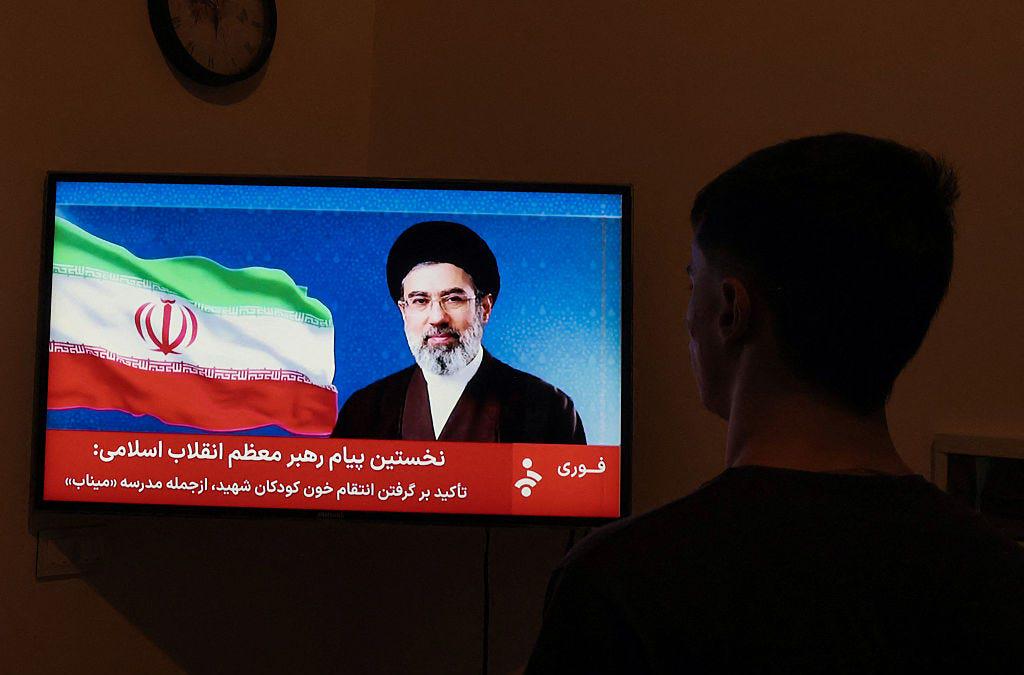
The most important fact in Iran right now is not what the regime says about Mojtaba Khamenei’s health; it is what the regime has not revealed. After the February 28 attack that killed Ali Khamenei, the Islamic Republic appointed his second son, Mojtaba, as the third supreme leader on March 8.
However, since the war began, Mojtaba has neither appeared in public nor delivered a televised speech. He has not released even a recorded audio message to the Iranian people. Even his first remarks as supreme leader were read by a television presenter. Although Iranian officials claim that Mojtaba is well and directing the war, many, including President Donald Trump, believe he is injured, and some think he may be in a coma.
That leaves one basic question at the center of Iranian politics today: If Mojtaba is wounded, incapacitated, or even in a coma, who is making the decisions? Who wrote his first message?
The Islamic Republic is not in a normal succession moment. It is in the middle of war, leadership decapitation, and an unprecedented crisis of command. In such a situation, the person with the title does not automatically assume power. Instead, power goes to the people who can communicate, coordinate, survive, and remain hidden. Mojtaba may have been elevated to preserve continuity after his father’s death, but continuity on paper is not the same as control in practice. If the new supreme leader cannot speak to the public, cannot appear before elites, and cannot reassure the system through his physical presence, then his position becomes vulnerable to capture by those operating around him.
Some may say the answer must lie with the visible civilian and semi-civilian leadership, figures such as President Masoud Pezeshkian or Judiciary Chief Gholam-Hossein Mohseni Ejei, who are still alive. After all, these are the men the public see. Pezeshkian and Ejei appeared recently at a Quds Day rally in Tehran, and have been the public faces of the state since Ali Khamenei’s death.
But that visibility is exactly why they are unlikely to be the real wartime decision-makers. If Israel or the United States can locate targets through public appearances, speeches, and open movement, the men standing before cameras are not the safest to manage sensitive military and security decisions.
Public figures have political value: They can signal continuity, calm internal audiences, and provide a formal face for the state. But in wartime Iran, the people likely making the hardest decisions are those who are not visible.
The real center of gravity is probably elsewhere, inside the hidden security apparatus around Mojtaba and, more importantly, the Islamic Revolutionary Guard Corps. The answer lies in the regime’s structure of power, which Mojtaba helped to build and shape. As the second most important man in his father’s office, the Bayt, he was aware of the underground tunnels, secure networks, and institutions through which the regime exercised power, formally and informally.
The Islamic Revolutionary Guard Corps, established in 1979 as the clerical regime’s bodyguards, has since the 1990s become the most important organization in the Islamic Republic. Ali Khamenei repeatedly treated the Guard as the central pillar of the regime’s survival. The organization strongly pushed for Mojtaba’s elevation and has tightened its grip over wartime decision-making despite major losses in its command structure. Even if Mojtaba is alive, the structure around him is likely already moving toward direct Guard control.
If that reading is correct, the people who matter most are not the politicians seen in public, but the less-visible security actors who have remained in the shadows since the war began. This includes Mohammad-Bagher Ghalibaf, the parliamentary speaker who has a long Revolutionary Guard background; Ahmad Vahidi, the new Islamic Revolutionary Guard Corps commander; Hossein Nejat, commander of the Guard’s security command; and Majid Khademi, the head of the Guard’s intelligence organization. Not all their roles can be confirmed directly in real time, especially when wartime reporting is incomplete, but the pattern is clear. The men with the guns, secure communications, and underground networks will make decisions in Mojtaba’s name if he cannot.
That would mean the Islamic Republic has moved one step further in its long transformation from clerical authoritarianism to security guardianship. Mojtaba’s succession was a sign that the system no longer cared much about public legitimacy, clerical stature, or even revolutionary symbolism. His possible incapacity would push the same process even further, effectively reducing the supreme leader from a decision-maker to a figurehead. The title would remain clerical, but the rule would become more military- and security-based.
All of this helps to explain why the regime’s behavior has become so rigid and escalatory. A hidden chain of command dominated by the Islamic Revolutionary Guard Corps is far less likely to compromise, de-escalate, or test a diplomatic opening. The men around Mojtaba are not pragmatists; they are hardliners shaped by intelligence work, internal repression, missile doctrine, and survivalist thinking. They do not see war as a reason for moderation, but as proof that only coercion, ideological discipline, and regional escalation can save the system.
In authoritarian systems, silence is never neutral. Iran’s silence strongly suggests that the Islamic Revolutionary Guard Corps’ security commanders are already making the most important decisions and Mojtaba’s rise means something darker than dynastic succession: It means the final masking of military and security rule behind a cleric’s name.
Posted by AmericanPurposeMag
7 Comments
[removed]
The IRGC. They were already leading the country even before his dad was eliminated
>All of this helps to explain why the regime’s behavior has become so rigid and escalatory. A hidden chain of command dominated by the Islamic Revolutionary Guard Corps is far less likely to compromise, de-escalate, or test a diplomatic opening.
Not really following here… Deescalation in the past hasn’t done much to stop US/Israel aggression. Keeping the West’s hand on the stove is the best their move to stay in place
It’s like captians in Wall-E with Auto, only Auto is the IRGC.
> That would mean the Islamic Republic has moved one step further in its long transformation from clerical authoritarianism to security guardianship.
I stand in awe of the President of the United States, who managed to take an Islamic totalitarian theocracy and transform it into an Islamic totalitarian military junta. This is the 9D chess so many within MAGA speak of, no doubt.
> It means the final masking of military and security rule behind a cleric’s name.
This was largely already true. Khamenei was a necessary spiritual figurehead that legitimized the “Islamic” piece of the Islamic Republic. It was how Iran could tell people both internally and externally that they were a pious leadership governed by Islamic thought and morality. Such a representation was necessary – without it, then the Islamic revolution was nothing but a power grab by militant factions.
I would argue that Epic Fury has allowed the IRGC to shed the pretense of any sort of leadership derived from divine mandate and can now simply consolidate power the old-fashioned way – monopolizing violence and using external threat as social cohesion behind their rule.
Regimes collapse not from air power, but from internal contradictions, unmet expectations, and corroded leadership in all institutions within the state. If Reagan had launched an air campaign against the USSR, I am completely convinced (assuming there was no nuclear war) much of the Soviet Union would still exist today.
Trump and Netanyahu granted the IRGC the only thing they could not create themselves – a true binding mission against a foreign adversary. And now, with their top leadership constantly getting haircuts, decision-making is pushed further down the org chart and there’s nobody left to speak for the nation as a whole. It’s just a collection of warlords united under a common banner.
> In authoritarian systems, silence is never neutral.
LOL, I’m taken aback by this epic sentence. This post is 80% AI-written speculation. It’s incoherent, first states that it makes sense for a leader (like Mojtaba) to hide because “Israel or the United States can locate targets through public appearances, speeches, and open movement” then adds a non-sequitor that Iran must be escalatory because an occult chain of command is behind the decisions rather than Mojtaba, even though Mojtaba had 6 family members killed, and any concessions will likely get himself killed somewhere in the future too, therefore he would have all the reason in the world to be escalatory.
wait so we don’t actually know who’s running the country? that’s kinda terrifying tbh, like someone’s making decisions but nobody knows who.