
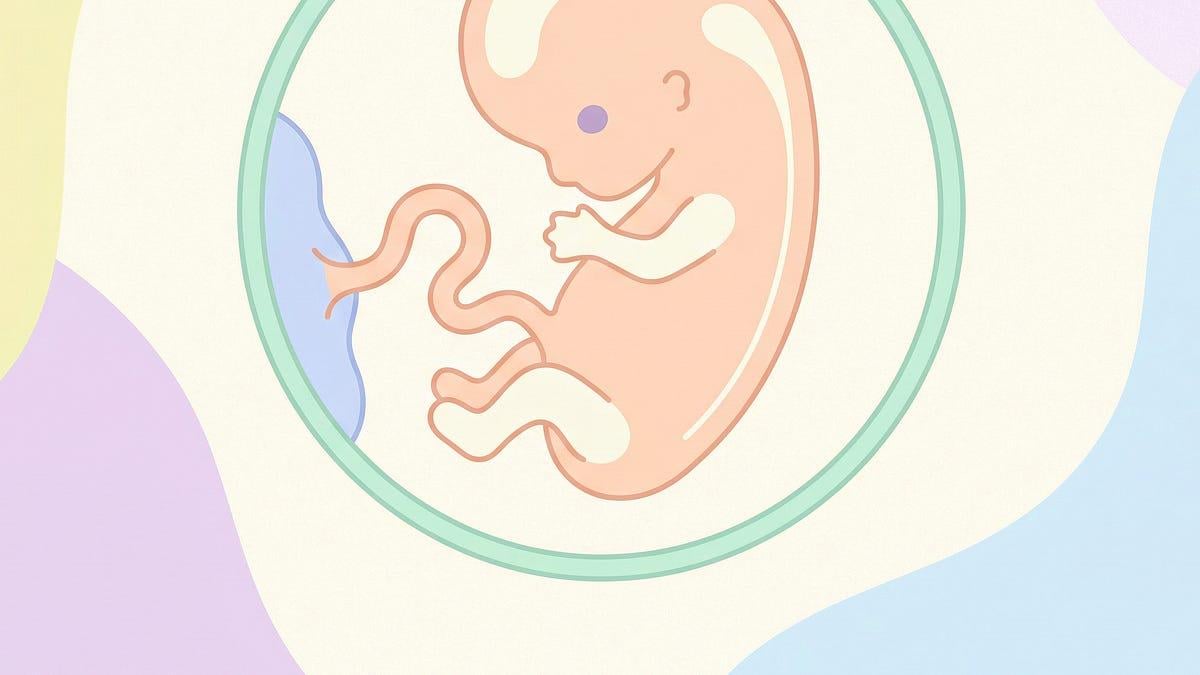
From the article:
A first-trimester abortion, the kind that accounts for roughly 93% of all abortions performed in the United States, is about as morally significant as removing a mole.
I know this sounds unhinged. But I think the abortion question, on the merits, is not close, and I think most people who've spent real time with the philosophical arguments agree, even the ones who frame their conclusions diplomatically. The culture-war version of this debate treats it as a 50-50 clash of irreconcilable values, where reasonable people simply disagree and the best we can hope for is an uneasy truce. That framing is wrong. Not because the opposing side doesn't have any arguments (it does, and I'll take the best ones seriously), but because when you follow those arguments to their conclusions, they either collapse under their own weight or prove far too much to be useful at all.
A sperm cell is alive. An egg cell is alive. A skin cell you scratch off your arm is alive. A bacterium in your gut is alive. “Life” is not a morally interesting category. The question is not whether something is biologically alive but whether it is the kind of thing that has interests, that can be harmed, that possesses what philosophers call moral status. In ordinary language: is it a person?
- It is wrong to kill innocent persons.
- A fetus is a person.
- Therefore, it is wrong to kill a fetus.
The problem, as Mary Anne Warren pointed out in 1973, is that "person" in premise 1 and "person" in premise 2 mean completely different things. In premise 1, "person" means a moral person: a being with consciousness, the capacity to feel pain and suffer, the ability to reason, some form of self-concept. This is the sense in which killing a person is wrong. In premise 2, "person" just means a member of the species Homo sapiens: a biological human. And while a first-trimester embryo is certainly a biological human (it has human DNA, it is the offspring of human parents), it is, by any reasonable accounting of the relevant features, not a moral person.
For context: the entity we're discussing at 10 weeks weighs about 4 grams. It has no functioning cerebral cortex. It has no thalamic connections to interpret sensory input. It has the computational complexity of, generously, a shrimp. If you believe a 10-week fetus has equivalent moral status to a newborn baby, or to you, you need a reason other than its current mental capacities, because it has effectively none.
If you hold that every embryo is a person from conception, then this means that more "people" die of spontaneous embryo loss than of cancer, heart disease, and every other cause of death combined. It is not a close comparison. It is, by this accounting, the number one killer of humans by an enormous margin.
If you want an even starker test: imagine you are in a burning fertility clinic. In one room, there is a crying five-year-old child. In another room, there is a container holding a hundred frozen embryos. You can save one or the other, not both. Which do you save? If you believed embryos were full moral persons, saving the container would be obligatory, because a hundred lives outweigh one. But nobody believes this when the choice is in front of them. The thought experiment strips away the abstraction and forces you to confront what you actually think an embryo is worth. The answer is: less than one child. Far less.
A first-trimester embryo is not a person in any philosophically meaningful sense. It has no consciousness, no capacity for pain, no self-awareness, no preferences, no interests. For the first trimester, the expert consensus is not ambiguous at all. The philosophical arguments for extending full moral status to such an entity fail: the “life begins at conception” view is undermined by the twinning problem, the potentiality argument confuses potential rights with actual rights (a prince is a potential king, but he does not have the rights of a king; a fertilized chicken egg is a potential chicken, but scrambling it is not the same as boiling a chicken alive), and Marquis’s “future like ours” argument, the most sophisticated attempt, collapses under the identity objection and the contraception problem.
Even if all of this were wrong, even if the embryo were a full person with a right to life from the moment of conception, Thomson’s argument from bodily autonomy demonstrates that abortion would still be permissible. Having a right to life does not give you a right to someone else’s body. This is a principle we accept in every other context without controversy.
The evidence, the philosophy, and the moral reasoning all point in the same direction. First-trimester abortion is permissible. Treating it as a profound moral dilemma is a failure of clear thinking, not a sign of moral seriousness. And policies that restrict it are not protecting “life,” because there is no one there to protect. They are controlling women.
Posted by lakmidaise12
2 Comments
We’ve allowed anti-abortionists to turn the philosophical debate of when human life starts into political policy and the ramifications are absurd and evil. Murder charges for a period. Children denied childhood and demanded they go through the labor pains when their bodies haven’t developed for that yet. Fear of providing care to pregnant women with major complications that result in the death of the fetus or, worse, the death of the woman.
Abortion is pro-family as it allows the parents, the means to provide for the children they have instead of forcing them to worry about the theoretical children they cannot support.
The author seems to lay a lot of stay in equivalence of behaviour. So while he can arguably establish that miscarriage isn’t equivalent to the death of an adult or child, this does of course rather negate his- possibly deliberately hyperbolic- claim that this is no different to a mole then falls down. As he says, people do grieve and are sad, require counselling and so on. No one does this for having a mole removed. You could probably conclude from that that while the embryonic death isn’t equivalent to an adult death, there is some degree of seriousness?