
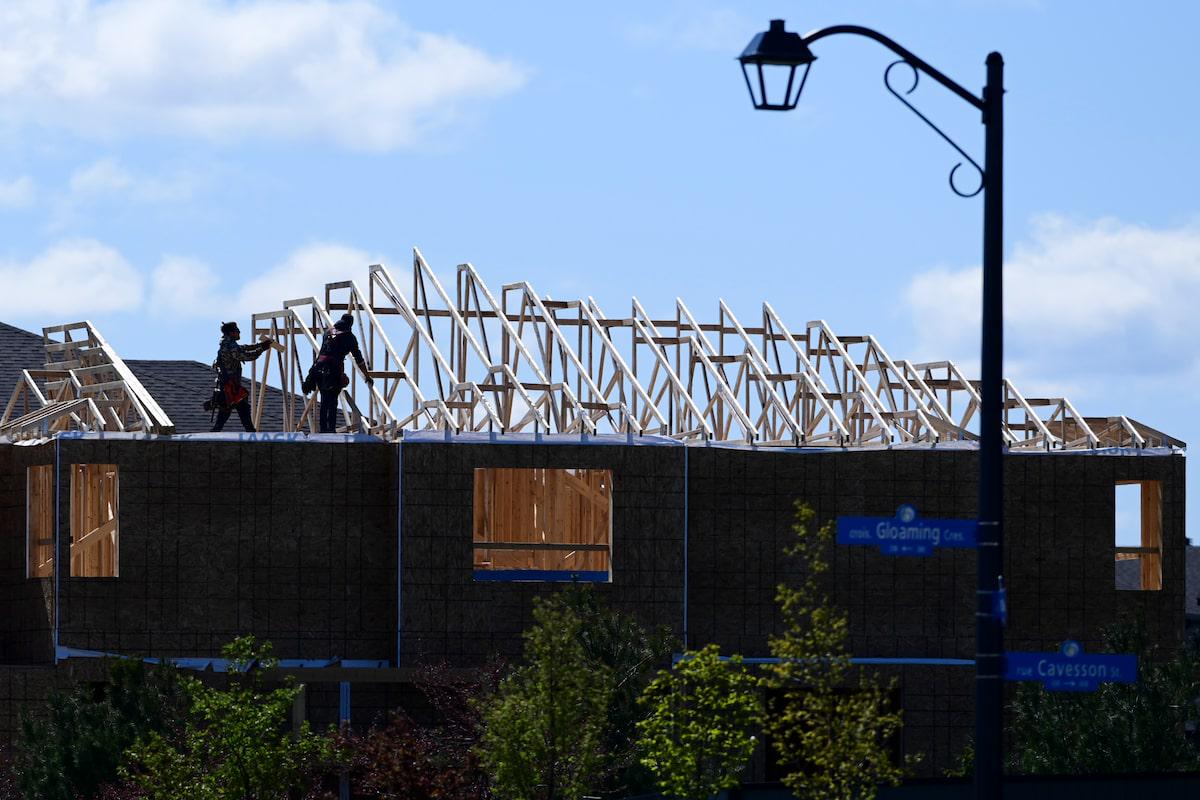
SS: A preliminary analysis by Mike Moffatt on the federal government's recent agreement with Ontario to slash development charges. While tax rebates and lower development charges could lower home prices by 15 and 20%, it is still not enough as both the recent slash to the HST and development charges are time-limited. Yet they will provide the government with time to, hopefully, implement other changes that will tackle the housing crisis.
Recent federal-Ontario agreements to provide tax rebates and lower development charges will temporarily cut the cost of building a new home by between 15 and 20 per cent, filtering savings down to homebuyers.
Previously, unlike resale homes, all new houses were subject to HST, which tacked 13 per cent onto the cost. But the new agreement, struck in March, provides a full HST rebate on newly built homes under $1-million and a partial one for homes above that value.
This move alone will lower the cost of Ontario homes priced under $1-million by roughly 10 per cent. It is, however, time-limited, since it only applies to those sold between April, 2026, and March, 2027.
The impact of lowering the development charges is more difficult to estimate. The agreement doesn’t specify the conditions for the reductions, only that the charges might be cut by as much as 50 per cent in some cases. This could still result in substantial savings, however, since development charges in Ontario can add as much as $200,000 on a home.
Unlike the HST, development charges are not assessed based on the value of the house, but rather on the type of housing and the location. This can be particularly harmful to young couples looking for a starter home, which could be subject to the same amount of tax as a luxury home.
Let’s consider a new, simple, entry-level townhome in Oshawa, Ont. Currently, development charges of $100,000 are embedded into the cost of a home like this, which may otherwise cost a builder $500,000 in land, labour, materials, permits and financing costs.
After a minimal viable profit margin of 10 per cent, for example, the lowest pretax price the developer could sell the unit for is $660,000. Add in HST and land-transfer taxes, subtract the old rebates, and the final price jumps to $730,000.
However, a 50-per-cent reduction in development charges lowers the cost of building the home by $50,000, and a full HST rebate brings the final price, including land-transfer tax, down to a little more than $610,000. That makes for a 16-per-cent reduction in price, saving the homebuyer nearly $120,000 in taxes. It is worth noting, however, that the buyer still pays nearly $60,000 in development charges and land-transfer taxes.
There are some important caveats. The first is that we do not know if this home will qualify for a full 50-per-cent reduction in development charges. Those details have not been announced, nor do we know when that change will take effect – what we do know is the reductions will be in place for three years.
The second and most important caveat is the assumption that the seller of the home will pass the savings along to homebuyers. After all, if a builder could sell a home for $730,000, why would they choose to accept less?
One answer is competition. If one builder reduces their prices, others will have little choice but to follow, otherwise they will lose sales. But more importantly, builders can’t currently sell those homes for $730,000. There’s simply no market for them at that price, which explains the 81-per-cent decline in new and preconstruction home sales in the Greater Toronto Area.
Housing is unusual in that, unlike most new goods and services, the biggest competition comes from the resale market. And with resale prices having fallen, there are too many such units of comparable quality in the $650,000 price range in Oshawa. And unlike a new home, buyers do not have to pay HST on a resale home, though they are required to pay the land-transfer tax.
Ultimately, the resale market will ensure builders pass most, if not all, of the tax savings along to homebuyers. And now that new homes can be sold at prices that make them viable to build, more homes will be built, adding further downward pressure on resale prices.
These two moves do not solve the middle-class housing crisis, but they do go a long way in creating enhanced affordability, albeit temporarily. Even a $605,000 townhome is well out of reach for many young, middle-class families, so governments must do more to bring down the cost of building new homes.
Both the enhanced HST housing rebate and the development charge reductions are not the kind of wholesale reform the system needs; they are temporary fixes that expire in one and three years, respectively.
They do, however, give governments time to implement much-needed changes to our housing-tax system to make it more efficient and equitable.
Posted by IHateTrains123
2 Comments
> Previously, unlike resale homes, all new houses were subject to HST, which tacked 13 per cent onto the cost. But the new agreement, struck in March, provides a full HST rebate on newly built homes under $1-million and a partial one for homes above that value.
If you told me there was a tax even stupider than tariffs and export taxes, I wouldn’t have believed you. The idea of literally, directly taxing new housing construction wouldn’t have even entered my mind.
I’m sorry Ontario, I was not familiar with your game.
!ping Can&YIMBY