
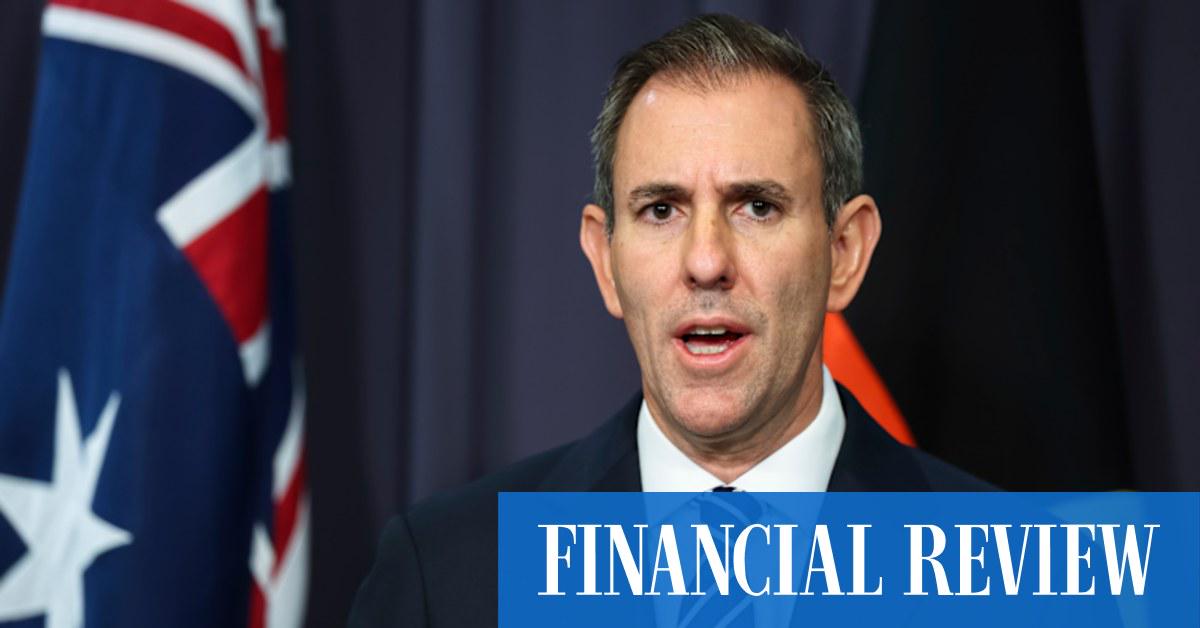
The International Monetary Fund has urged the Albanese government to avoid untargeted cost-of-living relief measures that fuel inflation, as it warned a prolonged closure of the Strait of Hormuz could plunge the global economy into its third recession this century.
The warning, issued in the IMF’s new global economic report, came as Treasurer Jim Chalmers flew out to Washington for talks with US Treasury Secretary Scott Bessent and other finance ministers at the Group of 20 and IMF meetings.
The treasurer said the talks would help him calibrate the May budget with the severe global economic upheaval, as new data showed consumer and business confidence are at near-historic lows.
“The IMF’s World Economic Outlook shows it’s a dangerous moment for the global economy,” Chalmers said. “The world is expecting slower growth, higher inflation, and extreme volatility arising out of the conflict in the Middle East, and we are, too.”
Reserve Bank of Australia deputy governor Andrew Hauser, speaking in New York on Tuesday morning, said Australians would suffer a big income shock from the oil price spike triggered by the Iran war.
“[It] is the central banker’s nightmare … inflation up, activity down,” he said.
The IMF warned governments to resist a spending splurge that would make it harder for central banks to combat inflation. “Avoiding fiscal stimulus is also critical when inflation is rising, so as not to complicate central banks’ task,” the report said.
In a scenario of severe shocks to energy and oil prices – which would see the price of oil average at $US110 and $US125 a barrel in 2026 and 2027 – the IMF said global economic growth would be slashed by 1.3 percentage points this year to 2 per cent, the threshold for a global economic recession.
“Despite the recent news of a temporary ceasefire, some damage is already done, and the downside risks remain elevated,” the fund cautioned.
The price of Brent crude – the international oil benchmark – has been fluctuating at about $US100 a barrel for the past week on news of a potential diplomatic solution to the conflict, but remains well above its pre-war levels of $US70 a barrel.
Leading economists have warned that high oil prices have left Australia facing the risk of stagflation – a combination of high inflation and low economic growth.
Inflation is expected to reach into the fives or even the sixes by the middle of the year, well above the Reserve Bank’s target band of 2 per cent to 3 per cent. It was 3.7 per cent in February.
Chalmers warned about budget’s impact on inflation
The IMF cautioned against untargeted cost-of-living relief, such as the Albanese government’s recent decision to halve the fuel excise to 26.3¢ a litre, which will cost it $2.55 billion in forgone revenue.
It said that while such policies were popular, they were “poorly designed and costly” and could contribute to further inflation.
“Preserving price signals is important: high prices signal scarcity, encouraging demand restraint and supply expansion. Price controls … cannot change that fact,” the IMF said.
“Worse, such measures often backfire by raising underlying prices, leading to rationing.”
The IMF said this was particularly important for governments with elevated budget deficits and rising public debt. Australian gross debt is set to pass $1 trillion later this year, and the budget is forecast to remain in deficit for a decade.
HSBC chief economist Paul Bloxham said the government should continue to pursue an ambitious reform budget, and agreed that doling out further cost-of-living relief would make the RBA’s job harder.
“On the other hand, a continued focus on supply side reform in the budget could help to deal with the high inflation challenge and improve the economy’s growth prospects,” he said.
Inflation and higher commodity prices will leave the budget bottom line $30 billion better off between now and 2028-29, according to independent economist Chris Richardson, who has urged the government not to spend the windfall on more cost-of-living support that could push inflation higher.
RBA will raise rates again if inflation marches higher
RBA deputy governor Hauser said Australia was left vulnerable to the effects of the Middle East war because it is the biggest consumer of diesel in the world on a per-person basis, reflecting the widespread use of the fuel in farming and mining.
“This is a big, real income shock for Australia, even if national income and the fiscal coffers may benefit from that net export position,” Hauser said.
Hauser would not be drawn on the contribution of government spending, which is at a near 40-year high, excluding the pandemic, to domestic inflationary pressures. But he said, “fiscal policy has already responded a little in Australia, and they may respond more” to the economic fallout from the war.
Hauser said how the war will affect economic growth in the coming months – and what that will do to inflation over the medium term – is the “big question” facing the RBA.
He said the central bank would continue to raise rates if it assesses the risk of high inflation to be more important than the hit to economic growth.
“[Inflation risks] might still be on the upside [in the medium term], in which case we’re going to have to respond. But we do also need to take account of the possibility that activity slows.”
The RBA raised rates at its meetings in February and March this year due to the resurgence of inflation in Australia.
Economists widely expect the central bank to raise interest rates by another 0.25 percentage points in May, taking the official cash rate from 4.1 per cent to 4.35 per cent.
Consumer, business confidence near historic lows
The RBA deputy governor said it was obvious that inflation would rise in the short term and warned that the economy was still pushing past its capacity constraints.
Household consumption and business investment would need to cool down to help tame inflation, Hauser said.
“We did need, and do need, private sector demand to slow a little, given the supply capacity of the economy … but we’ll need to watch closely as we see the effect of the oil price shock work through.”
Household consumption was “not spectacular, but … certainly not in recessionary territory”, according to Hauser, who said the RBA would be closely monitoring how it evolves given that consumer confidence has fallen “very, very sharply”.
New data released on Tuesday showed the Westpac-Melbourne Institute consumer sentiment index fell 12.5 per cent in April, recording its biggest monthly fall since the pandemic. Job loss fears are also at their highest level in a decade, excluding the pandemic.
“A sharp deterioration in expectations suggests consumers are bracing for a return to the extended period of weakness seen during the 2022-24 inflation fight,” said Westpac head of macro forecasting Matthew Hassan.
The index is “near historical lows” but above the “extreme” levels recorded during the pandemic and the recessions in the 1980s and 1990s, Hassan said.
NAB’s business survey, also released on Tuesday, showed business confidence in March recorded the second-largest monthly fall in the survey’s history.
Posted by RTSBasebuilder
1 Comment
As proof, here’s the **World Economic Outlook:**
[LIVE: International Monetary Fund releases World Economic Outlook](https://www.youtube.com/watch?v=nzyyLIvt_jE)