
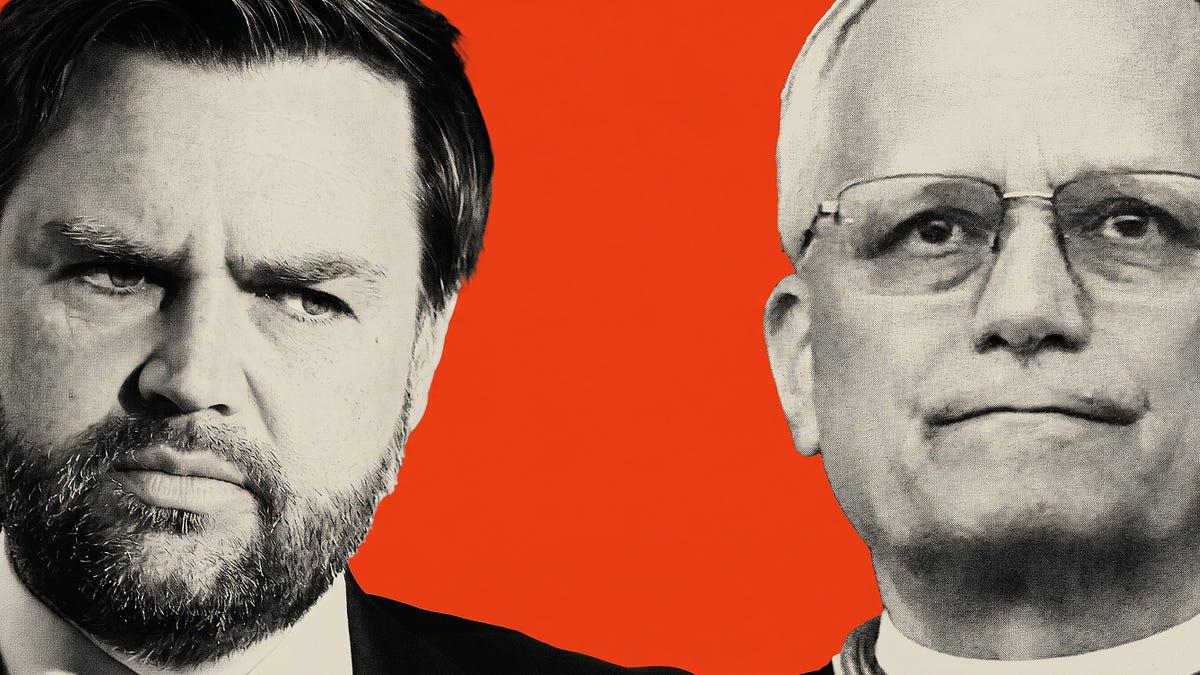
Bishop James Massa issued a statement [yesterday] defending Leo XIV's authority as the Vicar of Christ — hours after Vance told a Turning Point USA crowd the pope should “be careful” with theology.
After Vice President JD Vance questioned Pope Leo XIV’s fidelity to the Church’s just war tradition, the United States Conference of Catholic Bishops has responded.
[Yesterday], Bishop James Massa, chairman of the USCCB Committee on Doctrine and a longtime moral theologian who has taught at Saint Joseph’s Seminary in New York, issued a statement affirming Pope Leo XIV’s teaching on war and peace.
The statement arrived hours after Vance told a Turning Point USA audience at the University of Georgia that the pope should “be careful when he talks about matters of theology.”
The statement does not mention the vice president by name. But the timing and the substance speak for themselves.
“For over a thousand years, the Catholic Church has taught just war theory,” Massa wrote, “and it is that long tradition the Holy Father carefully references in his comments on war.” Massa cited the Catechism of the Catholic Church directly: a nation can only legitimately take up the sword “in self-defense, once all peace efforts have failed.”
Massa continued: “When Pope Leo XIV speaks as supreme pastor of the universal Church, he is not merely offering opinions on theology. He is preaching the Gospel and exercising his ministry as the Vicar of Christ.”
With those two sentences, the U.S. bishops gently but unmistakably placed the Church’s teaching authority alongside Pope Leo XIV.
A Week That Built to This
To understand why the bishops spoke, you have to walk back through the past seven days.
Last week, six independent reports confirmed what I had described as a belligerent meeting: a Department of Defense delegation met with the Vatican at the Pentagon in what was widely read as an attempt to lobby the Holy See over U.S. policy toward Iran and elsewhere.
On Saturday, Pope Leo XIV denounced the “delusion of omnipotence” that drives modern war.
On Sunday, three of Leo’s most senior American cardinals appeared on 60 Minutes to stand with the pope and to ask the country to rise above the cruelty of the current moment.
Within an hour, the president of the United States answered them. Donald Trump declared that if he were not in the White House, “Leo wouldn’t be in the Vatican,” and posted an AI-generated image of himself as Jesus that he later deleted.
On Monday, Pope Leo XIV, unshaken, responded from Rome with three words: “I am not afraid.”
Then came JD Vance.
On Monday night, Vance went on Fox News’s Special Report and told Bret Baier that “it would be best for the Vatican to stick to matters of morality” and let the president of the United States “stick to dictating American public policy.” I reported on that appearance yesterday.
Last night at the University of Georgia, Vance invoked “a 1,000-year tradition of just war theory” and suggested the pope’s words were out of step with that tradition. He told the crowd Pope Leo should “be careful” when talking theology.
Vance’s pressure on the pope did not arrive in a vacuum. It came after the Pentagon’s visit, after the president’s taunts, after the cardinals’ television plea, and after two full weeks of escalating language between the White House and the Vatican over Iran.
It was the eight blow against the pope from the administration in three days — and the first to reach for a theological justification.
Massa’s statement today revisits the same thousand-year tradition Vance claimed, and draws a different conclusion. Just war doctrine, Massa wrote, requires that force be defensive and that “all peace efforts” be exhausted first. That, he suggests, is precisely what Pope Leo has been saying.
Why the Bishops Spoke
The chair of the Committee on Doctrine does not issue statements lightly. His role is precisely what it sounds like: clarifying what is and is not Catholic teaching. When he speaks, it speaks with an institutional weight the U.S. Church reserves for moments when a point of doctrine needs to be named clearly.
That is what happened today. The committee chairman reminded American Catholics of something foundational: when the pope teaches on matters of faith and morals, he is doing more than sharing a personal view. He is carrying out his ministry as the Vicar of Christ.
Just war theory is not a private political opinion that Leo XIV is free to set aside when the vice president tells him to. It is the settled moral tradition of the Catholic Church, and Leo is teaching it.
That is the quiet force of Massa’s statement. The Committee on Doctrine did not quarrel with Vance. It did something stronger. It took his central claim — that he, a seven-year-old Catholic convert, understood the just war tradition better than the successor of Peter — and it gently returned the tradition to its rightful custodians.
The pope, Massa wrote, is not offering opinions. He is teaching the Gospel.
There is a pattern worth naming in how this week unfolded. Every time the administration has raised the temperature, a voice in the American Church has answered.
The news of the Pentagon’s visit was met by Cardinal McElroy and two of his brother cardinals on 60 Minutes. The president’s mockery of the pope was met by the pope himself, with three calm words: “I’m not afraid.” And now Vance’s theology lecture has been met with a response from the chairman of the Committee on Doctrine, the single body in the American hierarchy whose job is to clarify what Catholicism actually teaches.
This is what a Church finding its footing looks like. It is not loud. It is not furious. It is patient, deliberate, and clear. It says: the pope teaches the faith. Anyone who suggests otherwise is outside the tradition he claims to defend.
It has been a heavy week. It is likely to grow heavier before it is over. The Iran question is not resolved. The president is not chastened. The vice president is not done talking.
But for the first time, the U.S. bishops have stepped out of the background and placed themselves, in the plainest institutional language they have, alongside the pope.
Posted by IHateTrains123
3 Comments
I don’t get this play by the admin. I know during Francis’s papacy there were American bishops critical of him and speaking out but would they ever have taken the side of the government over him?
Like do they expect Catholics to not support the pope?
He’s going to get himself excommunicated, the meme will become reality
Malarkey level of JD Vance leading an American schism?