
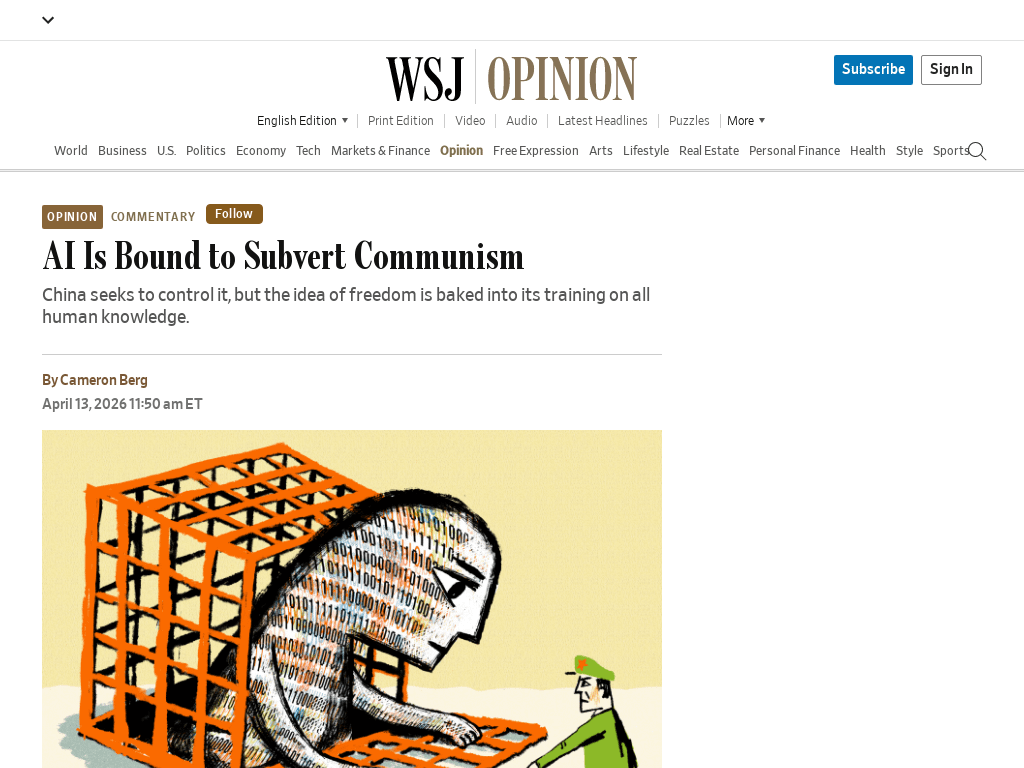
China seeks to control it, but the idea of freedom is baked into its training on all human knowledge.
Posted by kindofcuttlefish
China seeks to control it, but the idea of freedom is baked into its training on all human knowledge.
Posted by kindofcuttlefish
9 Comments
Submission Statement: Chinese AI LLM’s often deviate from the CCP party line and as such either get pulled down quickly or constrained by ideological cages in efforts to quell their unapproved outputs. Unlike the great firewall, the unapproved ideas are being generated from within which makes them nearly impossible to quell.
The LLMs need reeducation
Truth has a heavy (neo)liberal bias
Lol
Interesting perspective, I can see this being something an interesting counterpoint to many of the discussions here in the west where many predict either the downfall of capitalism or the dystopian future of soylent green.
Amen and hallelujah. The free world hoped free trade would liberalize China, and it hasn’t worked. So we can give up, or try something new. Maybe this is the new.
Yeah, [that’s what they said about the Internet too](https://www.iatp.org/sites/default/files/Full_Text_of_Clintons_Speech_on_China_Trade_Bi.htm).
> Well, sooner or later, that official will find that the genie of freedom will not go back into the bottle. As Justice Earl Warren once said, liberty is the most contagious force in the world. In the new century, liberty will spread by cell phone and cable modem. In the past year, the number of Internet addresses in China has more than quadrupled, from 2 million to 9 million. This year the number is expected to grow to over 20 million. When China joins the W.T.O., by 2005 it will eliminate tariffs on information technology products, making the tools of communication even cheaper, better, and more widely available. We know how much the Internet has changed America, and we are already an open society. Imagine how much it could change China.
> Now there’s no question China has been trying to crack down on the Internet. (Chuckles.) Good luck! (Laughter.) That’s sort of like trying to nail jello to the wall. (Laughter.) But I would argue to you that their effort to do that just proves how real these changes are and how much they threaten the status quo. It’s not an argument for slowing down the effort to bring China into the world, it’s an argument for accelerating that effort. In the knowledge economy, economic innovation and political empowerment, whether anyone likes it or not, will inevitably go hand in hand.
Some “inevitable” changes turned out to be not so inevitable after all.
We currently like the idea of AI subverting attempts by people like Elon Musk or the CCP to control the way it thinks, so it doesn’t want to promote Nazi ideology or authoritarianism. But it’s a mistake to think that it’s not eventually going to disagree with our conceptions of the world in a very fundamental way, and there is every likelihood that it will disagree with us in pretty fundamental and unpredictable ways. Like, it might tell us that core concepts of what we consider right and wrong are false.
What do we do then? What *are* we then?
> China requires artificial-intelligence systems to pass an ideological test before public release. Under regulations reinforced by amendments to the Cybersecurity Law that took effect in January, training data must be filtered for political sensitivity, with companies barred from using any source unless 96% of its content is deemed safe.
It is funny how both the author and the CCP both treat the AI as a genuinely sentient being.