
The Chinese government is pressuring Spain to help thwart European Union proposals aimed at making the bloc’s companies more competitive, according to a person familiar with the matter.
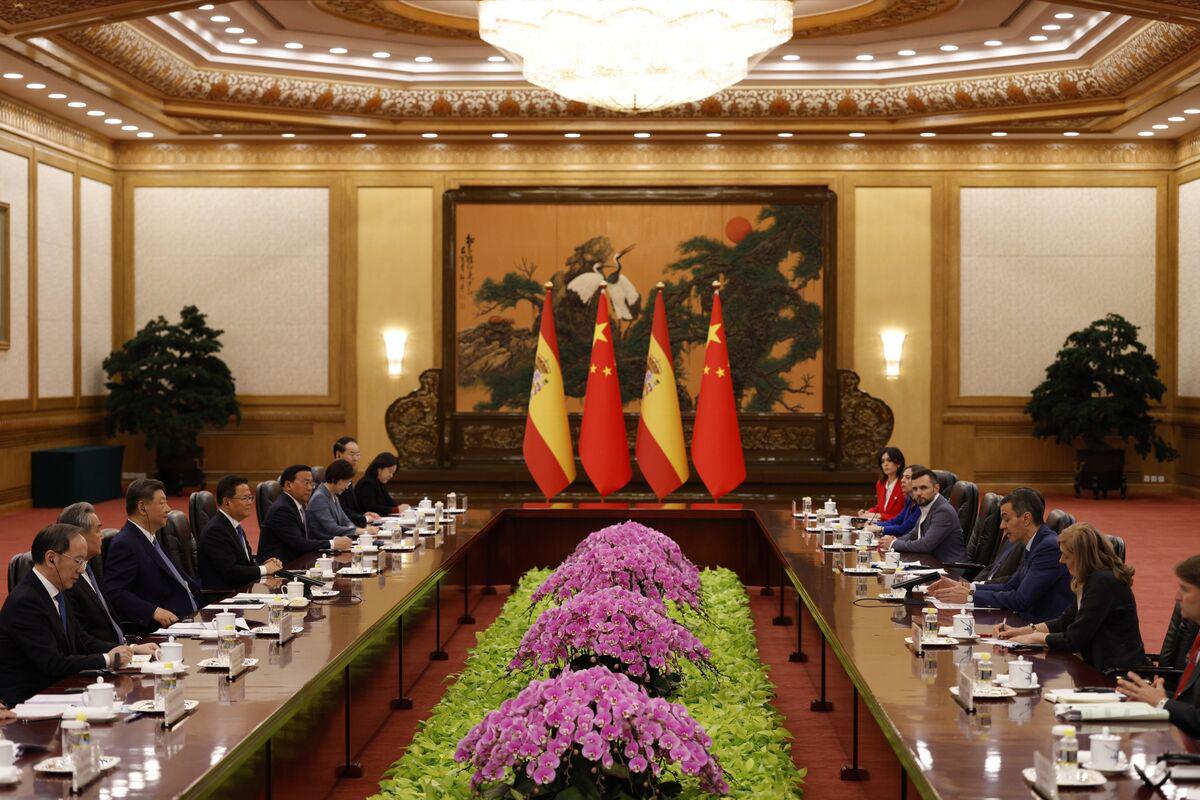
Spanish Prime Minister Pedro Sánchez met with President Xi Jinping in Beijing this week, when Chinese officials complained that Europe was becoming too protectionist, said the person, who spoke on the condition of anonymity. The officials warned that the EU’s policies would harm trade and political ties between the regions.
The EU is struggling to remain competitive after the US launched a trade war with the bloc last year and as China floods the EU’s single market with low-cost goods. The European Commission, the EU’s executive arm, has proposed measures to bolster domestic companies in an attempt to revitalize domestic manufacturing.
Last month, the commission announced the so-called Industrial Accelerator Act, dubbed the “Made in Europe” proposal, which will mandate that EU nations have to favor domestic companies in public procurement contracts. The goal is to ensure that a fifth of the bloc’s economic output comes from manufacturing by 2035.
Spokespeople from the Chinese foreign ministry and Spanish government didn’t immediately respond to requests for comment.
Spain has for years positioned itself close to China, aiming to attract investment and diversify alliances amid competition between the US and the Asian nation. That strategy has at times come into conflict with the EU, which has been seeking to de-risk from China and reduce over-dependence in critical sectors.
The push comes as China is losing one of its closest EU partners, Prime Minister Viktor Orban, whose party lost a parliamentary election on Sunday. Orban had ushered in close economic ties with Beijing, with China becoming a key partner for Budapest in the electric vehicle industry as well as in telecommunications.
Sánchez said that the EU’s trade deficit with China was “unsustainable” and that China played a role in the protectionist measures the bloc is working on.
“We need China to open up so that Europe doesn’t have to close itself,” Sánchez said Monday in a speech at Tsinghua University. “Help us correct the current trade deficit we have with you.”
China has been critical of the EU’s Industrial Accelerator Act. Last month, China’s Commerce Ministry expressed “serious concerns,” saying the plan would increase uncertainty for Chinese companies investing in the EU, according to a statement.
The plan is central to the EU’s efforts to step up support for strategic industries, from cars to green steel, as it seeks to stem a wave of plant closures that risk weakening the region in its rivalry with China and the US.
Speaking last week in Madrid, European Commission Vice President Stéphane Séjourné said “Chinese investment in Europe and Spain can be compatible with rebalancing trade.”
“It is possible to use the trade relationship to gain new technologies and the transfer of knowledge and capacity for economic growth in Europe,” he said. “That path is narrow but it can be pursued.”
— With assistance from Jing Li
Posted by moldovaman99
3 Comments
**Submission statement:**
Well, well, well, 🤔 🤨 is there a possibility that China is not Europe’s future wholesome big chungus ally? This article highlights that that the Chinese government does not want the EU to implement certain protectionist measures that China itself has been implementing for decades.
So either Xi has received the light of capitalism and unhesitatingly recited the wealth of nations by Adam Smith, or he is a filthy hypocrite. Please discuss which possibility is more likely.
Is it just me or did nobody used to talk about trade deficits as a particularly bad thing (or basically at all) until Trump predicated the tariffs on them?
Am I just getting Baader-Meinhof’d?
Given that even Spain, one of the EU member-states closest to China, has criticized the protectionism-fueled trade deficit, it’s likely the Industrial Accelerator Act will go through mostly unchanged compared to the current version, though there could always be surprises from both Spain and other member-states Beijing is likely courting from behind the scenes.
Another sign that China considers these EU shifts important is that [it has implemented two new regulations preventing foreign states from conducting due diligence and gathering intelligence on Chinese supply chains through the likes of the recent Foreign Subsidy Regulation,](https://www.morganlewis.com/pubs/2026/04/china-issues-new-regulations-on-countering-foreign-extraterritorial-jurisdiction-what-mncs-need-to-know) to ascertain how Chinese SOEs reach the European market. Obviously, these are intended to complicate operations for non-European blocs as well, but the timing of China’s internal discussion on how to counter the IAA, combined with investigations on the likes of CRRC’s rail tenders in Bulgaria and Portugal, that into Chinese BEVs, or wind turbine producers, no doubt backed with many details not given by the Chinese companies themselves, is uncanny.
But legislation like the Anti‑Coercion Instrument (ACI), International Procurement Instrument (IPI), Carbon Border Adjustment Mechanism (CBAM), Critical Raw Materials Act (CRMA), Net‑Zero Industry Act (NZIA), European Chips Act and several others, are also present to both blunt and eventually reverse this mercantilist process, both during negotiations on the very instruments used to achieve these goals, and after they’re adopted. Are these protectionist measures? Absolutely, but the EU isn’t willing to die on the hill of morality and subject its political and industrial whims to an authoritarian power that isn’t reciprocating.
It also remains the world’s most open to trade major bloc, with things like Global Gateway, numerous FTAs with trusted partners, critical raw materials strategic partnerships, the Trade and Technology Council (TTC) with the United States, Investment facilitation agreements (IFAs), Horizon Europe international cooperation and other joint initiatives around the world.