
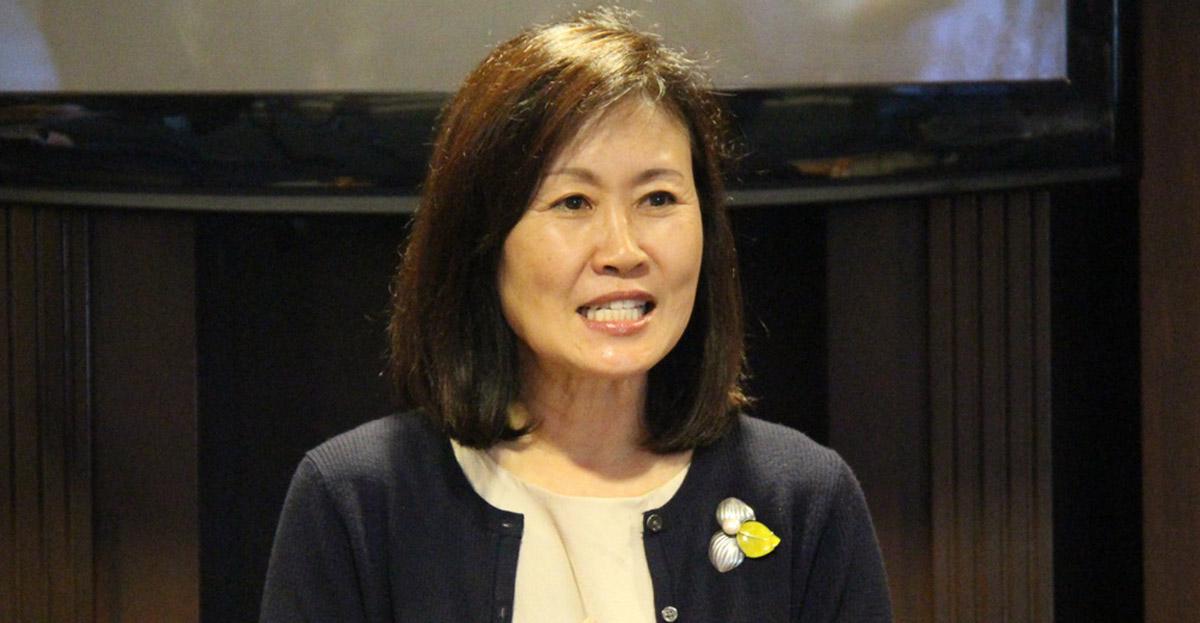
After U.S. President Donald Trump nominated former U.S. Representative Michelle Park Steel as the first U.S. ambassador to South Korea in his second administration, professors and foreign policy and security groups issued statements criticizing the move.
The concern is that Steel, who has raised North Korean human rights issues and positioned herself as a hardline conservative on China, could align with some far-right groups within South Korea.
Within the pro-government camp, the Rebuilding Korea Party called for a cautious approach to granting agrément (approval of a diplomatic envoy).
As President Trump nominated Steel, a Republican, as “Ambassador Extraordinary and Plenipotentiary of the United States to the Republic of Korea” and requested Senate confirmation, the South Korean government responded with a general statement on the 14th.
A presidential office official said, “If she is formally appointed, we expect her to contribute to strengthening Korea–U.S. relations and promoting friendship between the peoples of both countries.”
The presidential office, which values close communication with the United States, holds the position that restoring ambassador-level diplomatic channels is necessary.
The U.S. ambassador position in South Korea has been vacant for over a year since former Ambassador Philip Goldberg, appointed under the Biden administration, stepped down last year.
Although delayed, the appointment of a successor would provide an opportunity to make up for that gap.
However, contrary to such expectations, some political circles and expert groups responded negatively to Steel’s nomination.
The Social Transformation Knowledge Network, a nationwide association of professors and researchers, along with the foreign policy think tanks Diplomacy Square and Forum Knowledge Empathy, immediately issued a statement calling for the withdrawal of her nomination.
Two days after the news broke in the United States, on the 16th, these groups released a joint statement.
They raised concerns, saying, “As a Republican politician who grew within a conservative political base in the United States rather than a career diplomat, she has reflected specific ideological and strategic interests more strongly than diplomatic neutrality and mediation capability.”
Steel, as a second-generation displaced Korean, is a figure with a strong conservative orientation, known for her firm stance on North Korean human rights and China.
Pointing this out, the three groups added, “Her political stance and actions carry the possibility of resonating with extreme political forces within South Korean society,” and anticipated further controversy.
In other words, they argue that the new U.S. ambassador could find common ground with domestic election fraud conspiracy theorists or groups advocating strong anti-North Korea and anti-China positions.
The groups warned that “this carries the risk of deepening internal divisions within Korean society.”
They also emphasized, “The symbolic aspect of her being ‘Korean American’ must not serve as a shield to obscure these concerns.”
In fact, after Steel’s nomination was announced, conservative YouTube channels responded with enthusiasm, posting content such as “A hardline conservative is coming—are progressives on high alert?” and “Michelle Park Steel, who enabled the U.S. screening of ‘The Birth of Korea War’.”
Even far-right YouTuber Jeon Han-gil, currently facing a court hearing on an arrest warrant, welcomed the nomination, claiming that Steel is “just like us,” while chanting slogans such as “Stop election fraud” and “Chinese Communist Party, get out.”
Within the pro-government Rebuilding Korea Party, there is also a cautious atmosphere.
Kim Jun-hyung, a lawmaker from the party and former head of the Korea National Diplomatic Academy, argued at the National Assembly’s Foreign Affairs and Unification Committee on the 15th that Steel had previously denied South Korea’s identity and insulted its head of state.
He questioned, “Why did we issue a welcoming statement so quickly without addressing these issues? We cannot simply grant agrément.”
Noh Kyu-duk, a professor at Halla University and former Foreign Ministry spokesperson and head of the Korean Peninsula Peace Negotiation Division under the Moon Jae-in administration, also predicted significant repercussions in a radio interview on MBC that same day.
He said, “As a second-generation displaced Korean, Steel has taken hardline positions on China and North Korea,” and added, “It is only natural to be concerned about what impact those activities may have when she comes as ambassador to South Korea.”
Posted by Freewhale98
1 Comment
1. Summary
2. Trump’s nomination of Michelle Steel as U.S. ambassador to South Korea has sparked criticism from academics and political groups, who worry her strong conservative stance could align with domestic far-right forces and deepen political divisions, while the government and some politicians urge caution despite the need to restore diplomatic channels.
3. How is this related to the sub
(1) Globalization of Far-right: Donald Trump appoints a MAGA politician who promotes “election fraud” conspiracy theory as US ambassador to Korea, raising the fear of American meddling on Korean domestic politics. This represents American eagerness to export their new MAGA ideology.