
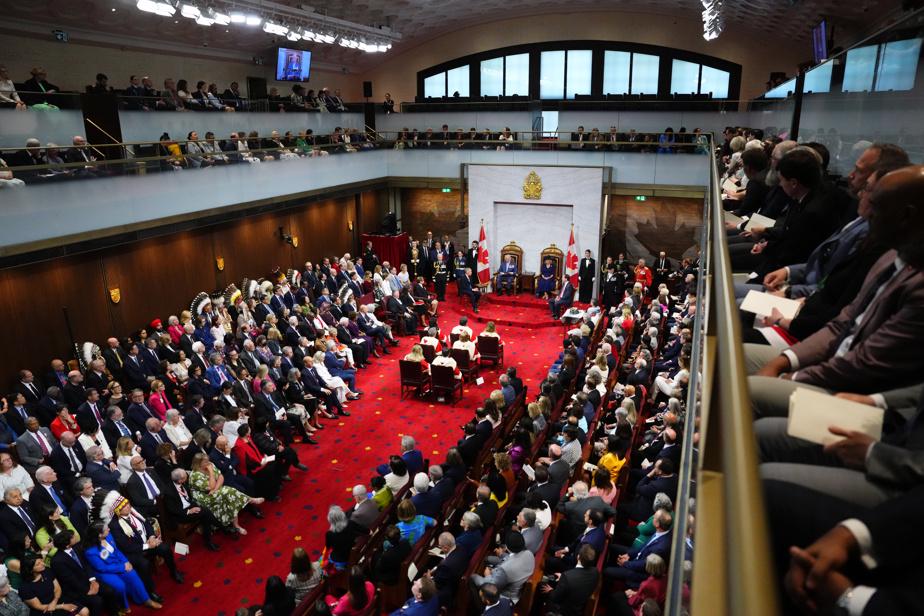
Mark Carney is toying with the idea of reinstating senators to the Liberal Party of Canada caucus. Now holding a majority in the House of Commons thanks to the arrival of five defectors and Monday's victory in the by-elections in three ridings, the prime minister now wants to have a free hand in the Senate.
La Presse has learned from several sources that Mr. Carney is consulting behind the scenes with members of the Liberal establishment, including former Prime Minister Jean Chrétien, and that a return of senators to the Liberal fold is in the cards.
Since coming to power, Mr. Carney has earned a reputation for governing at a fast pace. But the Senate could slow down its momentum, especially since we have seen, over the years, the formation of new groups of senators with diverse interests. The Senate has a say in the consideration and passage of government bills.
"The idea of bringing senators back into the Liberal caucus is an option on the table," confirmed a Liberal source familiar with the matter, who requested anonymity in order to speak more freely.
In an interview, former Liberal Senate leader Jim Cowan said the future of the upper chamber has been a topic of discussion among his former colleagues in recent weeks. He said former prime minister Justin Trudeau's decision to exclude senators from the Liberal caucus in January 2014 was never optimal in a two-chamber parliamentary system.
"To this day, I still can't explain the logic behind this decision. When I was a member of the national caucus as a senator, it made me a better legislator. I could discuss the flaws in the bills with government ministers during the weekly meetings of the Liberal caucus. We have lost that. And the Senate became less effective after that," Cowan said, reached from his home in Nova Scotia.
"I know that the Prime Minister wants to govern at a fast pace. The question is how the Senate can function most effectively. When I was in the Senate, there were half a dozen bills introduced by senators. Today, there are an average of about a hundred. It slows things down, too," said the former senator, who retired nine years ago.
Historical independence
One thing is certain, the majority of senators have been wondering for months what will happen to the Prime Minister of the institution that has gained historic independence in the last decade.
The government representative in the Senate, Pierre Moreau, did not want to comment. "The Government Representative in the Senate is focused on moving government bills through the upper chamber, ensuring they are considered in a timely manner. As for the composition of the Senate, it is the prerogative of the prime minister," his office said in an email to La Presse.
The same caution was required on the side of the facilitator of the Independent Senators Group (ISG), Lucie Moncion. This group, which has the largest number of senators with 41, has been the subject of several reports in recent weeks on possible desertions.
Media reports have reported that senators are considering creating another Senate group that would be more aligned with Mark Carney's Liberals.
"Speculation about divisions within the ISG ignores who we are and how we operate," Sen. Lucie Moncion said in a news release Thursday night.
The Prime Minister's Office has been quiet.
"The Prime Minister will announce his decision on the Senate in due course," said Carney's aide, Audrey Champoux.
The shock of 2014
In 2014, Justin Trudeau caused a commotion by expelling all 32 Liberal senators from his party's caucus.
Shortly after his election in 2015, Mr. Trudeau introduced a new appointment formula to restore this institution, whose mandate is to be Parliament's "second look," to its former glory.
He wanted senators to be truly independent, and senators took a liking to it. All of the senators we have spoken to say that they want to keep their current status.
"If Prime Minister Carney's goal is to make a Senate more agile and efficient by passing bills more quickly, I believe he can easily achieve those goals without necessarily creating a group of Liberal senators that will be integrated into the Liberal Party caucus," said Quebec Senator Clément Gignac.
He gave the example of a parallel study of bills in the Senate and the House of Commons, rather than in a "consecutive" way, which is generally the practice whereby members of Parliament vote first and senators second.
Today, there are 81 senators appointed by Mr. Trudeau in the Senate and eight vacancies. Seven more will be completed by the end of the year. It is therefore about fifteen senators that Mr. Carney could appoint in the coming months.
Currently, there are five groups in the Senate, and only Conservative Party senators attend caucus meetings with members of Parliament.
Autotranslated by Google, mistakes are my own.
Posted by IHateTrains123