
The European Commission has issued a loan agreement for Poland to borrow €43.7 billion (185.5 billion zloty) for defence spending under the European Union’s SAFE programme.
Poland is the largest recipient of the fund, and European Commission President Ursula von der Leyen, announcing the issuing of the agreement on Thursday, singled out the country as “an essential pillar of Europe’s security architecture”.
There have been some doubts over the implementation of the programme in Poland after opposition-aligned President Karol Nawrocki last month vetoed a government bill intended to facilitate receipt of the funds.
The government has insisted that it can obtain and disburse the funds even without the specific mechanism blocked by Nawrocki. On Friday, following talks with von der Leyen, Prime Minister Donald Tusk said both Poland and the EU still want Warsaw to receive the full amount.
“Poland is treated as the absolute most important element of [SAFE],” said Tusk, quoted by the Polish Press Agency (PAP). “Everyone will work with us to effectively and quickly spend all the funds at our disposal.”
The SAFE programme, which was announced last year, is providing around €150 billion in loans on preferential terms for defence spending. Nineteen of the EU’s 27 member states have applied for funds.
There had initially been hope that the loan agreements would be signed in March. That was then pushed back to April. But now it looks likely it will take place in May. The funds themselves must be spent by 2030.
On Thursday, European Commission spokesman Thomas Regnier announced that Brussels had sent the text of the agreements to the 18 member states whose spending plans have been approved. Hungary, which is currently in the process of changing government, is the one country still awaiting approval.
“Once each member state completes its national procedure, the commission will proceed immediately with the signing of the loan agreements,” said Regnier, quoted by PAP.
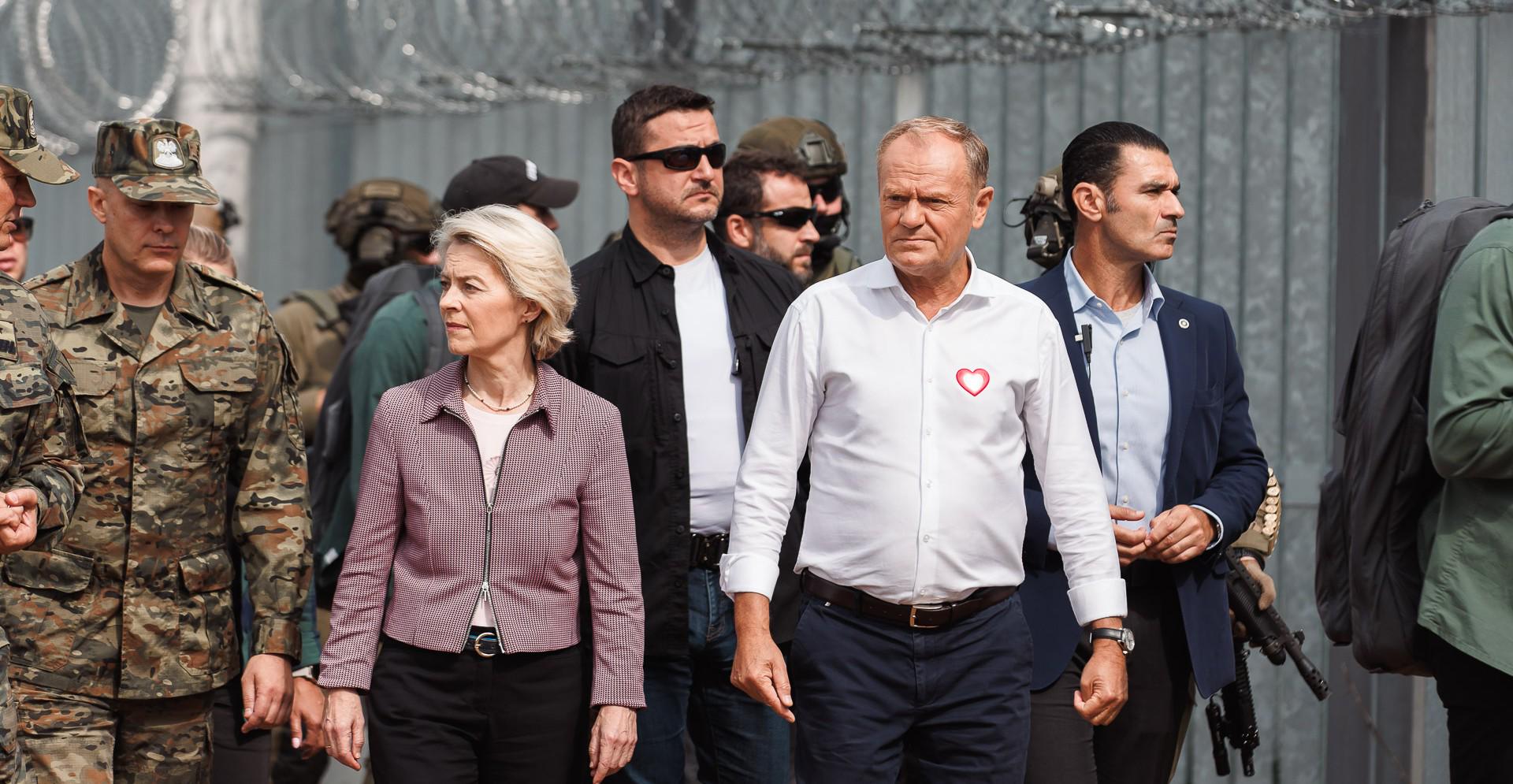
Meanwhile, von der Leyen shared a photo on social media of a meeting with Tusk and announced that Poland’s loan agreement had been issued. It was the only country among the 18 that she mentioned.
“Poland is an essential pillar of Europe’s security architecture,” she wrote. “You help keep our Eastern flank safe. This is why Poland is the biggest beneficiary of SAFE.”
However, SAFE had become embroiled in Poland’s domestic political disputes, with the right-wing opposition warning that it will saddle Poland for decades with debt on uncertain terms and will give the EU greater ability to interfere in national defence policy.
The government insists that the loans – which are equivalent to almost the entire annual defence budget – will significantly bolster security. It also says that almost 90% of the money will be spent domestically, providing a major boost to the defence industry.
In February, the government’s majority in parliament approved legislation that would have established a special mechanism for the National Development Bank (BGK) to receive and disburse the SAFE funds. However, Nawrocki, who has regularly clashed with the government, vetoed the bill.
Nawrocki instead proposed a “sovereign” alternative to SAFE that would involve using funds generated by the central bank. However, the government, as well as many experts, have dismissed the idea as unrealistic
The government has insisted that the funds can still be received and immediately launched a “plan B” that will instead likely see the money disbursed through the Armed Forces Support Fund, an existing instrument.
However, the government has also warned that, without the vetoed bill, the process will be more complicated and also that parts of the funds previously designated for non-military security spending may have to be reallocated.
Speaking in Brussels on Friday, Tusk said that Warsaw is working with the European Commission to establish a reliable mechanism for receiving the funds.
“There’s no question of rushing things. I want our decision to be treated as secure from the perspective of European procedures,” he said. “This requires, I would say, a slightly more flexible approach, and our partners in the commission understand this.”
Once Poland signs the agreement with the commission, it will immediately have access to a 15% advance payment from SAFE, which amounts to around €6.5 billion. It is then due to receive the next installment – of an amount yet to be specified – in the autumn.
Daniel Tilles is editor-in-chief of Notes from Poland. He has written on Polish affairs for a wide range of publications, including Foreign Policy, POLITICO Europe, EUobserver and Dziennik Gazeta Prawna.
Posted by BubsyFanboy
1 Comment
!ping POLAND&EUROPE
**1. Why is this relevant for** r/neoliberal **?**
This is relevant to Polish politics, the European Union and the economy.
**2. What do you think people should discuss about it?**
I think people should talk about the SAFE program, Poland’s internal back-and-forth on the funds, Poland’s current and future capabilities and the EU’s impact.
**2a. What do you think of the issue at hand?**
The far-right opposition only being minded for like 10% of the article is perfect.
Also, thanks, EU!