
From the Antarctic Treaty to the super entity. (The Ring) How the elites control governments, wars, and workers.
Posted by a_human-being
From the Antarctic Treaty to the super entity. (The Ring) How the elites control governments, wars, and workers.
Posted by a_human-being
4 Comments
SS:
Have you ever wondered how the hardest, most complex global problems seem to get solved with perfect cooperation, while everyday life remains a chaotic struggle?
To understand how modern power really works, you have to look at the link between the most remote continent on Earth and the most dense financial networks in human history.
At the height of the Cold War in 1959, the Antarctic Treaty was signed.
Today, 58 nations agree to its terms. It completely bans military activity and mining.
Why did ruthless global rivals suddenly agree to share an entire continent?
Because of predictability. Uncontrolled, lawless scrambles for resources are unpredictable. By “freezing” the hardest problems and putting the continent’s immense untapped raw commodities in “cold storage,” the global system ensured that no rogue nation could break away and gain an unmanaged advantage.
Admiral Richard E. Byrd, a renowned American naval officer and polar explorer, emphasized the vast, untapped natural resources of Antarctica during his multiple expeditions between 1928 and 1957.
We are taught that governments run the world and that global powers are constantly at each other’s throats. But if you look at the financial architecture beneath those governments, a different picture emerges.
Of the 58 nations signed to the Antarctic Treaty, all major decision-making powers belong to full members of the World Bank and IMF.
While we view war as a failure of this system, it is often just a brutal part of its life cycle. When member nations go to war, physical infrastructure is destroyed.
The “circle” doesn’t break; it shifts. The World Bank and IMF step in with multi-billion dollar reconstruction loans, and massive multinational corporations are awarded the contracts to rebuild.
So who owns these multinational corporations? This is where the web of corporate cross-ownership comes in.
In a landmark study by systems theorists at ETH Zurich, researchers analyzed over 43,000 transnational corporations. They untangled the web and discovered a “Super-Entity” of hyper-connected companies.
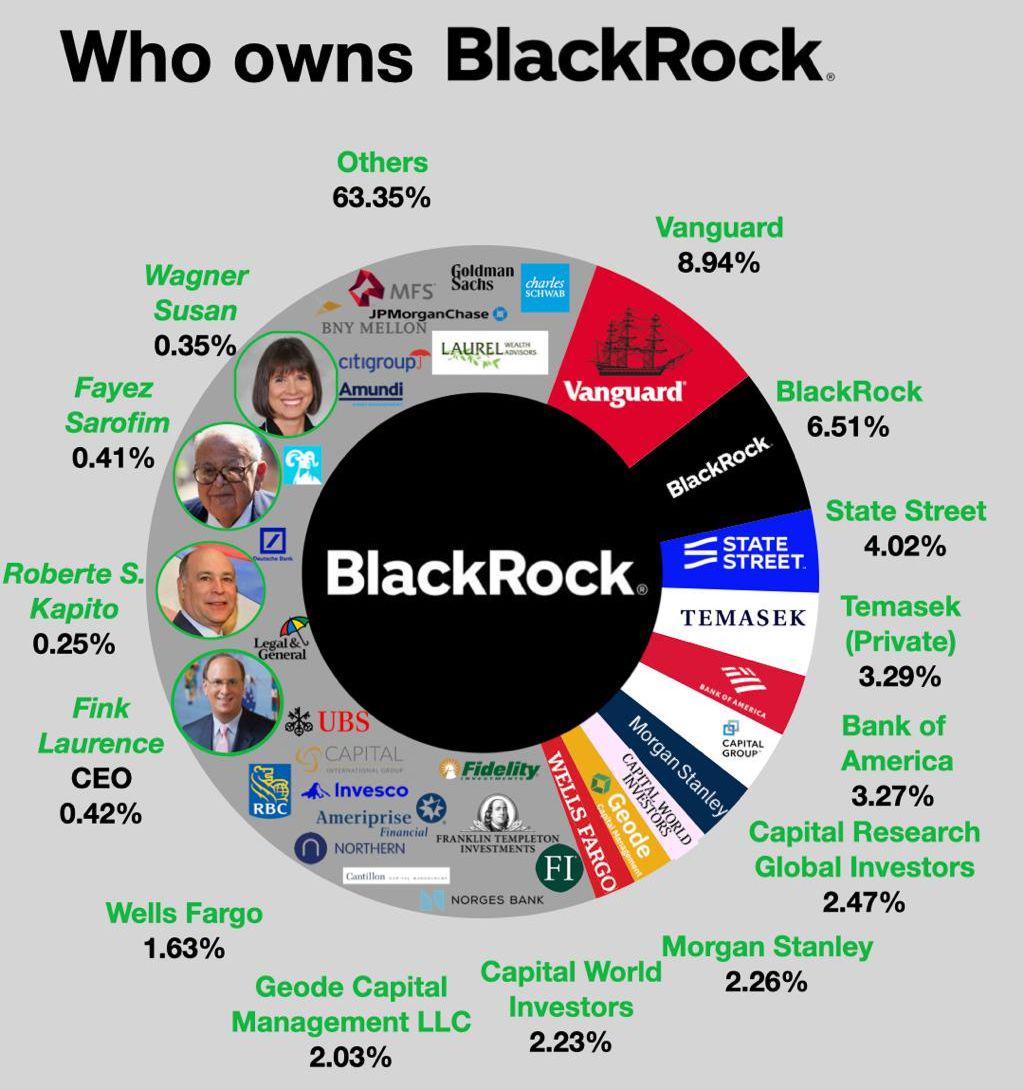
At the absolute center sat a core dominated by financial giants like Barclays, JPMorgan Chase, State Street, and Vanguard…
If you look at the data of these top firms, you will find a physical “ring” of ownership. Vanguard owns a massive chunk of BlackRock, BlackRock owns a chunk of State Street, and State Street owns a chunk of Vanguard and on and on.
This is not a conspiracy of a few people sitting in a dark room; it is a mathematical reality of modern capital called Common Ownership.
Because these massive asset managers simultaneously hold the top stakes in competing companies—owning the top shares of both Apple and Microsoft, or both ExxonMobil and Chevron, they have zero financial incentive to let those companies engage in brutal competition.
They prefer steady, predictable, system-wide stability.
From the ice of Antarctica to the boardroom of JPMorgan Chase, the system is designed to maintain a rigid, highly managed status quo. The “Ring” of cross-ownership ensures that global capital remains consolidated, while the World Bank and IMF framework keeps governments locked into the exact same financial rules.
We live in a world where complexity has been automated into a self-reinforcing loop of capital.
Power isn’t held by one villain, it is held by the Ring. The (Super-Entity).
These are the people that control governments, wars, laws and they do not care about you.
all these mentioned own each other
The graphic makes it look like Blockrock is actually Hell/Satan. Seems accurate.
thought experiment – if the common man can put his and his wifes life savings into blackrock/vanguard growth etfs and retire into upper middle class is this really a ring of evil as you put it?