
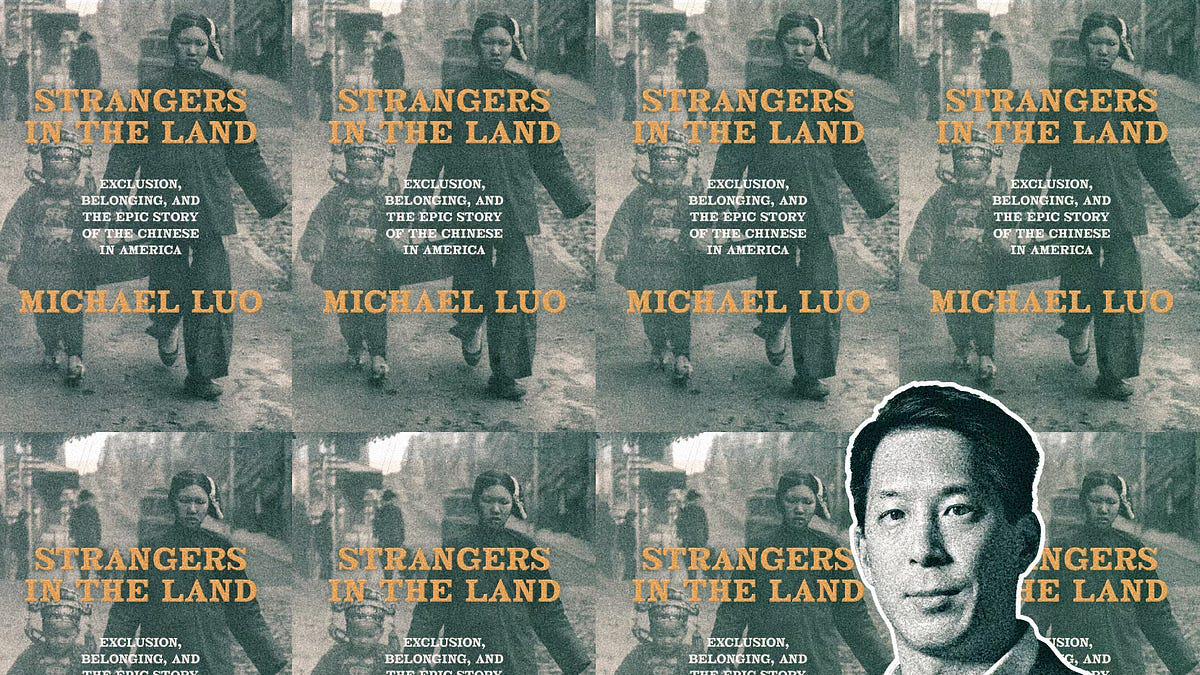
The text below is a section of a book review called Strangers in the Land: Exclusion, Belonging, and the Epic Story of the Chinese in America by Michael Luo. Sections relating to the history of Chinese American immigrants and Trump's historically illiterate are below.
Free Labor, Free Soil, and Political Fracture
Chinese immigration became the wedge that cracked the Republican Party’s postwar coalition. Its antislavery unity had been a northern unity which the tug of West and East unsettled. The antislavery coalition had joined two distinct causes we too easily conflate: “Free Labor” and “Free Soil.” The Free Labor movement’s antislavery sentiments were grounded in economic self-interest: independent farmers and tradesmen competing with free rather than enslaved workers. The Free Soilers, by contrast, opposed slavery on moral and religious grounds: their antislavery convictions were intertwined with the religious heritage of the Northeast, particularly Quakers, Congregationalists, and evangelicals. The Civil War, in Eric Foner’s account in The Fiery Trial, transformed Lincoln from a Free Labor abolitionist to a Free Soiler: the antislavery cause became a moral as well as an economic and political necessity.
But Chinese immigration pulled these two strands apart again. The Free Labor argument against slavery—opposition to unfair economic competition—was repurposed and deployed against Chinese workers. In Congress, some Republicans used claims that Chinese laborers were “coolies”—workers effectively enslaved by the men who contracted mining and railroad companies for their services—to try to square anti-immigrant policy with the party’s antislavery traditions.
Why did the case against Chinese migrants gain traction among labor advocates and within the Republican Party?
The answer lies at the intersection of demography and economics. The pursuit of free and fair economic competition spurred the Free Labor movement, the formation of the union movement at the end of the 19th century, and calls for restrictions on Chinese immigration. It also spurred on that very immigration itself, as Chinese men came to seek opportunities not available at home.
There weren’t many Chinese in America at the time, and they were almost exclusively located in the western states. Yet anti-immigrant sentiment in those states—along the coast and among inland laborers—made Chinese immigration a national question: California, Washington, and Oregon were swing states whose electoral votes and congressional seats both parties coveted. Chinese labor was cheap and Chinese men were viewed as unassimilable. So in the boom-bust cycles of the postbellum decades, popular sentiment turned against them. The Knights of Labor, the largest organization of the Reconstruction-era labor movement, excluded Chinese workers (even while allowing Black membership); its members took part in forcibly expelling Chinese workers from mining towns along the California-Oregon border. By the 1880s, New England Republicans, the last heirs to the Free Soil tradition, stood more or less alone in opposing the Chinese Exclusion Act.
This was the federal government’s first major foray into immigration policy. Until then, immigration had been largely managed by individual states. While it did not literally exclude all Chinese nationals, near-total exclusion was its goal. The law excluded “laborers”—those who competed for jobs with white Americans—and made it exceedingly difficult for women to immigrate, the goal being to encourage a return back to China by making it impossible for Chinese men to begin family life in America.
The Exclusion Act was immediately met with organized challenges and test cases. These challenges emphasized how the law had created categories of restricted immigrants but failed to define them or specify enforcement mechanisms. In San Francisco, the Federal District Court was overwhelmed with writs of habeas corpus brought by petitioners who argued they had been detained without due process. Decisions in these cases defined the broad concepts Congress had failed to specify: Who qualified as the prohibited “laborer”? How was this to be proven? What of the wives and children of legal residents?
American Birthright
The most pressing legal question raised by the Exclusion Act is among the most salient today: birthright citizenship. In 1884, an early test concerned Look Tin Sing, an American-born 14-year-old denied reentry after five years in China. Although neither parent had been naturalized, a court ruled that Look Tin Sing must be allowed reentry, citing the 14th Amendment. Perhaps more notably, his case was aided by an amicus brief from former Nevada Sen. William Stewart. Previously in Congress, Stewart had “vociferously opposed naturalization of Chinese immigrants” but now “warned that there were ‘millions’ of white children born in the United States whose parents were not yet naturalized. Refusing to recognize Look Tin Sing as a citizen could spur a backlash that would jeopardize the passage of additional Chinese restrictions.”
In the 1898 case Wong Kim Ark v. United States, the Supreme Court confirmed that to exclude American-born children of foreign nationals would “be to deny citizenship to thousands of persons of English, Scotch, Irish, German, or other European parentage who have always been considered and treated as citizens of the United States.”
The Trump administration’s arguments against birthright citizenship are grounded in a textual claim about the 14th Amendment: that undocumented or unlawful immigrants, as well as temporary residents, are not “subject to the jurisdiction” of the U.S. Their children, therefore, do not qualify for birthright citizenship. According to Trump, the accepted, expansive view of birthright citizenship is grounded in “historical myth” that was never the intent or purpose of the 14th Amendment.
These are legal claims that require historical evidence. Though Luo finished Strangers in the Land well before the January 2025 executive order attempting to limit birthright citizenship, his book helps us see that Wong Kim Ark was not an aberration or judicial overreach, but emerged from and accurately represents decades of public argument over immigration policy. Luo shows how immigration was indeed a consideration as Congress wrote, debated, and ratified the 14th and 15th Amendments. Congress recognized that guaranteeing the franchise, citizenship, and due process to freed slaves also had ramifications for immigration policy—enough so that concerns about allowing Chinese immigrants access to citizenship and voting rights “nearly derailed” the 15th Amendment. Congress knew exactly what the amendments would entail. Then they and the states chose to ratify them.
There are echoes of our present in this history: poorly-written major policies, like the Exclusion Act and its 1892 extension, the Geary Act, without defined categories or enforcement mechanisms, overwhelmed immigration courts, debates over constitutionality, judicial intervention. We see the constitutional system largely holding against demagoguery—and also co-existing with an 80-year exclusionary legal regime.
The Chinese Exclusion Act and, especially, the Geary Act produced policy chaos. Between 1890 and 1920—the heart of the period called “the Immigration Era” when the focus is on the eastern United States—the number of Chinese residents and citizens declined from 107,000 to 62,000. Rising post-World War I nativist dismay at southern and eastern European immigration (especially of Jews fleeing Tsarist and Bolshevik Russia) led legislators to use the Chinese Exclusion Act and its successors as a model for the Immigration Restriction Acts of 1921 and 1924. Yet it was during this decade that the Chinese American population began to grow again, bolstered by American-born citizens. Closing the gates failed to create a homogeneous America, perhaps because no such place had ever existed.
Posted by TheUnPopulist
1 Comment
Relevance to the sub:
Exploring the importance birthright citizenship by going back to history of the early days of Chinese Americans and the court cases that shaped the functions of the 14th Amendment.