
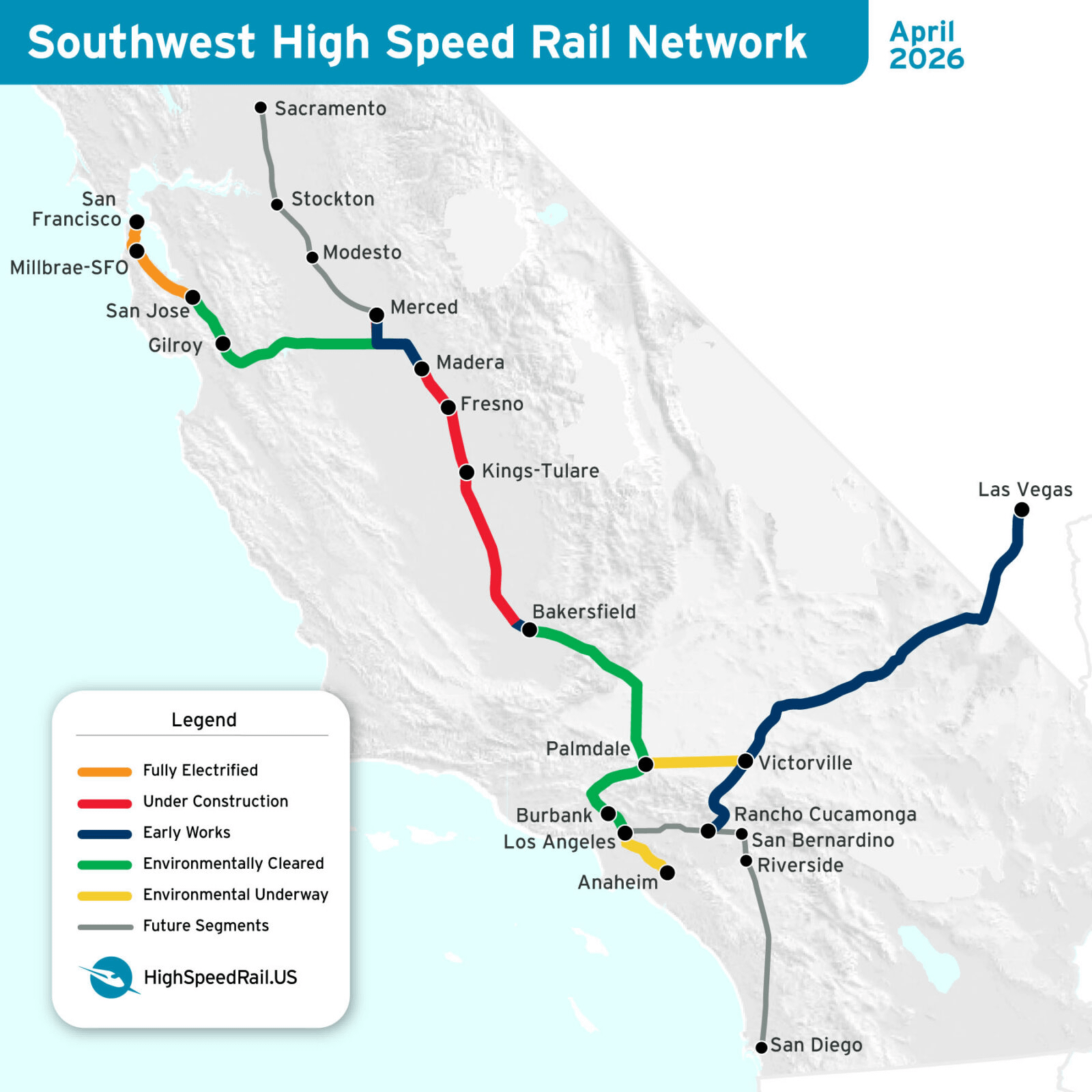
Asking the legislature to approve a new strategy, new powers, and new funding
The California High Speed Rail Authority’s 2026 Draft Business Plan proposes a significant shift in strategy, building on a series of reforms the Authority began advocating for last summer.
The Authority is now restricted by state law to building a 171-mile, double-track segment in the Central Valley, from Bakersfield to Fresno to Merced. By law, work on several key tunnel segments that would connect the Central Valley segment to the coasts—through mountain ranges south of San Francisco and north of Los Angeles—can’t begin until this segment is complete.
The new document—more a sales pitch to the State Legislature than a formal plan—proposes to begin work on the tunnels right away, and to launch the service with a single track (though most civic works would be designed for double track).
With this approach, the Authority hopes to achieve three priorities: 1) start work immediately on the tunnels, which are essential to making trains a real alternative to driving statewide; 2) get trains running from the Central Valley to the state’s major coastal cities as soon as possible; and 3) attract private investors to the project.
Three options
The plan lays out three possible paths forward, depending on the level of funding the Legislature is willing to commit to:
1) Central Valley only: Complete the Central Valley line that is now underway from Bakersfield to Merced with funds already identified. Stations would be moved from downtown Bakersfield and Merced to greenfield sites outside of town to avoid the cost of viaducts into town. The line’s estimated launch date would be 2033, with eight daily round trips.
2) San Francisco to Bakersfield: Build the Central Valley line and begin work on tracks and tunnels from Madera to Gilroy, a city about 80 miles south of San Francisco. From Gilroy, the line would connect to San Jose and San Francisco via the Silicon Valley’s regional railroad, Caltrain. The Authority assumes that Caltrain can collaborate with the Union Pacific Railroad to electrify and upgrade the existing tracks from Gilroy to San Jose. The estimated launch date is 2039. This option—which will connect several of the state’s population centers—is probably the bare minimum for attracting private-sector investment.
3) San Francisco to Los Angeles: Do the above while also beginning work on the high-speed tracks and tunnels from Bakersfield to Palmdale (about 60 miles north of Los Angeles); and work with the Los Angeles area regional railroad Metrolink, on upgrades—including a tunnel and electrification of some tracks—that will allow high-speed trains to reach downtown Los Angles. The estimated launch date for this interim version of full line is 2040.
The project has secured about $39 billion in funding (through 2045), which is roughly the cost of option 1. The estimated buildout cost for option 2 is $60 billion (in current dollars). The estimated buildout cost for option 3 is $126 billion. So the Authority has only a fraction of the funds needed to pursue options 2 or 3.
The Legislature should find the funds, because the return on investment would be immense.
As it stands, there is no quick and easy way to get from the San Francisco Bay Area or Los Angeles to the Central Valley. The trip from San Francisco to Madera on Amtrak’s Gold Runner service takes about 4½ hours (and involves a bus). The only Amtrak service from Bakersfield to Los Angeles is a Thruway bus, which takes about 2½ hours.
The tunnels will change all of that—and create ripple effects far beyond the high-speed rail system. The trip time from San Francisco to Los Angeles (in option 3) would be about four hours. The surge of ridership between the Central Valley and California’s coastal cities would benefit local transit systems—and generate revenue for steady upgrades and expansions to the state’s entire passenger-rail network.
Notably, the Authority projects that option 2 above will generate at least $1.2 billion in revenue annually (from ticket sales and public-private partnerships), versus operating costs of roughly $700 million to $800 million. It projects that option 3 will generate at least $3.2 billion in revenue, versus operating expenses of $1.2 billion to $1.4 billion.
Decision time for the Legislature
Before any of that can happen, the State Legislature needs to change the law so that the Authority can begin work on segments beyond the Central Valley. And it needs to come to grips with a fundamental question.
The 2026 Draft Plan asserts that “high-speed rail is the centerpiece of California’s infrastructure strategy because it integrates multiple priorities into one transformative project.”
That’s an extraordinary claim. If it’s true, the only reason not to go all-in on funding the line (as we’ve said before) is that the Legilsature doesn’t believe it will actually be built. Which becomes a vicious cycle. Doubt leads to paltry funding, which leads to delays and more doubt.
If the Legislature really does believe this is a viable and transformative project, it should commit to getting it done—as quickly as possible.
Which will mean vastly increasing the money for it. Transformative projects require transformative funding levels. It will also mean regulatory reform to clear the way for permitting and right-of-way acquisition, plus enforceable timelines and accountability for Pacific Gas & Electric and other utilities that have delayed the project with slow infrastructure relocation.
There’s broad public support for this path. Remarkably, Californians have never wavered in their enthusiasm for the high-speed line despite constant attacks and a torrent of negative press. Because they see it for what it is: the best hope to break the stranglehold of car culture and fossil fuels in California, to unlock prosperity, and to chart a new path for the state’s economic and environmental future.
The Legislature should recognize this truth and double down on it. Which means it needs to authorize—and fund—work on the tunnels that connect the Central Valley to the Bay Area and Los Angeles. Soon. That will be costly, sure. But not nearly as costly as letting this project limp along, scrape by, and never fulfill its promise—while car culture steadily tightens its death grip on the state.
Posted by IHateTrains123
4 Comments
California will literally create Artificial Superintelligence that makes human concerns obsolete before they finish a HSR project even morocco was able to succeed at
Excited to read the first committee report in 2029 evaluating the future impact of the rail.
Honest question, why has Brightline been able to do more in 8 years than California has done in 18 years? Is California incompetent and corrupt? Did Brightline grease the right palms?
Just seems absurd how little California has accomplished on this project whereas Brightline has secured land / leases to build the route and have broken ground.
It can’t be this hard building a train in the middle of nowhere.