
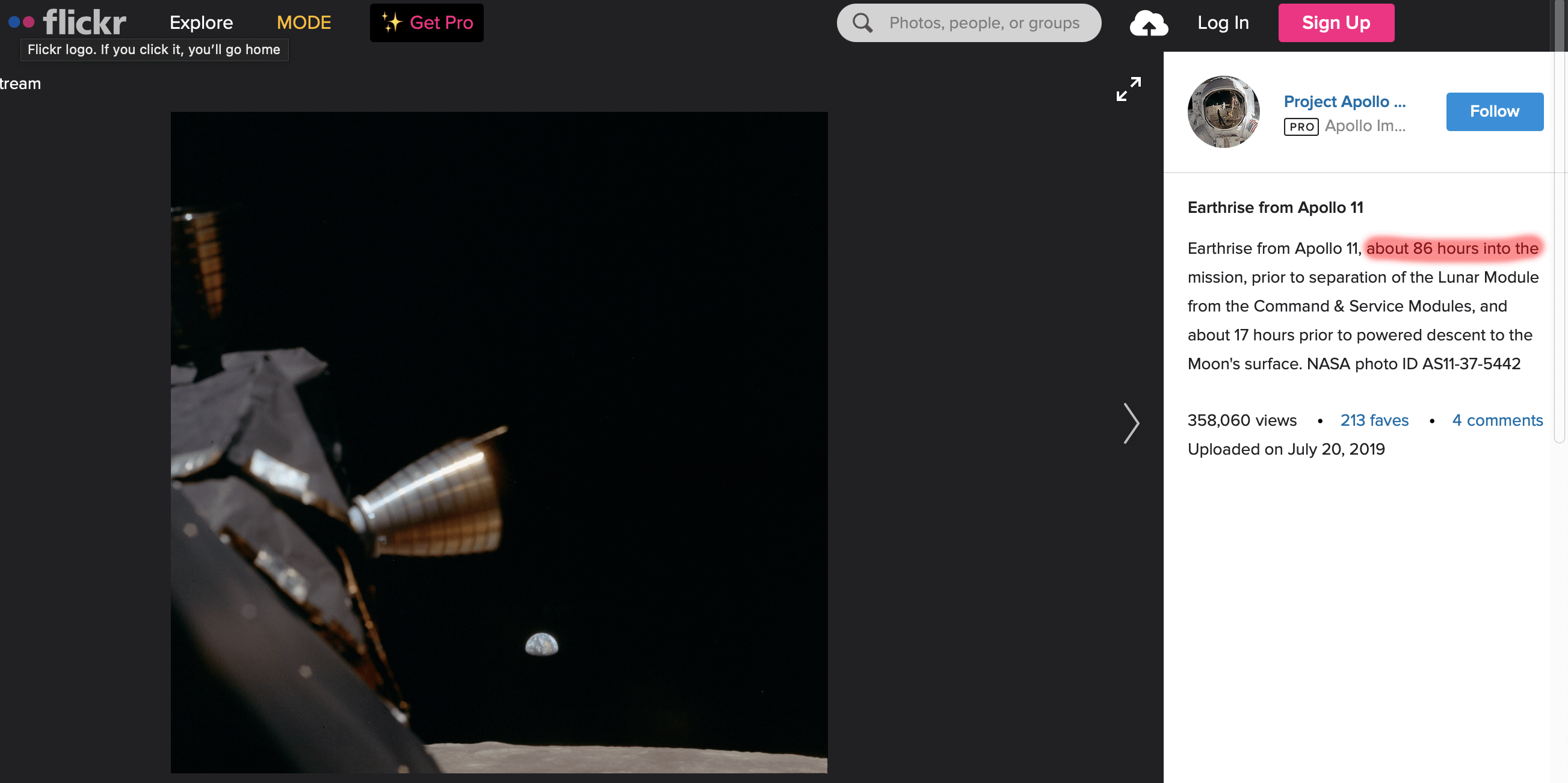
Today, my dear Watson we are opening a forensic file on the most iconic photographic archive in human history: Apollo 11. Grab your pipe and magnifying glass and let's go. Decoding the clock for the uninitiated. NASA doesn't use standard UTC time or Eastern Standard Time in its mission logs. They use GET—Ground Elapsed Time. It’s a master clock that starts ticking the exact second the Saturn V rocket lifts off the pad. Apollo 11 Liftoff: July 16, 1969, at 13:32 UTC.000:00:00 GET clock starts ticking. If you crawl through the official repositories, NASA’s public image archives, and current verified galleries (like the official Flickr Commons archives), you will find a stunning photograph of Earth rising over the lunar horizon: Catalog ID AS11-37-5442. The official description stamped on it "About 86 hours GET." Let’s do the math. 13:32 GMT plus 86.5 hours moves the cosmic clock precisely to July 20, 1969, at 04:02 GMT. Armstrong and Aldrin are getting ready for the historic landing. Everything seems perfect. Except for one fatal detail. Zoom in on the Earth on this specific photograph (AS11-37-5442). What You see, Watson? the African continent is sitting dead-center in the frame. Specifically, the Sahara Desert is fully illuminated, baking under bright, high-noon daylight. Now, let’s run a basic astronomical sanity check. On July 20, 1969, at 04:02 GMT the Sahara was experiencing midnight. It was pitch black. The quick defense will always be: "Oh, it’s just a caption error! A typo by a low-level archivist on Flickr!" But it isn't that simple. If you look at the foreground of the photo, you can see the dark, metallic housing of an RCS thruster quad. This uniquely identifies the image as being shot through the window of the Lunar Module (LM), not the Command Module. According to the Apollo 11 Flight Journal, Armstrong and Aldrin didn't even enter the LM to begin setup until roughly 83:10 GET, and they were buried in critical, live telemetry communication checks with Houston at 86:30 GET. They weren't clicking away with their hassies or iphones. So, we have a photograph supposedly taken by astronauts from a specific module, at a specific hour, showing a daytime continent that was legally experiencing midnight. Flickr pushes the 86 GET timestamp. The apologists scream 'clerical error. 'But as an investigator, you have to ask yourself a deeper question. Why hasn't NASA just quietly corrected the timestamp to, say, 100 GET (which would align the clock with a daytime Africa right before the descent)? Why are they desperately clinging to the impossible 86-hour mark? What if the 86 GET caption isn’t a sloppy mistake? What if nasa HAD to lie about the time to cover up an even more obvious, anomaly that occurs if you move that photo anywhere else on the timeline? The game is afoot, my dear Watson. I have laid out the facts of the clock. Now, I turn to you for your medical opinion on this madness. Look closely at the data. Use your logic. Why do you think they cannot afford to change that timestamp? What is the hidden trap that forces them to keep this lie alive? Looking forward to your deductions in the comments below.
Posted by Nuuskurkoer
8 Comments
Submission Statement.
Paragraphs would be nice.
Yes, yes, that is very interesting, dear inspector.
In reality, this photo was taken at 100:18:10 GET (source: Apollo in real time), shortly after undocking, and is part of the sequence of other photographs.
As such, it *is* a simple error in the Flickr description, and the reason NASA hasn’t corrected it yet is because they probably weren’t aware of it, inspector.
I liked it, but yeah paragraphs would be nice.
“Grab your pipe and magnifying glass and let’s go.”
you grabbed the wrong pipe…
That’s because space is fake and ghey.
I trust more you than that organization and thats enough
Lol