
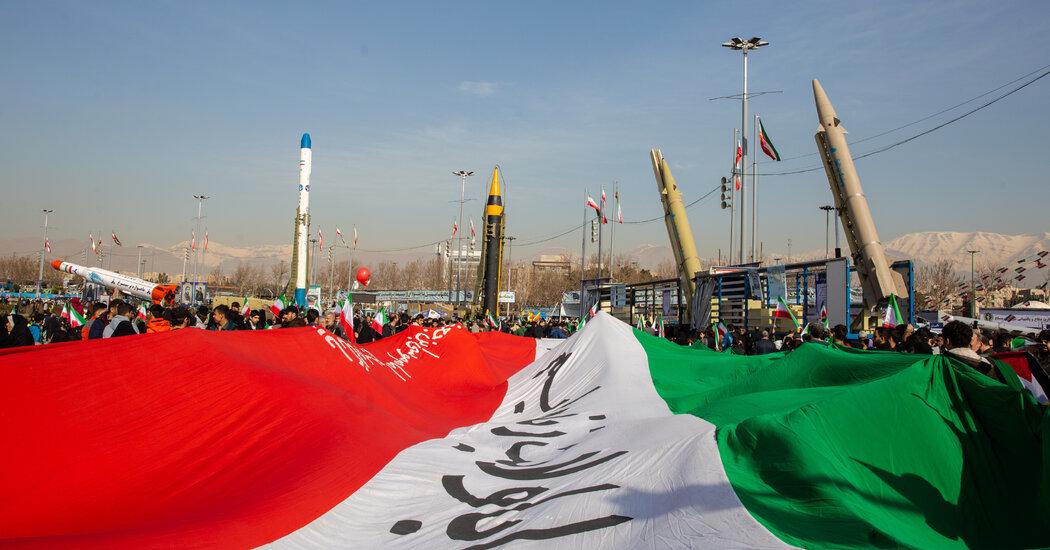
The Trump administration’s public portrayal of a shattered Iranian military is sharply at odds with what U.S. intelligence agencies are telling policymakers behind closed doors, according to classified assessments from early this month that show Iran has regained access to most of its missile sites, launchers and underground facilities.
Most alarming to some senior officials is evidence that Iran has restored operational access to 30 of the 33 missile sites it maintains along the Strait of Hormuz, which could threaten American warships and oil tankers transiting the narrow waterway.
People with knowledge of the assessments said they show — to varying degrees, depending on the level of damage incurred at the different sites — that the Iranians can use mobile launchers that are inside the sites to move missiles to other locations. In some cases they can launch missiles directly from launchpads that are part of the facilities. Only three of the missile sites along the strait remain totally inaccessible, according to the assessments.
Iran still fields about 70 percent of its mobile launchers across the country and has retained roughly 70 percent of its prewar missile stockpile, according to the assessments. That stockpile encompasses both ballistic missiles, which can target other nations in the region, and a smaller supply of cruise missiles, which can be used against shorter-range targets on land or at sea.
Military intelligence agencies have also reported, based on information from multiple collection streams including satellite imagery and other surveillance technologies, that Iran has regained access to roughly 90 percent of its underground missile storage and launch facilities nationwide, which are now assessed to be “partially or fully operational,” the people with knowledge of the assessments said.
The findings undercut months of public assurances from President Trump and Defense Secretary Pete Hegseth, who have told Americans that the Iranian military was “decimated” and “no longer” a threat.
On March 9, 10 days into the war, Mr. Trump told CBS News that Iran’s “missiles are down to a scatter” and the country had “nothing left in a military sense.” Mr. Hegseth declared at a Pentagon news conference on April 8 that Operation Epic Fury — the joint U.S.-Israel campaign launched on Feb. 28 — had “decimated Iran’s military and rendered it combat-ineffective for years to come.”
The intelligence describing Iran’s remaining military capacity is dated less than a month after that news conference.
Asked about the intelligence assessments, a White House spokeswoman, Olivia Wales, repeated Mr. Trump’s previous assertions that Iran’s military had been “crushed.” She said that Iran’s government knows that its “current reality is not sustainable” and that anyone who “thinks Iran has reconstituted its military is either delusional or a mouthpiece” for Iran’s Islamic Revolutionary Guards Corps.
Ms. Wales pointed to a social media post from Mr. Trump on Tuesday declaring that it was “virtual treason” to suggest that Iran’s military was doing well.
Joel Valdez, the acting Pentagon press secretary, responded to questions about the intelligence by criticizing news coverage of the war. “It is so disgraceful that The New York Times and others are acting as public relations agents for the Iranian regime in order to paint Operation Epic Fury as anything other than a historic accomplishment,” he said in a statement.
The new intelligence assessments suggest that Mr. Trump and his military advisers overestimated the damage that the U.S. military could inflict on Iranian missile sites, and underestimated Iran’s resilience and ability to bounce back.
The findings also underscore the dilemma Mr. Trump would face if the fragile month-old cease-fire in the conflict collapses and full-scale fighting resumes. The U.S. military has already depleted its stocks of many critical munitions, including Tomahawk cruise missiles, Patriot interceptor missiles, and Precision Strike and ATACMS ground-based missiles, and yet the intelligence suggests that Iran retains considerable military capability, including around the vital Strait of Hormuz.
The passageway carries roughly a fifth of the world’s daily oil consumption, and the U.S. Navy now maintains a near-continuous presence transiting and patrolling it. The U.S. military’s Central Command said in a social media post on Sunday that more than 20 American warships were enforcing the blockade against Iran.
If Mr. Trump ordered commanders to launch more strikes to take out or diminish those Iranian capabilities, then the U.S. military would have to dig even deeper into stocks of critical munitions. Doing so would further undercut U.S. stockpiles at a time when the Pentagon and the major arms makers are already struggling to find the industrial capacity to replenish American reserves.
Mr. Trump and his advisers have repeatedly denied that U.S. munitions stocks have been drained to dangerously low levels. In private, Pentagon officials have offered similar assurances to anxious European allies. Those allies have purchased billions of dollars of munitions from the United States on behalf of Ukraine, and they are concerned that those munitions will not be delivered because the U.S. military will need them to replenish its own stocks — a worry that would only intensify if the president orders a return to hostilities with Iran.
In testimony on Tuesday to a House appropriations subcommittee, Gen. Dan Caine, the chairman of the Joint Chiefs of Staff, said, “We have sufficient munitions for what we’re tasked to do right now.”
The joint assault on Iran by the United States and Israel inflicted considerable damage on Iran’s defenses and damaged or destroyed many strategic sites around the country. Many of Iran’s senior leaders have been killed, and its economy is staggering under the pressures of the war, leaving questions about how long it can sustain its hard line on a negotiated end to the conflict and the halt on nearly all oil tanker traffic and other shipping through the Strait of Hormuz.
But Iran’s apparent ability to retain substantial military capacity has exacerbated concerns among U.S. allies about the wisdom of the war and generated criticism among Mr. Trump’s anti-interventionist supporters who opposed getting into the conflict in the first place.
The intelligence assessments on Iran’s capabilities point to the consequences of a tactical choice made by U.S. military commanders.
When American forces struck Iran’s hardened missile facilities, the Pentagon, faced with limited stocks of bunker-busting munitions, opted to try to seal off many of the entrances rather than trying to destroy the entire sites with all of the missiles inside, officials said, with mixed results.
Some bunker busters were dropped on Iran’s underground facilities, but officials said military planners faced a difficult choice and needed to be cautious in using them because they needed to preserve a certain number for U.S. operational plans for potential wars in Asia with North Korea and China.
As The New York Times previously reported, the United States expended roughly 1,100 long-range stealth cruise missiles in the war — close to the total supply that remains in the American stockpile. The military also fired more than 1,000 Tomahawk missiles, roughly 10 times the number the Pentagon procures in a year. And it used more than 1,300 Patriot interceptor missiles during the war, which accounts for more than two years of production at 2025 rates.
Replenishing those stockpiles will take years, not months. Lockheed Martin currently produces around 650 Patriot interceptors a year. The company has announced plans to ramp up production of the crucial air defense weapon to 2,000 a year. But doing so will not be easy. And the industry’s ability to produce rocket motors cannot be scaled up as quickly as Mr. Trump has demanded, officials said.
Sean Parnell, the chief Pentagon spokesman, said the military has everything it needs to carry out its mission. “We have executed multiple successful operations across combatant commands while ensuring the U.S. military possesses a deep arsenal of capabilities to protect our people and our interests,” he said in a statement to The Times.
Posted by John3262005
2 Comments
Absolutely embarrassing. Voters will never learn.
https://preview.redd.it/5lzygsoc4s0h1.jpeg?width=1077&format=pjpg&auto=webp&s=72669d74f1a7824e010c2a184d372a4087488f6e