
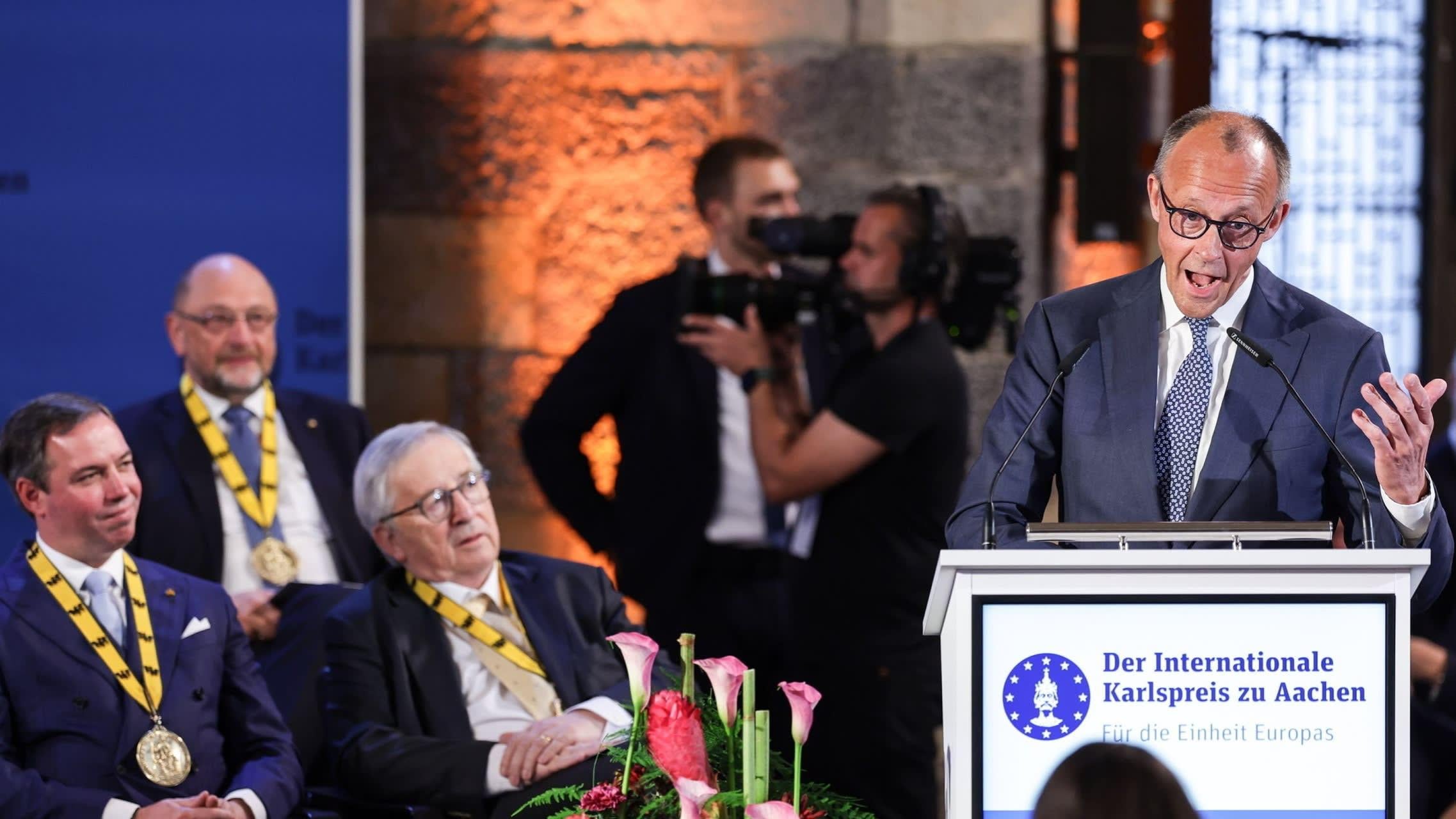
German Chancellor Friedrich Merz has vowed to oppose any future joint EU borrowing even as his government launched a €780bn debt-funded rearmament drive and urged other capitals to limit their spending in areas other than defence.
Speaking on Thursday in Aachen, where former European Central Bank president Mario Draghi was awarded the Charlemagne Prize, Merz said the bloc needed to reprioritise what it spends the budget on rather than take on fresh debt.
“Some now believe we could avoid this painful task by taking on new EU debt,” Merz said. “Germany cannot follow that path for constitutional reasons.”
He added: “Enough countries already spend more on interest than on defence due to immense debt. We must never allow the EU budget to fall into such a predicament.”
His speech sets up a confrontation with Paris over the EU’s next seven-year budget from 2028. France, whose debt exceeds 115 per cent of GDP, has been pushing for a larger EU budget and fresh joint borrowing to finance European defence projects.
The European Commission has proposed an increase in EU spending be funded by new joint debt and taxes.
The bloc in 2020 agreed to raise up to €800bn in joint debt to help ailing economies recover from the Covid-19 pandemic shock, with Germany and other fiscally prudent nations agreeing on the condition it would be a one-off and the funds would lapse by the end of this year. By the end of 2025, countries spent barely half of the €577bn in grants and loans that were made available, with the bloc raising less money in part because Berlin and Paris showed little interest in the loans.
Merz’s speech reflects Germany’s traditional fiscal stance, which he abandoned at home last year following President Donald Trump’s threats to scale back US military presence in Europe.
Days after his Christian Democratic Union won federal elections, Merz spearheaded a constitutional change allowing virtually unlimited public borrowing for defence spending. The German government plans to spend more than €778bn on defence by 2030, according to official figures.
Merz also loosened Germany’s constitutional limit on raising fresh debt to set up a €500bn fund over 12 years to repair Germany’s ageing infrastructure.
This policy shift came after more than a decade of under-investment following the 2009 introduction of the debt brake that limits fresh borrowing, meaning Berlin has much more fiscal margin than other EU countries.
Despite the spending surge, economists estimate that Germany’s debt burden will remain below 90 per cent of GDP by 2035, up from 63.5 per cent in 2025.
In an effort to appease Trump, Nato leaders last year agreed to raise defence spending from 2 per cent of GDP to 5 per cent of GDP by 2035, including 1.5 per cent earmarked for infrastructure that can also serve military purposes.
While Germany is expected to reach that target by 2030, it will prove far harder for heavily indebted countries such as Italy, whose debt to GDP is now around 137 per cent.
In Aachen, Merz argued that fiscal discipline and manageable debt levels were essential to “European sovereignty” — a term more commonly associated with French calls for greater strategic autonomy from the US and China.
He said he would push in EU budget talks for “a radically streamlined structure, investments in competitiveness and defence, and a focus on European money for European policies”.
Europe’s rearmament drive has not been without criticism. Pope Leo on Thursday said the massive defence spending “increases tensions and insecurity, depletes investments in education and healthcare, undermines trust in diplomacy, and enriches elites who care nothing for the common good.”
Speaking alongside Greek Prime Minister Kyriakos Mitsotakis, Merz also paid tribute to his political mentor, Wolfgang Schäuble, the late former German finance minister who advocated an exit of Greece from the Eurozone during the sovereign debt crisis.
Like Draghi, Schäuble — a champion of Germany’s previous Schwarze Null balanced-budget doctrine — had been “a saviour of the euro”, Merz said, by “pointing out the link between stabilising the currency and reforms”.
Addressing Mitsotakis, he said: “This reform path was hard for Greece — for many people in your country — but it has proven to be the right one.”
“The reality today is that excessive debt has long been threatening sovereignty in many places and has long been hampering the ability to act.”
Posted by Desperate_Wear_1866
1 Comment
Germany’s explicit opposition to the idea of further borrowing at the European level (Eurobonds) will be enough to prevent it from happening, given their veto power and their economic clout. This is a diplomatic victory for the fiscally conservative member states of the European Union, but will be opposed by France and proponents of deeper European integration.