
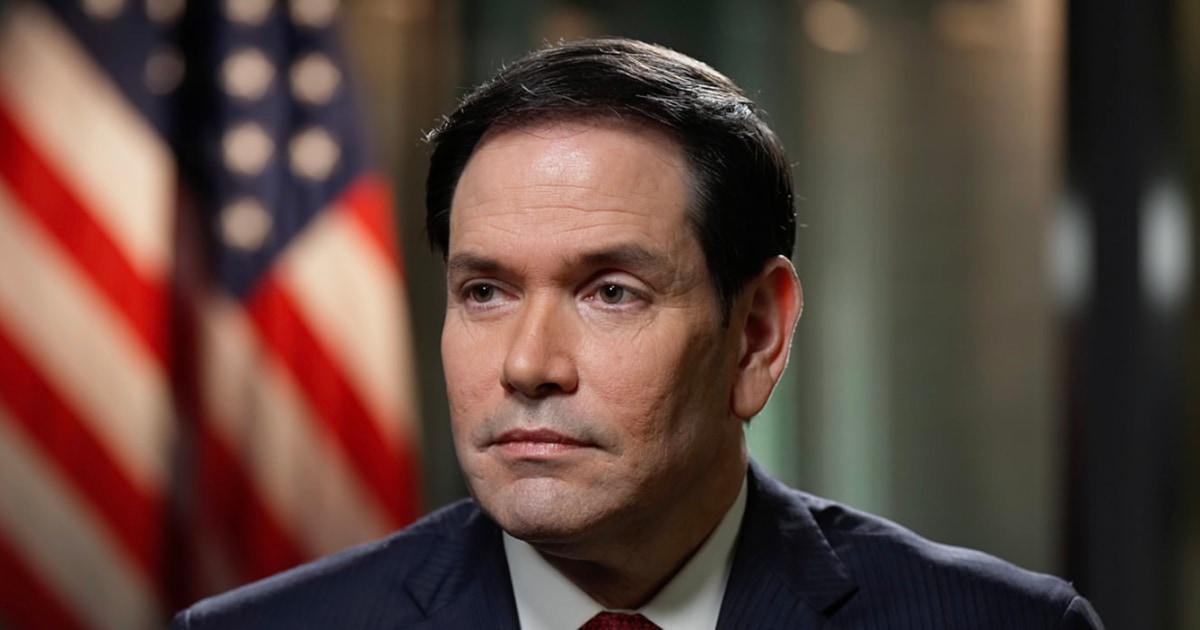
President Donald Trump discussed the Iran war and the blockade of the Strait of Hormuz during a summit with Chinese President Xi Jinping, Secretary of State Marco Rubio told NBC News in an interview Thursday, adding that the United States was not asking for Beijing’s help with Iran.
“The Chinese side said they are not in favor of militarizing the Straits of Hormuz, and they’re not in favor of a tolling system, and that’s our position,” America’s top diplomat said in Beijing after Trump, Xi and their delegations held more than two hours of talks.
During the wide-ranging interview, Rubio — who traveled to Beijing while under Chinese sanctions in what appears to be a first for a U.S. secretary of state — said Trump and Xi also discussed the Beijing-claimed island of Taiwan and the case of Jimmy Lai, a pro-democracy publisher in the Chinese territory of Hong Kong who was sentenced to 20 years in prison this year after his conviction in a landmark national security trial.
Trump had been expected to seek the Chinese leader’s assistance in ending the U.S.-Israeli war with Iran and resolving the standoff over the Strait of Hormuz, a crucial shipping route whose effective shutdown by Iran has disrupted global energy supplies and sent gas prices soaring. Trump had credited China with bringing Iran to the negotiating table for a ceasefire last month.
“We are not immune to global oil prices at some point, because we do buy from the global market, but other countries around the world are paying a much higher price,” Rubio said, not referring to China specifically. “They’ve got to get involved in this as well.”
But Trump “didn’t ask him for anything,” Rubio said.
“We’re not asking for China’s help. We don’t need their help,” said Rubio, who has been under Chinese sanctions since 2020 over his criticism of its human rights record. (Ahead of Trump’s trip, China indicated that the sanctions would not prevent Rubio from traveling to Beijing because they concerned his actions as a senator, not secretary of state.)
The Iran war has loomed large over Trump’s China trip, causing it to be postponed by six weeks. China, which has close ties with Iran, has criticized the U.S. and Israeli strikes that began Feb. 28 and called for a diplomatic solution to the war.
Rubio said Trump and Xi had found common ground on Iran, with China reiterating its opposition to Tehran developing nuclear weapons.
A Chinese readout of the Trump-Xi talks made no direct mention of Iran, saying only that the two leaders “exchanged views on major international and regional issues including the Middle East situation,” according to Xinhua, China’s state-run news agency.
Rubio defended comments Trump made earlier this week that he was “not even a little bit” concerned with the financial pressures Americans are facing as he negotiates with Iran.
“What the president’s making clear is, if the Iranians think that they are going to use our domestic politics to pressure him into a bad deal, that’s not going to happen,” he said.
Along with Iran, a top item on the summit agenda was Taiwan, one of the most sensitive issues in U.S.-China ties. Xi warned Trump on Thursday that tensions over Taiwan could jeopardize the relationship, leading to “clashes and even conflicts” if the issue is not handled carefully, according to Beijing’s readout of the talks.
Like most countries, the U.S. has no formal relations with Taiwan, but it is the self-ruling democracy’s biggest international backer and arms supplier. Though the U.S. is legally bound to provide Taiwan with defensive weapons, it has long maintained a policy of “strategic ambiguity” when it comes to whether its military would defend the island directly in the event of a Chinese attack.
“Our policies on that have not changed,” Rubio said. “It’s been pretty consistent across multiple presidential administrations, and remains consistent now.”
Trump has often spoken about Taiwan in transactional terms, demanding that it spend more on defense and complaining that its world-leading semiconductor industry is “stealing” American jobs. That has raised concerns from Taiwan supporters that Trump could make concessions to Xi on Taiwan such as changing U.S. policy from “not supporting” the island’s independence to “opposing” it, a subtle shift that Beijing has been pressing for.
Trump has also alarmed Taiwan supporters with comments suggesting that he and Xi are discussing U.S. arms sales to the island, which some experts say would violate long-standing U.S. policy prohibiting such consultations with Beijing.
Rubio said U.S. arms sales to Taiwan “did not feature prominently” in the Trump-Xi talks Thursday.
In December, the Trump administration announced an $11 billion arms package for Taiwan that is thought to be the largest ever, with an even bigger one potentially in the works. It has also been critical of the growing military pressure Taiwan faces from China, which sends warplanes and vessels toward the island almost daily.
“From our perspective, any forced change in the status quo and the situation that’s there now would be bad for both countries,” Rubio said.
Rubio said Trump had also asked Xi about Jimmy Lai, 78, whose case has become a symbol of Beijing’s crackdown on dissent in Hong Kong, a former British colony that returned to Chinese rule in 1997.
China describes Lai, a prominent critic of its ruling Communist Party, as the “mastermind” of pro-democracy protests that roiled Hong Kong for months in 2019.
“The president always raises that case and a couple others, and obviously we’ll hope to get a positive response from that,” Rubio said.
He did not directly respond to a question about whether Lai could go to the U.S. if released by Chinese authorities.
“We’d be open to any arrangement that would work for them, as long as he’s given his freedom,” Rubio said.
Posted by John3262005
3 Comments
ah well, nevertheless
They were stupid at the time, but those cope articles from early in the war about how this was all a 4D chess move to hurt China are even more hilarious now that Trump is begging Xi to help bail us out
“Other countries should get involved to open the Strait. But not China, we don’t need their help. And not Europe, we don’t need their help. Russia – like ‘Russia Russia Russia’, that was a hoax you know? – we don’t need them. In fact we don’t need any country’s help. But everyone else should get in here.”