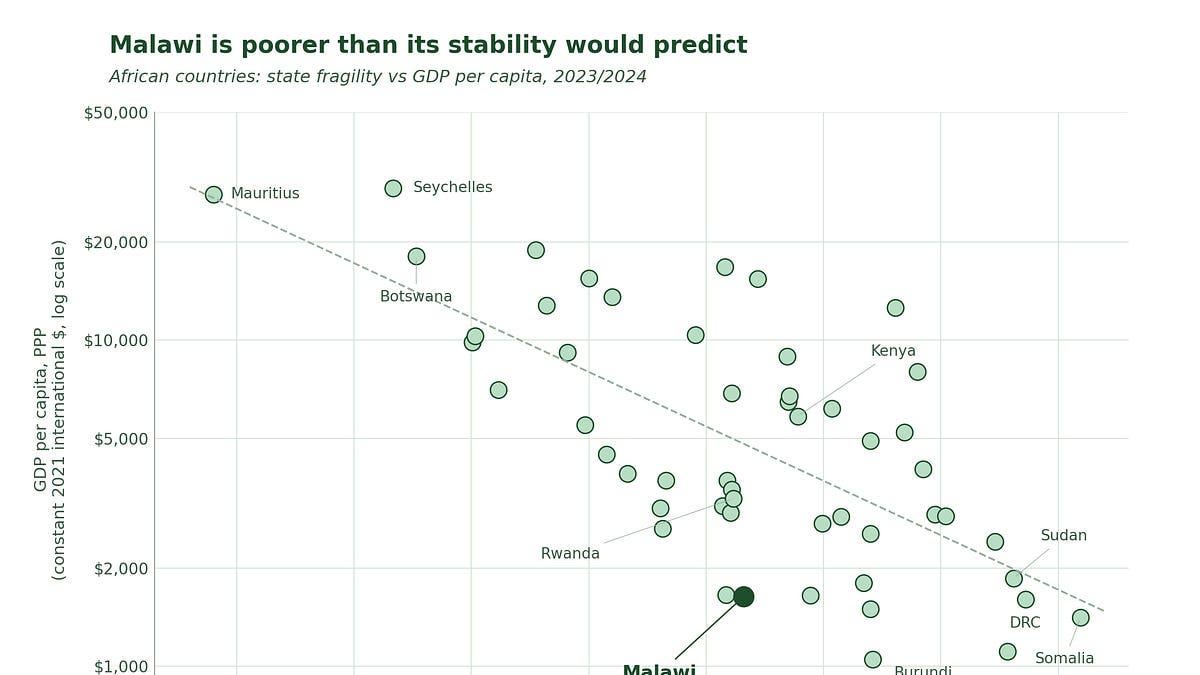
Submission statement: a brief article discussing Malawi’s laggard development. Relevant to discussions of how to boost economic growth in the developing world, and how to model economic policy success.
luciancahil on
Not sure I buy into it. You should never be shocked at any one data point. We’re not surprised when one person who smokes doesn’t get cancer.
PhiLambda on
Very interesting read, especially as Malawi is the one African country I have visited.
We went to assist with a school that a charity had established. It offered much better education than the public schools as well as other benefits.
I don’t know how it compares to other nations but I did notice 3 major concerns: weak education, poor electric grid, and stagnation.
It really felt that much of the attempts at development in the urban areas just kinda stalled. Our guides were frequently talking about failed projects and other sources of wasted effort. Build that weren’t built to code so they were unusable etc.
The gap between the urban and rural areas was especially sharp too. You went from relatively modern places to places with 0 electricity or plumbing very quickly.
TrixoftheTrade on
“Malawi is one of the world’s least developed countries. Its economy is heavily based on agriculture, and it has a largely rural and growing population. The country has a low life expectancy and high infant mortality. HIV/AIDS highly prevalent.”
ElectriCobra_ on
Interesting article. I’ve always wondered why they’ve lagged given that they’re fairly stable and democratic. First few thoughts:
Being landlocked, especially in Africa, is a huge problem. The three poorest African countries are landlocked (South Sudan, CAR, Burundi). The continent has notoriously underdeveloped transportation infrastructure and this is an issue that affects even coastal, stable countries like Senegal. Their closest connection is Mozambique, which is a nightmare basket case that’s even less developed than they are. The article keeps bringing up Bangladesh as a point about “poor agricultural productivity, but able to grow due to manufacturing”… but I think Laos is a better comparison than Bangla as Bangla is right on the Indian Ocean and therefore it’s a lot easier to export product. Rwanda, the other frequent comparison, isn’t in an *enviable* spot, but it’s denser and next to the notably stable Tanzania, which probably helps. Rwanda also grows cash crops like coffee, Malawi does not.
A few other things I would think of: Land use in Malawi is fucking shit and runs into the India problem where any reform gets thwarted by stakeholders. Malawi, like the rest of southern Africa, has a huge HIV/AIDS crisis, which obviously leads to a lot of issues that are toughest on LDCs such as productivity loss and medical strain.

5 Comments
Submission statement: a brief article discussing Malawi’s laggard development. Relevant to discussions of how to boost economic growth in the developing world, and how to model economic policy success.
Not sure I buy into it. You should never be shocked at any one data point. We’re not surprised when one person who smokes doesn’t get cancer.
Very interesting read, especially as Malawi is the one African country I have visited.
We went to assist with a school that a charity had established. It offered much better education than the public schools as well as other benefits.
I don’t know how it compares to other nations but I did notice 3 major concerns: weak education, poor electric grid, and stagnation.
It really felt that much of the attempts at development in the urban areas just kinda stalled. Our guides were frequently talking about failed projects and other sources of wasted effort. Build that weren’t built to code so they were unusable etc.
The gap between the urban and rural areas was especially sharp too. You went from relatively modern places to places with 0 electricity or plumbing very quickly.
“Malawi is one of the world’s least developed countries. Its economy is heavily based on agriculture, and it has a largely rural and growing population. The country has a low life expectancy and high infant mortality. HIV/AIDS highly prevalent.”
Interesting article. I’ve always wondered why they’ve lagged given that they’re fairly stable and democratic. First few thoughts:
Being landlocked, especially in Africa, is a huge problem. The three poorest African countries are landlocked (South Sudan, CAR, Burundi). The continent has notoriously underdeveloped transportation infrastructure and this is an issue that affects even coastal, stable countries like Senegal. Their closest connection is Mozambique, which is a nightmare basket case that’s even less developed than they are. The article keeps bringing up Bangladesh as a point about “poor agricultural productivity, but able to grow due to manufacturing”… but I think Laos is a better comparison than Bangla as Bangla is right on the Indian Ocean and therefore it’s a lot easier to export product. Rwanda, the other frequent comparison, isn’t in an *enviable* spot, but it’s denser and next to the notably stable Tanzania, which probably helps. Rwanda also grows cash crops like coffee, Malawi does not.
A few other things I would think of: Land use in Malawi is fucking shit and runs into the India problem where any reform gets thwarted by stakeholders. Malawi, like the rest of southern Africa, has a huge HIV/AIDS crisis, which obviously leads to a lot of issues that are toughest on LDCs such as productivity loss and medical strain.