
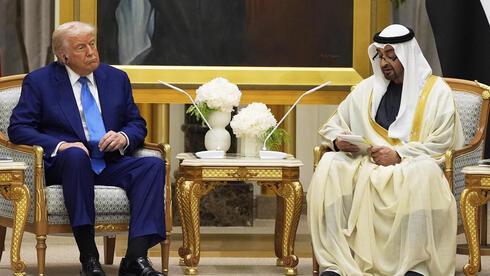
Officials in the Trump administration are encouraging the United Arab Emirates to become more involved in the confrontation with Iran — and even to take control of one of its islands, the British newspaper The Telegraph reported Saturday. The report said people close to U.S. President Donald Trump had suggested that the UAE seize Lavan Island, which, according to reports, it secretly attacked in April.
"Go take them!" a senior security official in the U.S. administration told the British newspaper, adding: "It would be UAE boots on the ground instead of US."
In recent weeks, a series of reports have emerged regarding the Gulf state’s involvement in the war with Iran and its strengthening ties with Israel. These were reflected in reports of visits by the heads of Israel’s security agencies — IDF Chief of Staff Lt. Gen. Eyal Zamir, Mossad chief David Barnea and Shin Bet chief David Zini — as well as a reported visit by Prime Minister Benjamin Netanyahu, which the UAE quickly denied.
Experts who spoke with the British newspaper said Iran’s aggression against Gulf states during the war is accelerating a dramatic realignment in the Middle East and could create a counter-axis against Tehran. The Telegraph noted that the UAE has borne the brunt of Tehran’s aggression, with more than 2,800 missiles and drones launched at it since the war began.
Moreover, the war with Iran and its implications for the UAE constitute a watershed moment for the country — a defining event described as its "9/11 moment" — forcing it to assess its defenses, reconsider its alliances in the region and ultimately strengthen its ties with the United States and Israel.
UAE officials told the British newspaper that the Gulf state received stronger backing from Israel and the U.S. than from its neighbors in the Gulf, which showed very little solidarity.
Dr. Burcu Ozcelik, a researcher at the Royal United Services Institute, said the war had accelerated the alignment between the U.S., Israel and the UAE. She also said Anwar Gargash, an adviser to the UAE president, argued that Tehran’s attacks were expected to entrench American and Israeli influence in the Gulf, not diminish it.
Former U.S. Ambassador to the UAE Barbara Leaf told The New York Times that "the longer this is going on, the more time they’ve had to reflect about their place in the world, their place in the Gulf – who’s a friend and who’s not."
Bloomberg reported this week that at the start of the war, the UAE tried to persuade Saudi Arabia and Qatar to take part in a coordinated military response to Iran’s airstrikes and was disappointed when they refused. Sources familiar with the matter said UAE President Mohammed bin Zayed held a series of calls with leaders in the region, including Saudi Crown Prince Mohammed bin Salman, shortly after the United States and Iran went to war on Feb. 28.
According to the report, his Gulf counterparts told him that "this is not their war." As a result, already tense relations between the UAE and Saudi Arabia deteriorated further, eventually leading Abu Dhabi to withdraw from OPEC, the organization of oil-exporting countries.
The Wall Street Journal reported that the UAE carried out military strikes in Iran. The strikes, which the UAE has not publicly acknowledged, included an attack on a refinery on Iran’s Lavan Island in early April, around the time President Trump announced the ceasefire. The attack sparked a large fire and disabled much of the facility’s production capacity.
According to the report, Saudi Arabia also took part in strikes against targets that included drone and missile launch sites. The UAE, as noted, has not confirmed reports that it struck Iran in early April.
Posted by John3262005
1 Comment
>”Go take them!” a senior security official in the U.S. administration told the British newspaper, adding: “It would be UAE boots on the ground instead of US.”
If you’re trying to convince someone to take the hot potato off your hands, exclaiming that you would rather that they get burned instead of you doesn’t really work.