
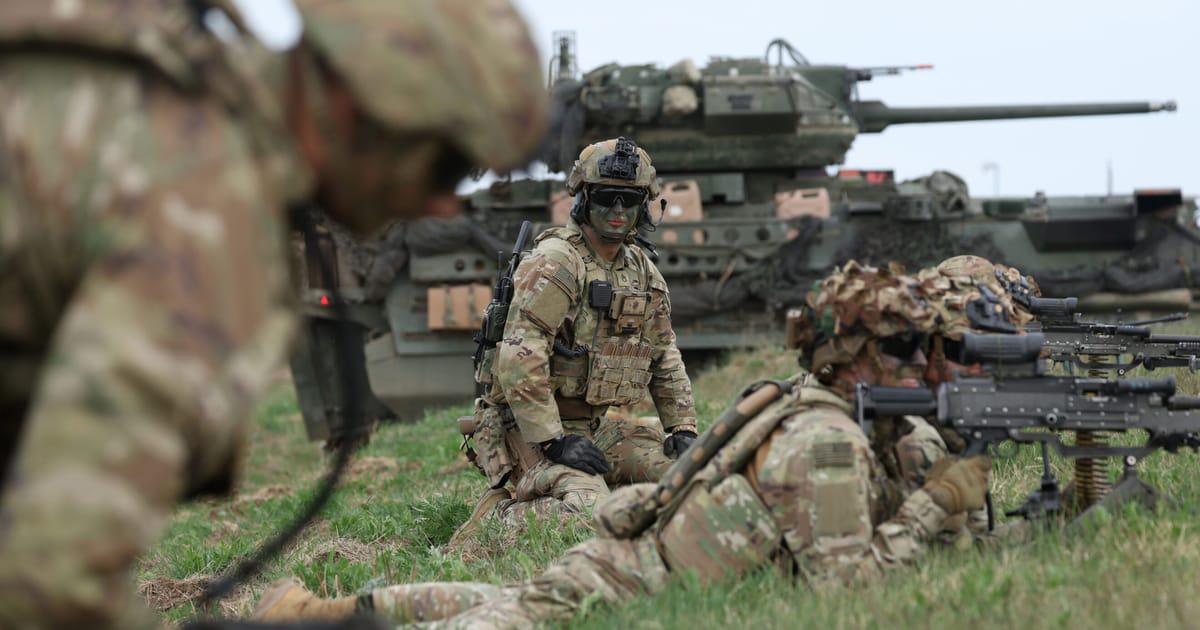
Poland was blindsided on Wednesday by the surprise U.S. decision to cancel a planned deployment of American troops to the country. But it turns out the warning had already arrived days earlier.
Poland’s military was alerted to the Pentagon’s move as early as last Monday, according to three people with knowledge of the matter who are in the immediate circle of the Chief of the General Staff of the Polish Armed Forces, Gen. Wiesław Kukuła, who received the alert.
But the message got stuck in the classified email of Gen. Kukuła. As a result, the ministry of defense leadership and members of Poland’s military learned through the media about the change in plans by the country’s most important ally.
The message sent to Gen. Kukuła early in the week said the U.S. Army was suspending the planned rotation to Poland of more than 4,000 soldiers from an armored brigade. But the news was first reported on Wednesday by the Army Times outlet, which said the decision concerns the 2nd Armored Brigade Combat Team of the 1st Cavalry Division. Similar reports were published by other American media.
U.S. military representatives subsequently confirmed the change in plans regarding the deployment of troops to Poland, though they did not disclose the reasons for the decision.
The Pentagon has since defended the move as part of a carefully considered process. “The decision to withdraw troops follows a comprehensive, multilayered process that incorporates perspectives from key leaders in [U.S. military in Europe] and across the chain of command,” said acting Pentagon press secretary Joel Valdez. “This was not an unexpected, last minute decision.”
On Wednesday night, Poland’s Deputy Prime Minister Władysław Kosiniak-Kamysz commented on the U.S. decision on social media, reassuring the public that the U.S. move did not mean a reduction in American troop numbers in Poland.
On Thursday, Kosiniak-Kamysz told a press conference that he had consulted with U.S. Gen. Alexus Grynkewich, commander of U.S. forces in Europe as well as NATO's supreme allied commander Europe, regarding the Pentagon’s decision. The American commander assured him that the suspension of the deployment does not mean a permanent reduction in the number of U.S. troops in Poland.
Kosiniak-Kamysz said he also was in constant contact on the matter with Poland’s commander-in-chief of the armed forces, President Karol Nawrocki, as well as with Polish Prime Minister Donald Tusk.
Although the matter concerns the military, Gen. Kukuła has not commented publicly on it. Gen. Kukuła was not present at Thursday’s press conference where Kosiniak-Kamysz discussed the issue.
On Wednesday, Polish political leaders were completely surprised by the decision of their transatlantic ally. However, according to the three people with knowledge of the matter, at the same time that the Pentagon was informing the commanders of the U.S. 2nd Armored Brigade that they would not be deployed to Poland, a terse message on the matter was also sent to the Chief of the General Staff of the Polish Army, Gen. Kukuła.
On Monday or Tuesday, the Americans sent a message regarding the suspension of the U.S. troop deployment to Gen. Kukuła via a classified communication system dedicated to contacts with allies, according to the three people familiar with the matter, all of whom are in the immediate circle of the Chief of the General Staff. Gen. Kukuła must personally authorize all communications.
“The chief of staff didn’t inform the command staff until Wednesday,” said one of the people, granted anonymity to discuss nonpublic communications, as were the others in this article.
“The Americans informed the General Staff at the beginning of the week about the suspension of the rotation, because it is responsible for coordinating the presence of U.S. forces in Poland,” another of the three people said.
But Col. Marek Pietrzak, spokesperson for the General Staff, countered the assertion that the message arrived as early as Monday. “No information regarding the suspension of the rotation of American forces was received by the [General Staff] on Monday,” Col. Pietrzak said. “My comment on the matter: please change your sources,” he said.
The American message regarding the transfer of soldiers from the 2nd Armored Brigade Combat Team from Texas to Poland was extremely short, including neither explanation nor justification. “It was a brief, one-sentence message sent through routine military channels in an informal manner,” said one of the people in the circle of the Chief of the General Staff.
“What happened at headquarters is a typical organizational mess,” said another of the people close to the General Staff. “The law on the protection of classified information stipulates that only the head of an institution may read classified correspondence. However, workarounds are necessary for the institution to function and maintain continuity,” this person said.
“It is well known that the chief of staff is often away and is a very busy person. That is why he should authorize others to read classified correspondence so that it is reviewed several times a day, and not just when the chief finds the time to do so,” this person said.
In this instance, the delay in reading correspondence meant that the civilian leadership of the ministry of defense learned that the rotation of U.S. troops to Poland had been suspended from the American media late Wednesday evening.
“I don’t know what system of communication between the chief of staff and the defense minister is currently in place, or how often he briefs the minister," said Gen. Mieczysław Cieniuch, who served as Chief of the General Staff from 2010 to 2013 and is now retired. "In the past, on important matters, the chief of staff had access to the minister around the clock. On day-to-day matters, however, he briefed the minister once a week,” he said.
“If the information from the Americans arrived on Monday, then the Chief of Staff should have been briefed on it by Tuesday at the latest,” Gen. Cieniuch said. “The whole problem lies in how this information was classified within the General Staff. In my opinion, it should have been classified as very important and urgently delivered to the minister of defense, because such information has not only a military but also a political dimension,” he said.
“The information flow system at the General Staff has recently undergone a profound breakdown and is not functioning, as the case of the rotation of the American brigade clearly demonstrated,” said Gen. Jarosław Gromadziński, who served at the General Staff for many years, most recently in 2023, and is now retired.
It was only after the news broke in the media on Wednesday that Gen. Kukuła sent a message to the heads of the command staffs stating that the transfer of troops from the United States had been suspended, according to the people with knowledge of the matter.
“From that moment on, officers have been aware of the matter and are working on it,” one of the people said, adding that the size of the U.S. military presence in Poland will be reduced, contradicting the earlier assurances by U.S. Gen. Grynkewich.
“Perhaps the scale of this reduction won’t be as large as the media reports, but we've received that information as well,” this person said. “We’re all pissed off that we’re learning about all this from the media instead of our superiors.”
Posted by John3262005
2 Comments
The more I learn about the behind the scenes of the cancellation of troop moves in Europe, the more I am just surprised
One sentence message to the chief of general staff about the cancellation that could or could not have happened
Then previously learning that the Pentagon was blindsided as well as Poland
Seems like the only ones to know what is truly happening is the Defense Secretary
Even if true, you would think that Poland, a loyal ally to the US especially to Trump, would deserve an explanation as to why that is happening than just a single sentence
Didn’t someone else *just* post a different article saying that this had nothing to do with Poland? I don’t even know