
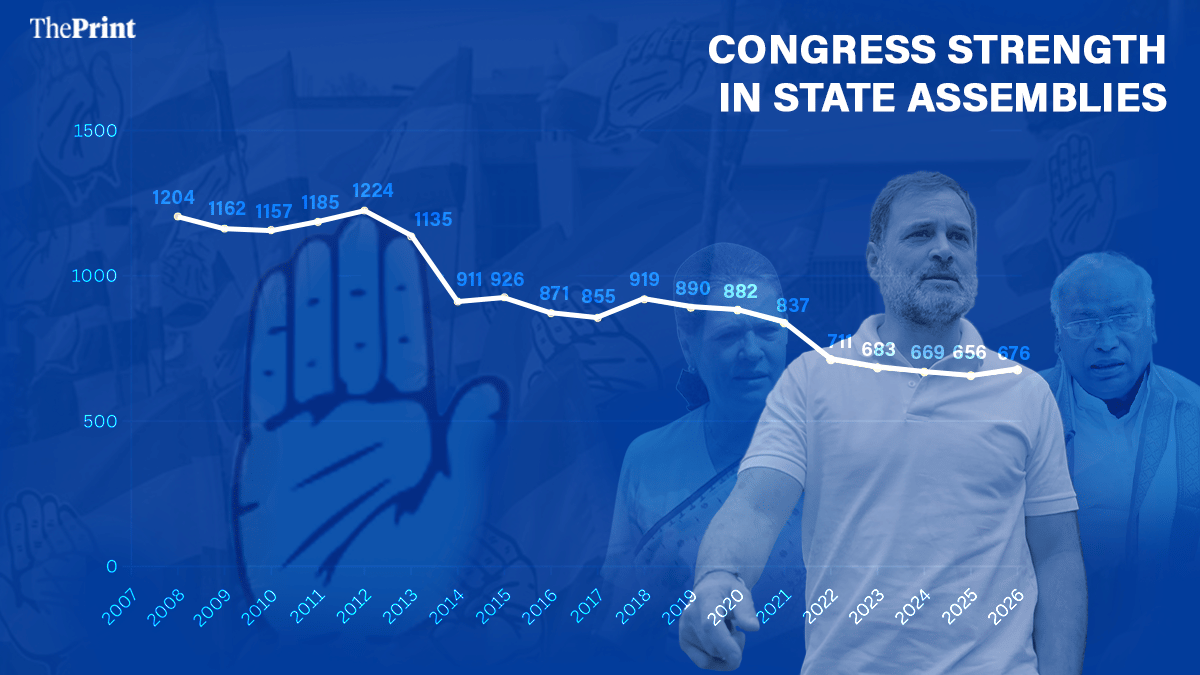
The INC is India's largest opposition party its the fulcrum that organizes the opposition to the BJP. It's the only pan-India opposition party for the most part. And it's been in decline for decades, it has seen a change in the number of seats by -43.8538206% since 2007, all the while the BJP has increased rapidly, with its share of seats doubling as it went from 889 to 1787
I guess I post this because I wonder what people here think about it? Why do they think it happened? What should be done? It also talks about the INC total wipeout in places like Delhi and Andhra Pradesh . At its core, the article argues that at its core the INC problem is Rahul Gandhi
Posted by ewatta200
2 Comments
**New Delhi:** The Congress-led alliance has returned to power in Kerala. But it appears to be only a minor deviation in an otherwise largely consistent, downward trajectory of its presence in state assemblies, shows ThePrint’s analysis of the party’s MLA strength across states post 2007—the year Rahul Gandhi began calling the shots after his appointment as All India Congress Committee general secretary.
[](https://vdo.ai/contact?utm_medium=video&utm_term=theprint.in&utm_source=vdoai_logo)
In 2008, the party had 1,204 MLAs pan-India. However, data collated by ThePrint shows that the number of Congress MLAs has shrunk by almost 44 percent since then—down to around 676 MLAs in 2026. Parallely, the BJP has seen a 101 percent increase from 889 MLAs in 2008 to 1,787 in 2026.
Of the total 4,120 MLAs in India, every second MLA now belongs to the BJP, while only one in six is from Congress.
The data analysed by ThePrint is based on the party affiliation of candidates who won assembly elections over the years. It does not include subsequent defections or bye-elections.
Although Rahul was given direct charge of Indian Youth Congress and National Students’ Union of India in 2007, he started playing a crucial role in the decision-making process of the party, with his mother and then party president Sonia Gandhi virtually giving him a free rein. She formally handed over the mantle to him in 2017.
Since 2008, the party breached the 1,200-mark only in 2012, when it had 1,224 MLAs, before seeing a 25 percent decline to 911 MLAs in 2014. The graph for number of Congress and the BJP MLAs intersects, and reverses in 2013-14 with the latter on a path of ascent since.
Rahul was appointed the vice president of the Indian National Congress in January 2013, when he began largely running the organisation, with Sonia playing a rather ceremonial role. He replaced her as Congress president in 2017, only to resign after the 2019 Lok Sabha debacle, which forced her to return to the helm as interim chief.
In October 2022, Mallikarjun Kharge took over as president. But while Rahul has not taken up any formal role since 2019, he has been the de facto party chief in terms of decision-making. Rahul has been a Member of Parliament for 22 years, and is currently the Leader of Opposition in Lok Sabha.
Chandrachur Singh, professor of Political Science at University of Delhi, lays the responsibility for Congress’s decline solely on Rahul. “He does not have an understanding of how politics operates, simple as that… His political culture is very alienated from the political culture in which we live,” he tells ThePrint.
However, Rahul Verma, a fellow at Delhi-based think tank Centre for Policy Research, does not hold the MP solely responsible for this drop in Congress’s assembly-wise presence, since the party has witnessed a structural decline.
“If you draw a graph from 1952 to 2024 every decade, Congress is losing seats and vote share in state assemblies,” Verma points out.
“Where you can hold Rahul Gandhi also accountable is that in some ways, he has been the face of the party for at least 12-15 years. While one can’t put the entire blame for the decline on him, he will definitely be held responsible for not being able to reverse this trend,” he adds.
Infographic: Deepakshi Sharma | ThePrint
***Also Read:*** [*‘Opportunism’ or ‘survival’? Congress & its revolving door of alliances in Tamil Nadu over decades*](https://theprint.in/politics/opportunism-or-survival-congress-its-revolving-door-of-alliances-in-tamil-nadu-over-decades/2928528/)
# The plunge
Verma explains the graph clinically, noting that the point where the graph reverses for Congress and BJP comes in 2013-14—by when the Congress had faced losses in several states.
Who would’ve thought that farmers making $1000 a year wouldn’t resonate with stories of affirmative action at Harvard.