
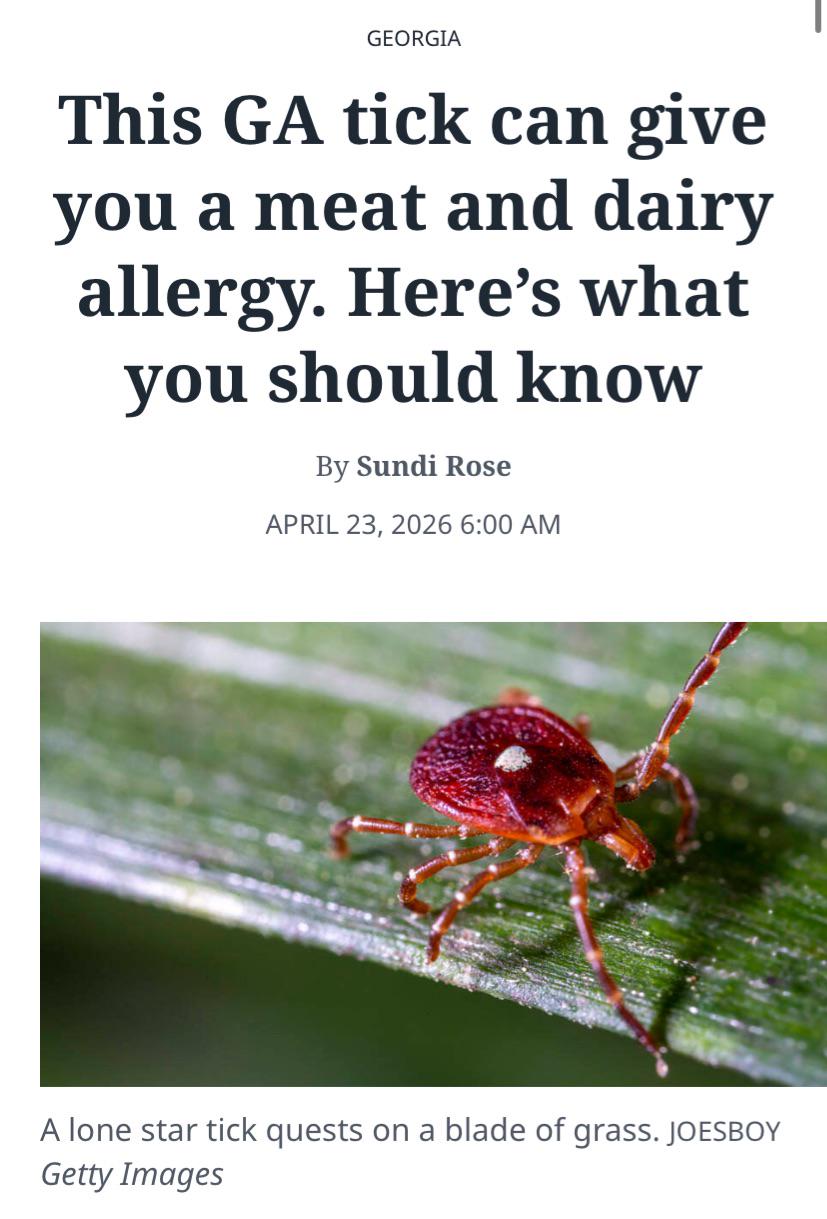
We keep being told that the rise in tick-borne red meat allergies is just an unfortunate natural phenomenon.
But what if we’re looking at one piece of a much larger puzzle?
Think about it:
More people suddenly become allergic to beef, pork, lamb, dairy, and other animal products.
Governments and international organizations increasingly promote reducing meat consumption for environmental reasons.
Insects are repeatedly presented as a future protein source.
Farmers across multiple countries have clashed with governments over regulations, emissions targets, livestock reductions, and agricultural policies.
Food prices continue rising while traditional farming faces growing pressure.
Now connect the dots.
If a population gradually consumes less red meat, not because it is banned, but because it becomes more expensive, harder to produce, socially discouraged, or even physically intolerable, what happens next?
Alternative proteins become the default.
The interesting part is that nobody would need to force people. The shift could happen through a combination of economic pressure, regulation, health concerns, and changing food availability.
The tick allergy phenomenon is especially strange because it directly targets a category of food that many policy makers and environmental activists already want people to reduce.
Coincidence?
Maybe.
But history shows that major societal changes rarely happen through a single event. They happen through dozens of small developments that all push in the same direction.
I’m not saying ticks were engineered or released intentionally. I’m saying that when you step back and look at the bigger picture, livestock reductions, farmer protests, alternative proteins, climate policies, and now a growing allergy that discourages meat consumption, the pattern starts looking a little too convenient for some people.
What do you think? Random coincidence, or part of a long-term shift toward a post-2030 food system?
Posted by HealthyHoliday3119
1 Comment
PETA set them loose upon the world!