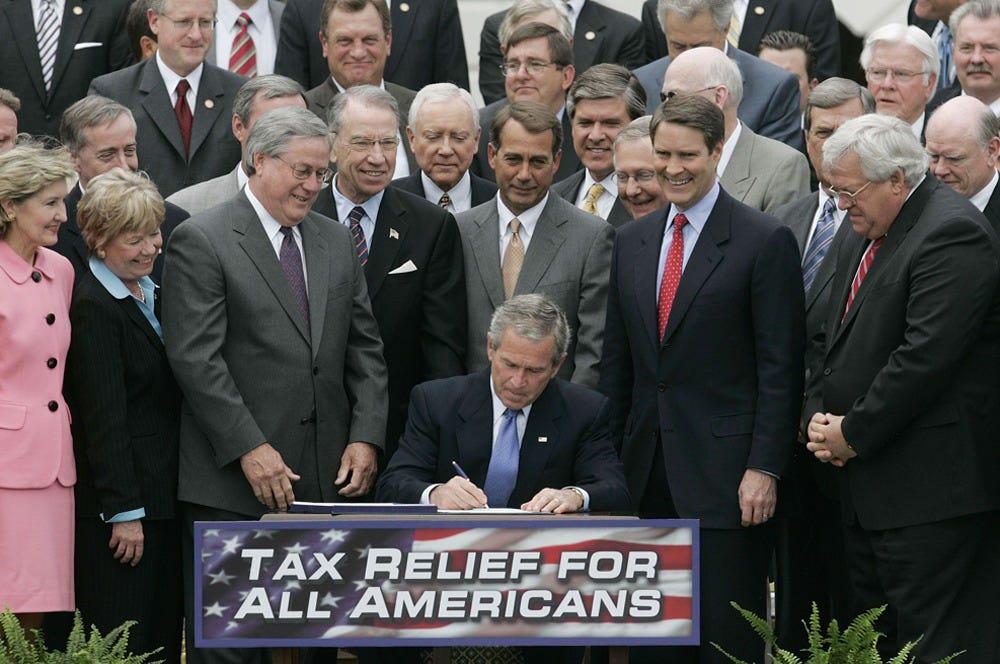
> By cutting taxes for everyone in the early 2000s with an expiration date, George W. Bush effectively created a ratchet. When the cuts were set to expire at the end of 2010, Obama was boxed in twice over. He had campaigned on a pledge not to raise taxes on families under $250,000, so he could only let the top rates snap back. But the economy was fragile, with unemployment near 9.5 percent, and letting any taxes rise risked pulling demand out of an economy that couldn’t afford it. The result was the December 2010 deal: all the Bush cuts extended, top rates and all, in exchange for unemployment insurance and a payroll tax cut.
> When the cuts came up again at the end of 2012, Obama framed the fight around middle-class tax cuts. Then-White House comms director Dan Pfeiffer argued “President Obama today will push for extension of middle class tax cuts. Will the GOP join him to provide certainty for 98% of Americans?”
> He ended up striking a different deal, making the Bush rates permanent under $400,000 and raising taxes above that. That decision locked in a tax architecture. The vast majority of the Bush tax cuts were now bipartisan law.
> Each campaign cycle deepened the tax threshold promise and boxed in policymakers more. Secretary Hillary Clinton championed the Buffett Rule in 2016, and Obama’s pledge was increased to $400,000 by Vice-President Biden while running in 2020.
—
**Relevance**
This shows how buck-passing from successive Dem administrations has entrenched bad Republican policy among even progressive-minded Democrats.
ldn6 on
The tax trap that Democrats built except for the fact that the author states quite clearly that Bush instigated.
Obvious_Chapter2082 on
Rachet is the correct word there. No tax bill on its own has been super significant, but they’ve moved us progressively further and further away from the pre-Bush tax code
This pretty much makes it impossible to go back to that code without also ratcheting back down over a long period of time. Returning to that code today would raise a lot of revenue, but it would also mean that all income over $32K would be taxed at a flat 26% through the AMT. So we’d be looking at substantially higher taxes on every single income group
RalphWImmersion on
It seems like every headline is along the lines of “my wife left me and it’s the Dems fault”

4 Comments
**The Bush Trap**
> By cutting taxes for everyone in the early 2000s with an expiration date, George W. Bush effectively created a ratchet. When the cuts were set to expire at the end of 2010, Obama was boxed in twice over. He had campaigned on a pledge not to raise taxes on families under $250,000, so he could only let the top rates snap back. But the economy was fragile, with unemployment near 9.5 percent, and letting any taxes rise risked pulling demand out of an economy that couldn’t afford it. The result was the December 2010 deal: all the Bush cuts extended, top rates and all, in exchange for unemployment insurance and a payroll tax cut.
> When the cuts came up again at the end of 2012, Obama framed the fight around middle-class tax cuts. Then-White House comms director Dan Pfeiffer argued “President Obama today will push for extension of middle class tax cuts. Will the GOP join him to provide certainty for 98% of Americans?”
> He ended up striking a different deal, making the Bush rates permanent under $400,000 and raising taxes above that. That decision locked in a tax architecture. The vast majority of the Bush tax cuts were now bipartisan law.
> Each campaign cycle deepened the tax threshold promise and boxed in policymakers more. Secretary Hillary Clinton championed the Buffett Rule in 2016, and Obama’s pledge was increased to $400,000 by Vice-President Biden while running in 2020.
—
**Relevance**
This shows how buck-passing from successive Dem administrations has entrenched bad Republican policy among even progressive-minded Democrats.
The tax trap that Democrats built except for the fact that the author states quite clearly that Bush instigated.
Rachet is the correct word there. No tax bill on its own has been super significant, but they’ve moved us progressively further and further away from the pre-Bush tax code
This pretty much makes it impossible to go back to that code without also ratcheting back down over a long period of time. Returning to that code today would raise a lot of revenue, but it would also mean that all income over $32K would be taxed at a flat 26% through the AMT. So we’d be looking at substantially higher taxes on every single income group
It seems like every headline is along the lines of “my wife left me and it’s the Dems fault”