
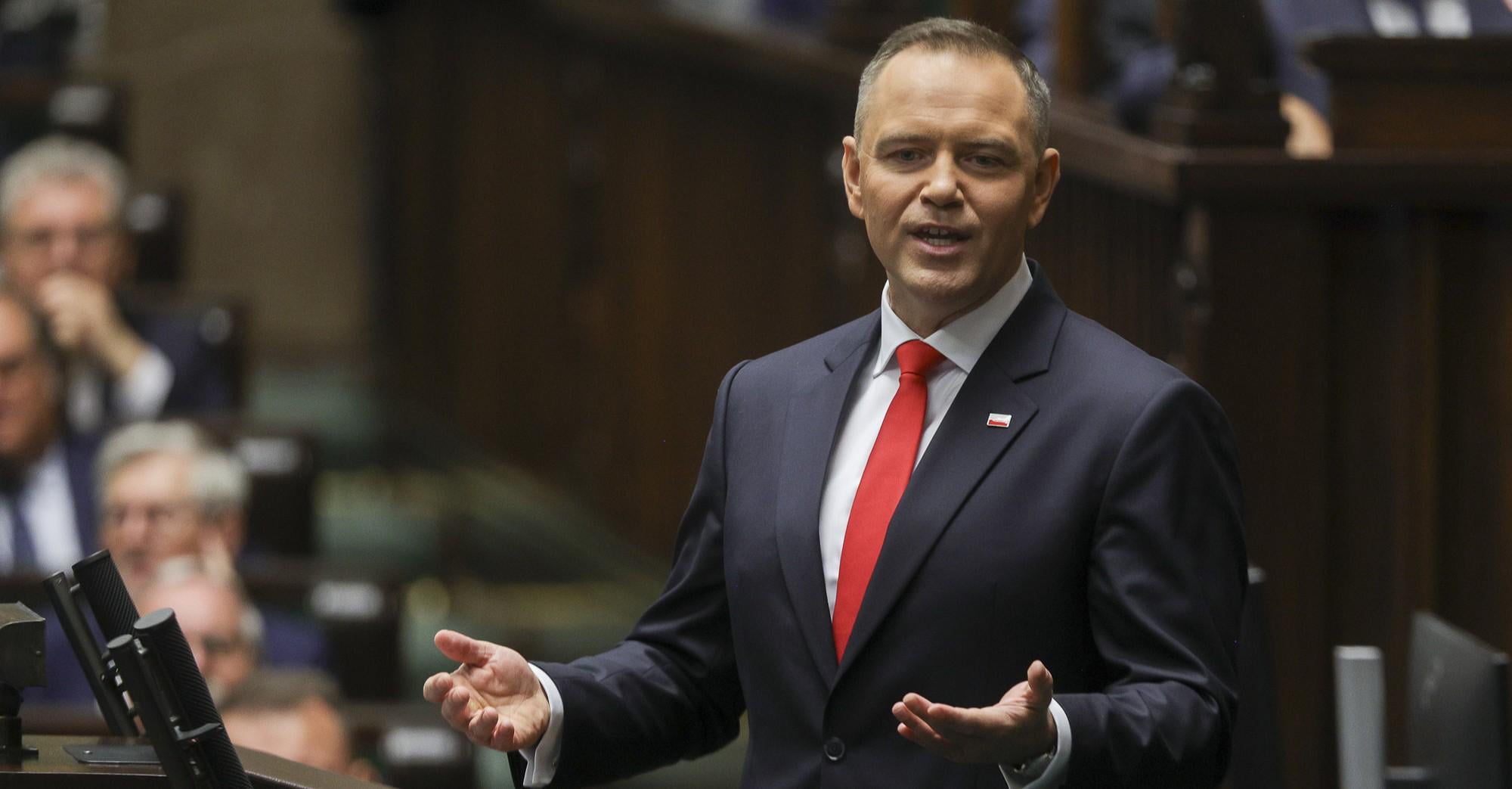
President Karol Nawrocki has now issued more vetoes than any other president in Polish history, despite being in office for less than a year, after announcing on Thursday that he would refuse to sign three more bills passed by parliament.
It now means that Nawrocki has vetoed 37 proposed laws in just ten months since coming to power. The previous record holder, Aleksander Kwaśniewski, issued his 35 vetoes over the course of ten years as president.
In an announcement on Thursday afternoon, Nawrocki, who is aligned with the right-wing opposition, revealed that he had, for the third time, vetoed an attempt by the more liberal ruling coalition to introduce regulation of the crypto-assets market.
As with his previous crypto veto, Nawrocki said that, while he supports regulating the sector, the government’s proposals were too restrictive and had ignored almost all of the suggestions previously made by the president.
He also vetoed a bill on HIV treatment because it extended a deadline for doctors from outside the EU to pass a Polish language exam until May 2027. “Every Pole has the right to expect to be able to communicate effectively and freely with their doctor,” said Nawrocki.
Finally, Nawrocki refused to sign a law allowing the suspension of the statute of limitations on tax liabilities if proceedings are initiated before the five-year period expires. The president argued that this would undermine legal certainty and citizens’ trust in the state.
Nawrocki’s latest three vetoes continue his highly confrontational approach towards the government of Prime Minister Donald Tusk. Poland’s presidency has often been regarded as a largely ceremonial position, but Nawrocki has sought to reshape that role by pushing the limits of presidential powers.
The strongest presidential prerogative has always been the veto. But, while Poland has previously had presidents opposed to the sitting government, never has it seen such a flurry of vetoes.
Poland’s first president after the fall of communism, Lech Wałęsa (who ruled from 1990 to 1995) used his veto power 27 times. His successor, Kwaśniewski (1995-2005), issued 35 vetoes. Lech Kaczyński (2005-2010) refused to sign 18 bills.
Bronisław Komorowski (2010-2015), whose term coincided with a government he was closely aligned with, vetoed only four times. Nawrocki’s predecessor, Andrzej Duda (2015-2025), issued 19 vetoes over his two five-year terms.
Given that Nawrocki took office on 6 August 2025, he has issued vetoes at the rate of one every 8.4 days. If that continued over the rest of his five-year term, he would issue 217 vetoes.
However, parliamentary elections will take place in autumn 2027 and, if the right-wing opposition wins power, it would make it much less likely that Nawrocki would issue vetoes.
But until then – and beyond if Tusk remains in power – the deadlock between president and government makes it very difficult to pass laws in a wide range of areas.
Nawrocki has vetoed legislation on judicial reform, EU defence loans, implementing the European Union’s Digital Services Act, tax increases on alcoholic and sweet drinks, recognition for regional languages, and creating Poland’s first new national park in 24 years.
For his part, the president has criticised the government for ignoring his own legislative initiatives, many of which have been submitted to parliament but not processed. He says that 20 such bills are in the so-called “parliamentary freezer”.
Among them are Nawrocki’s own proposal on how to regulate the crypto-assets market, as well as a plan to fund defence spending through central bank profits (instead of EU loans) and a bill banning the promotion of the ideology of historical Ukrainian nationalist leader Stepan Bandera.
In March, credit rating agency Fitch warned that the “political gridlock” between the government and president was hindering policymaking, including tackling Poland’s large fiscal deficit and rising debt. As a result, both Fitch and Moody’s, another rating agency, have switched Poland’s credit outlook to negative.
Daniel Tilles is editor-in-chief of Notes from Poland. He has written on Polish affairs for a wide range of publications, including Foreign Policy, POLITICO Europe, EUobserver and Dziennik Gazeta Prawna.
Posted by BubsyFanboy
1 Comment
!ping POLAND
**1. Why is this relevant for** r/neoliberal **?**
This is relevant to Polish politics, democracy, populism and legislature.
**2. What do you think people should discuss about it?**
I think people should discuss all of the Third Republic era Presidents of Poland, Nawrocki’s tenure thus far, him becoming the record-setter for the most vetoed bills, the vetoes and the vetoed bills, Poland’s reactions to the latest batch of vetoes, the president’s relationship with the current government and what the future holds for both of them.
**2a. What do you think of the issue at hand?**
Reminder: It took Kwaśniewski 10 years to get to that point. God, remember when being drunk was the worst offense as president? We all miss him now…
>For his part, the president has criticised the government for ignoring his own legislative initiatives, many of which have been submitted to parliament but not processed. He says that 20 such bills are in the so-called “parliamentary freezer”.
Boy, you literally started it with all the early vetoes. I am not a fan of the Marshall of Sejm or the parliamentary freezer, but if you wanna play ball and deadlock the country, so be it. You’re just getting a taste of your medicine – veto for veto.