
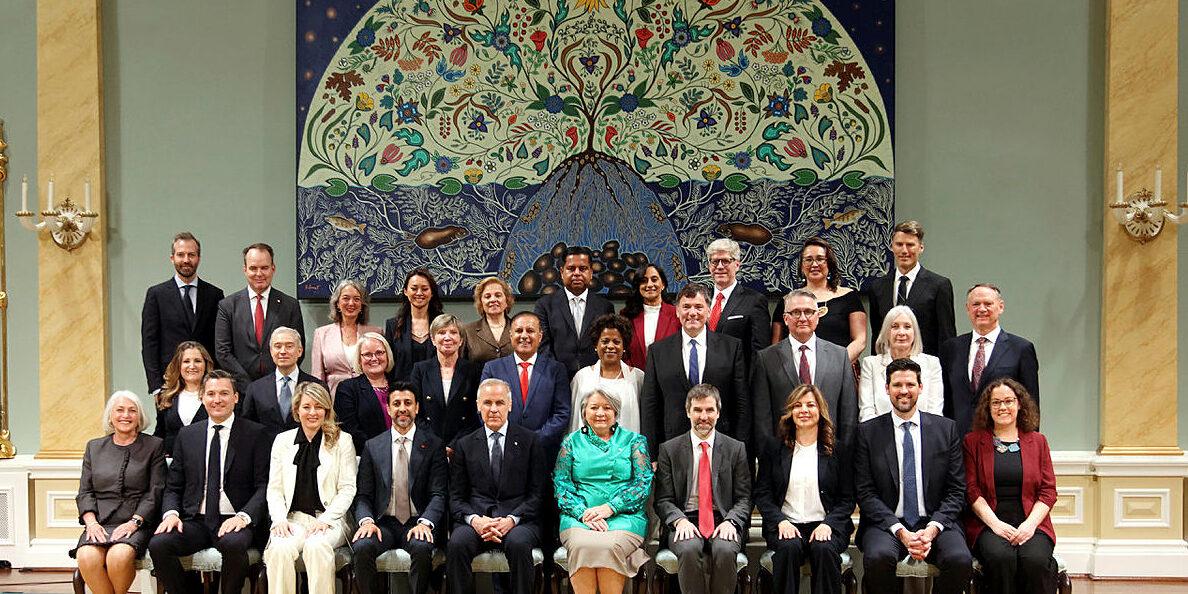
Cabinet ministers who once appeared relaxed and complacent under Justin Trudeau are now 'on their toes' under Prime Minister Mark Carney, say some Liberal MPs.
Prime Minister Mark Carney appears to be running the first cabinet government in about 40 to 50 years, but it’s unclear if it will continue in the medium and long term, especially if and when the Liberals face political setbacks and crises during their mandate, say some Liberal MPs, political insiders, and one of Canada’s leading experts on the machinery of government.
“He [Carney] believes in cabinet government far more than [former prime minister Justin] Trudeau did, and then when it comes to political advice, he turns to cabinet,” said Professor Donald Savoie, Canada Research Chair in public administration and governance at the University of Moncton, in an interview with The Hill Times.
“So technical advice [on economy and finance], perhaps less so, but political advice, getting a sense of the country, getting a sense of how ideas can float [and] be accepted, he turns to cabinet far more than Justin Trudeau, that’s my understanding, both from politicians and public servants,” said Savoie.
Savoie said that based on his own research, along with books and articles written about Trudeau, the former prime minister ran a highly centralized government, despite promising otherwise during the 2013 Liberal leadership race. Trudeau also declared after winning a landslide majority in 2015 that “cabinet government is back,” but Savoie said that the decision-making remained concentrated in the Prime Minister’s Office.
By contrast, Savoie—an award-winning author and editor of more than 28 books—said Carney (Nepean, Ont.) encourages informed discussion at the cabinet table on government policy and political issues. While Carney does not need advice on monetary or fiscal policy, given his expertise in those areas, he welcomes frank discussions on other subjects.
Savoie and others interviewed for this article said Carney can be “direct” when ministers or caucus members do not have their facts straight, but otherwise he listens carefully and welcomes political advice from cabinet colleagues. Savoie said that ministers should ensure that—before participating in debates in cabinet—they master their files, take charge of their departments, bring forward ideas, and contribute meaningfully to cabinet deliberations. Cabinet cannot function effectively, Savoie said, if ministers are unable or unwilling to do their part.
He also said that Carney’s 27-member cabinet is better suited to decision-making than Trudeau’s 39-member cabinet. Large cabinets, he argued, tend to become deliberative bodies rather than effective decision-making ons.
More broadly, Savoie said, governments typically begin their mandates with confidence and relatively open, free-wheeling cabinet discussions. Over time, however, as they encounter political headwinds, decision-making tends to become increasingly centralized. Savoie pointed out that, unlike Trudeau, who wrote a mandate letter for each minister before appointing his cabinet, and then gave those letters to his ministers, Carney has only one mandate letter for all ministers which shows he has given more autonomy to his ministers than Trudeau did.
“At the moment, cabinet government is close to being back, but you know, over time, prime ministers and their advisers gain a lot of confidence in how to settle issues, and they tend to look inward,” said Savoie.
“It may well happen to Carney, I don’t know, but at the moment it’s about as close to cabinet government as we’ve had [over the last 40 to 50 years].”
Stylistically, Savoie and Liberal MPs interviewed for this article said Carney’s leadership style also differs markedly from Trudeau’s. Whereas Trudeau was known for his warm, “touchy-feely” approach, often greeting cabinet ministers with hugs at swearing-in ceremonies and other events. In contrast, Carney is more business-like, preferring handshakes over hugs.
Savoie attributed that difference to their backgrounds. Before entering politics, Carney built a career as a senior associate deputy minister at the Finance Department, governor of both the Bank of Canada and the Bank of England, and a senior executive at Goldman Sachs and later Brookfield Asset Management.
That professional style, Savoie said, is reflected in cabinet meetings, caucus gatherings, and inside the Prime Minister’s Office. Staff are expected to wear business attire, including jackets, ties, and dress shoes, while Carney places a premium on punctuality, typically arriving on time and, if delayed, only by a few minutes.
A former senior Liberal compared Carney’s leadership style to that of a corporate executive, saying cabinet ministers are given room to operate, but are expected to stay aligned with the prime minister’s priorities. Rather than issuing highly detailed instructions, Carney sets the overall direction through a general mandate letter, the Throne Speech, the budget, and the fall economic statement, leaving ministers responsible for delivering on the core objectives within their portfolios.
“Once you understand the hierarchy and you have a clear idea of the objective, you understand the scope of your portfolio, and you understand machinery of government, you could be very successful as a minister under Mark Carney,” said the source.
“But if if you’re missing one of those things, you’re going to piss, moan, and whine to the press, and say that he’s cruel.”
The source said that serving as a cabinet minister is challenging under the best of circumstances, and that the current environment makes the job even more demanding. Canada is facing uncertainty on multiple fronts, including threats to the Canada-United States trade relationship that is worth more than $1-trillion, a technical recession, thousands of public service layoffs, and the prospect of separation referendums in Alberta and Quebec.
Many of these factors are beyond the government’s control, they said, requiring federal cabinet ministers to be flexible, nimble, and clear about both what they are trying to achieve and why.
The source added that Carney’s experience as a senior Department of Finance official and as a central bank governor gives him an exceptional understanding of how government works. As a result, cabinet ministers must be thoroughly prepared and possess deep expertise in their own portfolios—ideally exceeding the prime minister’s knowledge in those specific areas. Ministers who fail to master their files, they said, should not be in cabinet and could find themselves removed in the next cabinet shuffle, whenever it occurs.
“I don’t think he’s out there giving a lot of ‘atta boys’ or ‘atta girls’ for people who are just doing the job they’re paid to do,” said the source.
“Just doing what you’re supposed to do, you shouldn’t get a cookie. [You have to] know the objective and move your department towards that objective,” the source said.
Meanwhile, some Liberal MPs told The Hill Times that they agreed that cabinet government is back, but others said they are unsure if the Carney government is any less centralized than the Trudeau government. Based on their conversations with ministers and MPs, they said they believe some cabinet ministers such as Canada-U.S. Trade Minister Dominic LeBlanc (Beauséjour, N.B.), Finance Minister François-Philippe Champagne (Saint-Maurice—Champlain, Que.) and Energy Minister Tim Hodgson (Markham—Thornhill, Ont.) appear to have greater autonomy over their departments than others. They added that the degree of independence often depends on the ministry, and whether its files are among the government’s top priorities. One MP, however, said that based on their assessment, the only minister who has a “free rein” over their department is Hodgson.
They said they have observed a noticeable change in the demeanour of some senior ministers in national caucus or other meetings. Those who held major portfolios under Trudeau and were often more relaxed now appear far more attentive under Carney. They said ministers who were once considered close to Trudeau and sat casually during caucus meetings now lean forward intently, listening closely whenever Carney speaks, reflecting the more disciplined tone he has established.
“It depends on the person and it depends on the relationship and it depends on the actual file. The prime minister is more hands-on than Trudeau ever was,” said one Liberal MP. “They [senior ministers seen as close to Trudeau] never would have done that with Trudeau. They would be open-armed, relaxed, [giving the appearance of] ‘I’m the master of my own domain.’ But with Carney, they’re on their toes.”
Posted by IHateTrains123
2 Comments
The long short of it is that Carney, while more demanding than Trudeau, has taken a less centralised approach to governing, giving more autonomy and equal footing to his ministers than his predecessor. Although the newfound autonomy afforded to ministers is uneven, and specifically LeBlanc, Champagne and Hodgson are the ones who have greater autonomy relative to the other ministers.
!ping Can
How this situation compared with other Commonwealth Westminster democracies? And does Canadian ministerial selection process really create ministers who are capable enough to sustain a cabinet style executive? Asking for someone more knowledgeable