
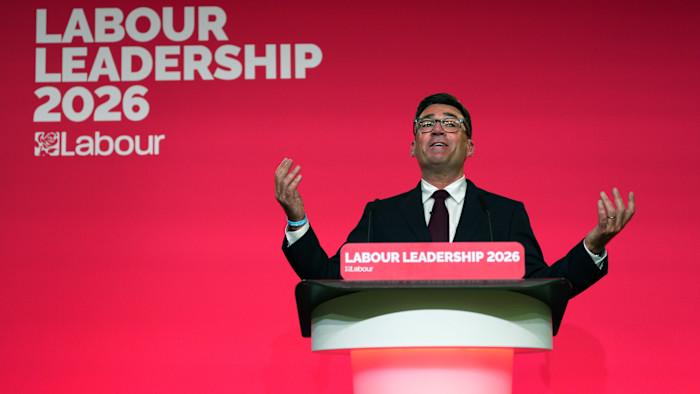
Andy Burnham will scrap the Labour government’s digital ID scheme in a “reset of priorities” after he becomes prime minister on Monday.
The incoming premier said on Saturday that he would ditch the programme as part of a drive to “focus on the daily priorities facing people across the country” with the money saved to be spent on ordinary people.
His spokesperson said that Burnham wanted to be “improving everyday life” rather than spending money on expensive schemes through an over-centralised model of government.
The Office for Budget Responsibility, the fiscal watchdog, had estimated the digital ID scheme would cost £600mn a year.
“All the time and resource that was going to be spent on a national ID scheme will go instead to where it is most needed such as helping with the cost of living,” the spokesperson said. “This government is determined to bring power back to communities, instead of hoarding it in Whitehall.”
Sir Keir Starmer approved the controversial ID plans last September as part of a drive to combat illegal migration. He was encouraged by his Labour predecessor Sir Tony Blair and former Conservative leader William Hague.
Darren Jones, first secretary to the prime minister, promised the new system would become the “bedrock of the modern state”.
But in the face of a large public pushback, including a petition against the policy that attracted more than 3mn signatures, Starmer was forced to drop plans to require workers to sign up to the programme.
Instead, by the time ministers launched a public consultation this year, they were trying to promote digital IDs as a way to drive reform in public services such as welfare payments, childcare entitlements and local government.
The ID would only be mandatory for right-to-work checks and not for access to any public services, they clarified.
The decision will probably disappoint organisations such as ThinkLabour and the Tony Blair Institute, which had both backed the scheme. But the policy was opposed by the Conservatives, the Liberal Democrats and civil liberties groups such as Big Brother Watch and Liberty.
The Labour government of two decades ago tried to set up a digital ID system but it was scrapped by the Tory-Lib Dem administration that took power in 2010. An estimated £4.6bn was wasted on that failed scheme.
Ironically it was Burnham himself who was the junior Home Office minister responsible for implementing the Identity Cards Act 2006.
The incoming prime minister’s decision was signalled last autumn when he told the Labour conference that he was not keen on new digital IDs. Asked if he supported the policy, he replied “not yet”, citing his own experience of trying unsuccessfully to push through ID cards.
“I was the ID cards minister under Blair, which is 20 years ago . . . I’m not kind of arguing against the principle. I was very pro, actually, I thought there was a real clear case for it,” he said in September.
“But . . . I think there’s a risk of an opportunity-cost situation here where something can consume a huge amount of time and actually doesn’t come through.”
His spokesperson said on Saturday that the Labour government would continue to crack down on illegal working.
There will still be mandatory right-to-work checks for all employers, which can be carried out digitally, the spokesperson said. Those will be extended to gig economy and zero-hours workers through Labour’s border security, asylum and immigration bill.
Posted by Desperate_Wear_1866