
A More Accurate Portrait of Homeownership
A better metric shows that homeownership is even less common among younger Canadians than official statistics suggest.
The traditional homeownership rate metric is misleading. Fortunately, the Minnesota Fed just came up with a better measure.
Here at the Missing Middle, we frequently write about and talk about homeownership rates and post a lot of graphs like the one below, from our piece The Homeownership Journey Is Broken. Policymakers Need to Repair It:
Figure 1: Homeownership Rate by Age Cohort and Year, Canada
The problem with the metric becomes apparent when we chart the homeownership rate for every age group, including 15-19 years, as shown in Figure 2:
Figure 2: Homeownership Rate by Age, Canada, 2021, Traditional Definition
A homeownership rate of 16% for individuals between the ages of 15-19 would strike most people as absurd, but the data is accurate. The problem is with how statistical agencies define homeownership. It is simply the proportion of families that own the house they live in. But very few 15-19-year-olds are the head of a family in the first place, so they are neither owners nor renters. They are absent from the calculation entirely.
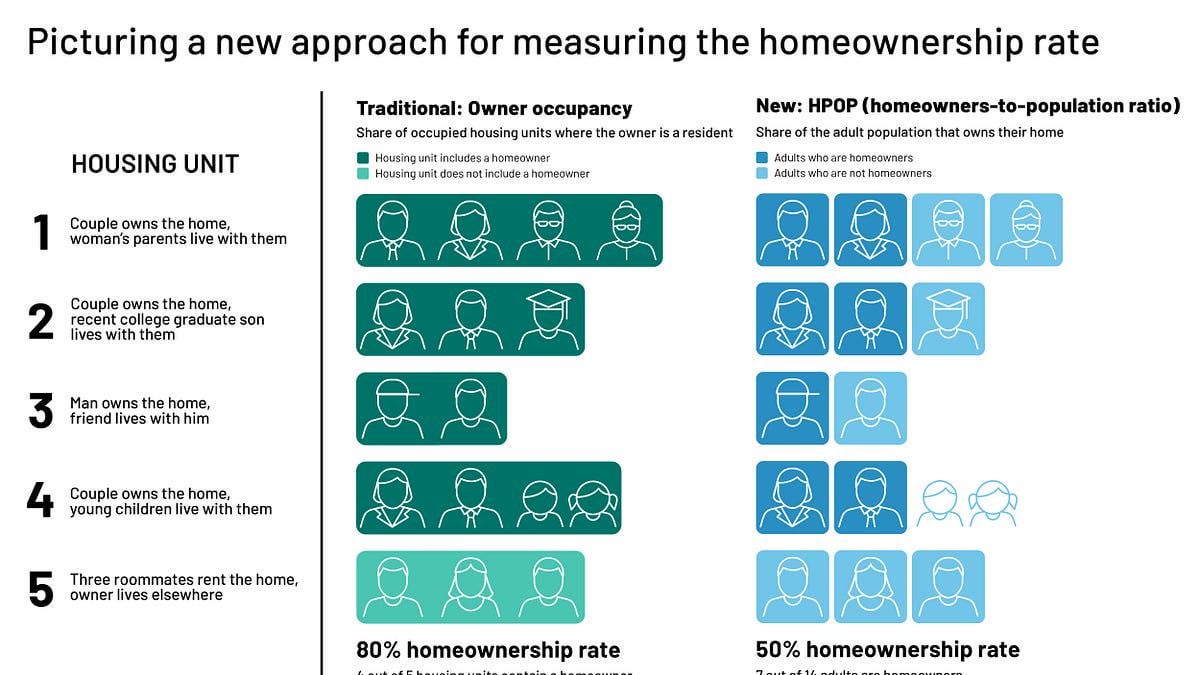
This absence from the calculation matters, as the traditional homeownership rate measure does not capture phenomena such as people in their 20s and 30s living with their parents longer. This problem has been recognized for some time, so the Federal Reserve Bank of Minnesota decided to address it. In their piece New homeownership measure puts people first they created a new metric, the “homeowners-to-population ratio”, which measures the percentage of the population that owns a home, either as an individual or as a couple.
In an instructive infographic, the piece shows how factors such as older family members or adult children living with homeowners, or roommates living with the owner of a home, are captured under their new metric, as shown in Figure 3.
Figure 3: Traditional vs. Minnesota Fed Measures of Homeownership Rates
Fortunately, Census 2021 contains enough data to calculate homeownership rates using the new Minnesota Fed definition. Figure 4 shows that, under the Minnesota Fed definition, homeownership rates fall dramatically for persons under the age of 40, and those over the age of 85. This better captures the phenomenon of younger people living with their parents longer, and the elderly living with relatives or in long-term care homes. Under the Minnesota Fed definition, the homeownership rates for 15- 19-year-olds in Canada are effectively zero, a much more sensible result.
Figure 4: Homeownership Rate by Age, Canada, 2021, Two Definitions
The new definition causes homeownership rates to fall by 15 percentage points for those under the age of 30, 10 points for those between 30 and 34, and a whopping 20 points for those over the age of 85.
Figure 5: Homeownership Rate by Age, Canada, 2021, Two Definitions
A few other points stand out to us:
- Even under the new definition, those aged 85 and up are still more likely to be homeowners in Canada than those between the ages of 30 to 34. The rate at which older Canadians sell their homes and move into other forms of housing is vastly overestimated by Canadian policy-makers, particularly at the municipal level.
- Further to the previous point, those aged between 75 and 84 have higher homeownership rates under the new definition than any age category under age 50.
- In 2021, less than one-quarter of all Canadians between the ages of 25 and 29 owned the home they lived in, either as an individual or a couple.
This new definition of homeownership from the Minnesota Fed is far more sensible than the traditional definition, and we are grateful that they created it. Where possible, we will utilize their definition in future work.
Posted by IHateTrains123