
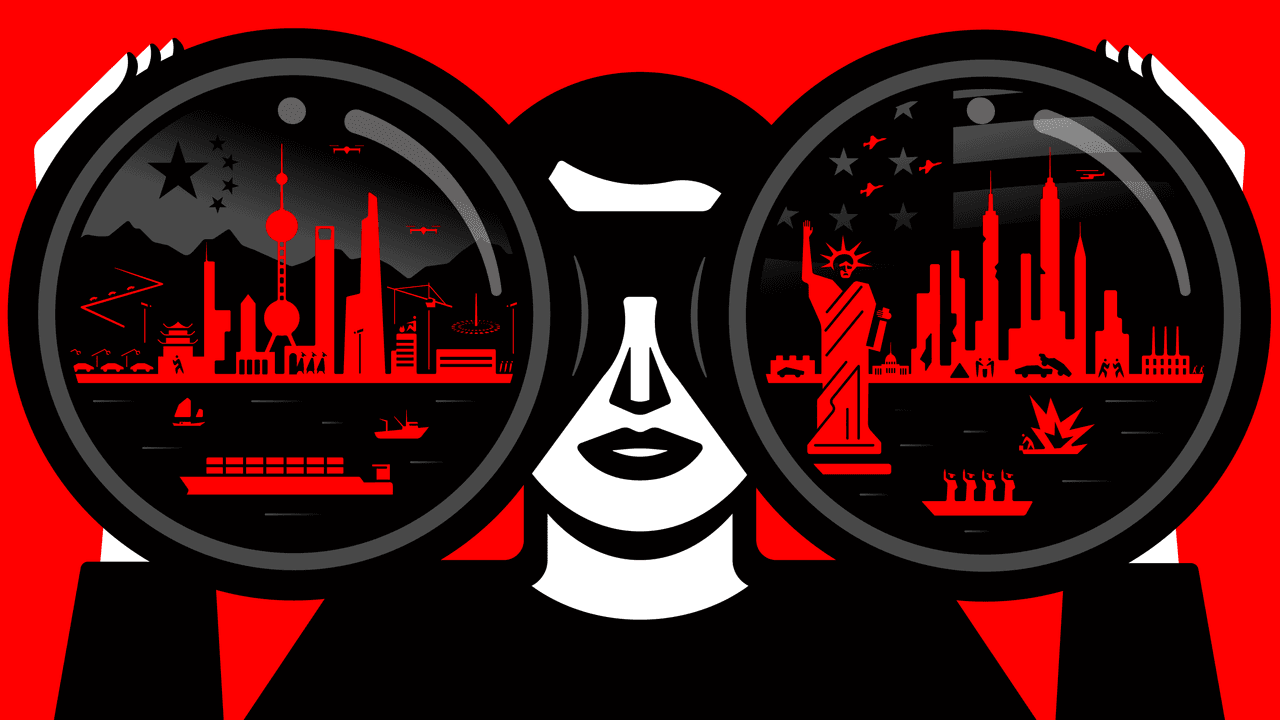
A long, interesting piece from the The New Yorker arguing that while the U.S. is distracted by domestic turmoil, China is pulling ahead in the next wave of critical industries (AI, biotech, robotics), building on decades of state investment and industrial policy just as America pulls back on immigration, trade, and research funding.
Some highlights:
"In Beijing, a think tank at Renmin University recently published an assessment titled “Thank Trump,” which wryly hailed his efforts to hasten the “twilight of an empire,” by undermining America’s alliances, civil service, scientific institutions, and democratic credibility. In the past two years, the international approval rating of the U.S. has dropped nearly forty points, according to a worldwide survey by the Alliance of Democracies; in multiple polls, China now rates higher than the U.S.
…
What kind of world does China imagine? A preview of sorts is provided by its Belt and Road Initiative, which since 2013 has directed about a trillion dollars into scores of countries, building highways, hospitals, mines, ports, and “smart cities” equipped with Chinese technology. To China, Doshi said, “autocracies are considered perfectly legitimate, and technology is used to strengthen them. China increasingly says to autocrats, Would you like to stay in power? I can help you with that.” In Nepal, where newly installed facial-recognition systems have been deployed against activists, a photograph from a security headquarters showed a wall of video feeds above a sign that read “With Compliments of the Ministry of Public Security of China.”
But the clearest indication of Beijing’s global vision may be the current state of China itself. “A country tends to create an external order that looks a lot like its internal order,” Doshi said. “China doesn’t want you to think too hard about what its ascendance will mean for the world. They want to show you the edge of the future. They have two messages they want to sell everybody. One is ‘We are inevitable.’ And the other one is ‘Don’t worry.’"
…
Chinese officials often warn against a lawless world in which “the weak are meat for the strong.” But the Party’s own tactics are uncompromising, both at home and abroad. Nicholas Burns, a former U.S. Ambassador to China, told me, “China always says, ‘The U.S. government is too pugilistic.’ That’s their rhetorical veneer. The reality is they are competing tooth and nail behind the scenes.” Last year, Trump pressured Panama to strip the control of two significant ports from a Hong Kong-based company and give it to an American-led consortium. In the dispute, China reportedly warned foreign executives against “illegal activities that harm the interests of Chinese companies.” Such warnings are dangerous to ignore. International businesspeople drawn into geopolitical disputes have been barred from leaving China. The message, the European diplomat told me, is “ ‘We are a great power, and we will retaliate against anyone who hurts our rights or interests.’ Behind this is the undisputed rule of the Chinese Communist Party.”
Yet China is not rushing to re-create the international order that has recently frayed. Since 1949, Beijing has signed only two formal alliances—with North Korea and the Soviet Union—and both proved costly. Patricia Kim, an expert at the Brookings Institution, calls Beijing’s posture a “China first” strategy. “China is happy to put out statements, but it has no interest in stepping in as a crisis manager,” she told me. “It wants greater influence, but it also wants to avoid responsibilities.” Chinese leaders view “the burdens of U.S. global leadership as a source of American overextension and decline,” she said, “and they have no interest in emulating this model.”
Zhou Bo, the retired People’s Liberation Army officer, made a similar point from a different perspective. “The Trump Administration has walked away from sixty-six international organizations,” he told me. “This is a big gap that China simply cannot close.”
The likely successor to the American order, then, is not a Chinese order so much as what Leonard calls a period of “un-order”: a jungle in which every country hedges, arms, subsidizes, hoards, and searches for choke points to exploit. In the words of Suisheng Zhao, a China scholar at the University of Denver, it is the makings of a “twenty-first-century Hobbesian struggle of all against all.”
Posted by loremipsumot
1 Comment
I hate the framing of the US’s preference for democracies as a moral thing instead of a clear realpolitik situation
US doesn’t require democracy as a pretense and it absolutely can (and regularly does) excuse human rights abuses in the quest for its best interest. I fear that selling China’s lack of regard for (or even preference for) autocracy as a moral issue ignores a bunch of the downsides that come with working with autocracies–that is, unpredictability, corruption hitting you in the face, ease of influence, and instability.