
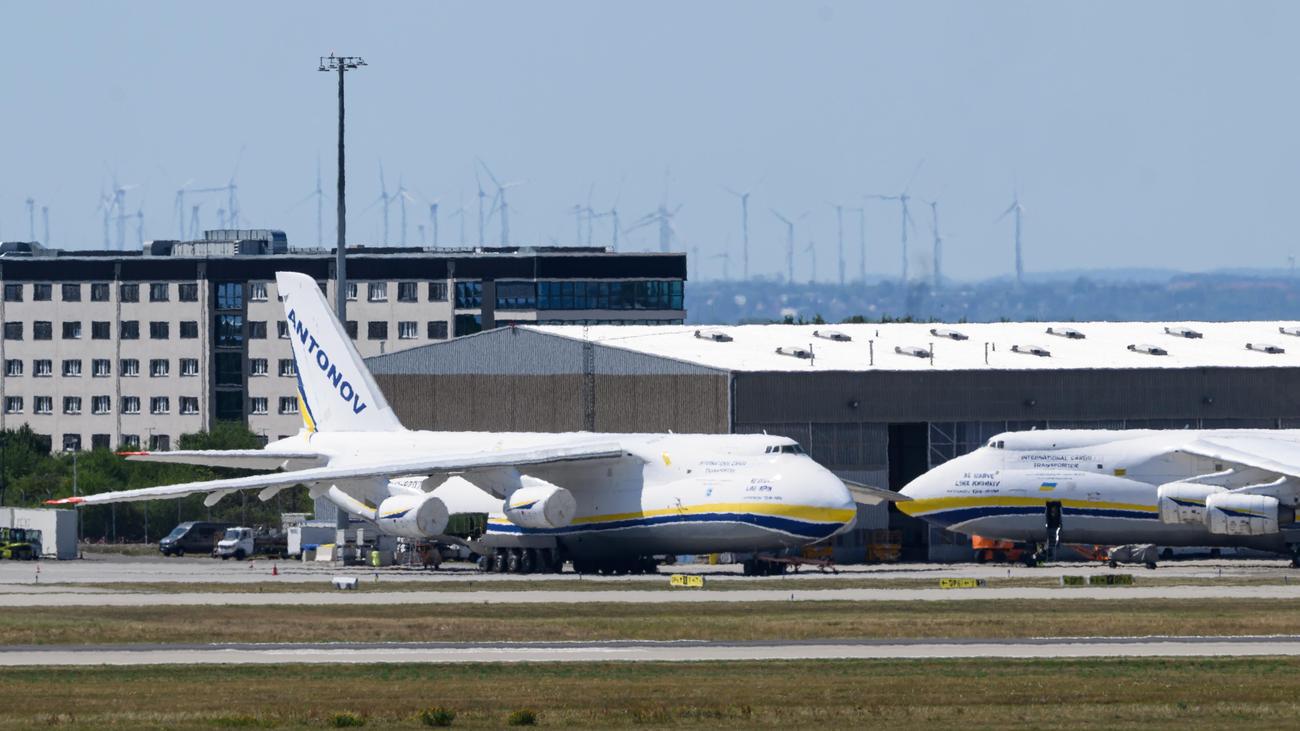
Leipzig Airport appears to have narrowly escaped a disaster—even more so than previously known. According to information obtained by Die Zeit, the armed drone struck an aircraft.
Since an armed drone was discovered at Leipzig Airport overnight into Wednesday, many details have come to light—such as the drone's size (a quadcopter with four rotors, roughly the dimensions of a microwave oven), where it was found (near a Ukrainian cargo plane also used to transport military equipment), and the type of explosive it carried (Semtex).
However, some crucial questions regarding the sequence of events have remained unanswered until now. These include how the armed drone managed to get close to the Ukrainian aircraft in the first place, the path it took, and whether it was scouting the plane or, for instance, attempting to fly underneath it.
According to information obtained by *Die Zeit*, video footage shedding light on these matters has now been analyzed, as the majority of the airport grounds are under camera surveillance. The videos reveal that Leipzig narrowly escaped a catastrophe—far more narrowly than previously known.
The footage shows the Antonov cargo plane parked at the airport. It also appears to show an object flying directly toward the aircraft around 7:30 p.m. on Tuesday evening. It ultimately struck one of the wings. Wings are particularly critical parts of an aircraft because they typically house fuel tanks; anyone intending to blow up a plane would detonate a bomb there. However, that did not happen in Leipzig. The footage indicates that the object bounced off the wing and fell to the ground. Traces found on one of the Antonov's wings confirm this suspected sequence of events. It remains unclear why the explosive device failed to detonate.
The drone was not discovered by chance until four hours later. Die Zeit had already reported on Wednesday that it was the bus driver for a tourist group who spotted the device. Previous reconstructions had assumed that he kicked the device and later pinned it to the ground. This was also the account given by CDU Member of the Bundestag Detlef Seif, who, along with other lawmakers specializing in home affairs, was briefed on the incident by the federal government on Thursday.
Camera footage, however, now reveals that the drone was already on the ground when the bus driver arrived. After a brief moment of hesitation, he placed his foot on it and alerted security personnel. Ultimately—contrary to earlier reports—the explosive device was not found on the drone itself but at some distance away; it may have detached upon impact with the aircraft.
This provides new insights for the Federal Criminal Police Office (BKA) officers who took over the investigation over the weekend. It is now clearer exactly how the drone approached the aircraft: not cautiously, but with the obvious intent to cause damage. Its purpose has also become clearer. Previously, one working hypothesis was that it might have been intended merely as a sort of warning—armed, yes, but not meant to actually detonate. That hypothesis is now difficult to maintain. Leipzig Airport narrowly escaped a devastating attack.
When Federal Interior Minister Alexander Dobrindt (CSU) interrupted his vacation on Wednesday to travel to Leipzig, he avoided making clear statements about whom he suspected of commissioning the attack. While he spoke of a "hybrid attack scenario" and "foreign powers"—phrasing commonly interpreted as a reference to Russia—he refrained from explicitly naming Russia as the perpetrator. He faced criticism for this from figures such as Konstantin von Notz, a Green Party MP and security policy expert. The federal government must make clear "where all the trails lead and state unequivocally that such operations will have clear consequences," von Notz said.
So far, the investigation has not yielded clear evidence that Russia is behind the attempted attack. However, several details point to highly professional perpetrators. The drone was not purchased off the shelf but custom-built—in a manner beyond the capabilities of petty criminals or hobbyists. Because it was a so-called non-commercial drone, it could not be detected by conventional radar systems. The Semtex explosive with which it was equipped was powerful enough that it would likely have caused the aircraft to explode. While Semtex is occasionally available on the black market, it is typically used by the military. Consequently, the involvement of a state actor in the attack—in whatever capacity—has become one of the increasingly likely hypotheses in the investigation.
Translated by Google Translate, mistakes are my own.
Archived version for original German text: https://archive.ph/IjK7L.
Posted by IHateTrains123
5 Comments
Another day, another Russian attack on NATO.
Nothing will be done until a mass casualty incident though.
Personally I think this is the most significant story of the year. With international espionage lines can get blurred, but this type of drone attack on planes at an airport in a NATO country feels a bit different than blowing up a warehouse or hiding incendiary devices in mail and detonating during shipping.
January 2027. After the drone attack on the Reichstag that claimed the lives of 57 legislators and injured hundreds more, Michael Kretschmer, prime minister of Saxony, calls for caution. “We must not give in to alarmism. Even should Russia have orchestrated this attack, antagonizing a government with nuclear warheads would be foolish. However, I am confident that Putin is a rational man who remains focussed on business and not senseless slaughter, which is why I will continue to advocate for the repair and opening of the Nord Stream 2 pipeline.”
bus driver W, foot placer of drones
!ping Germany&Foreign-policy