
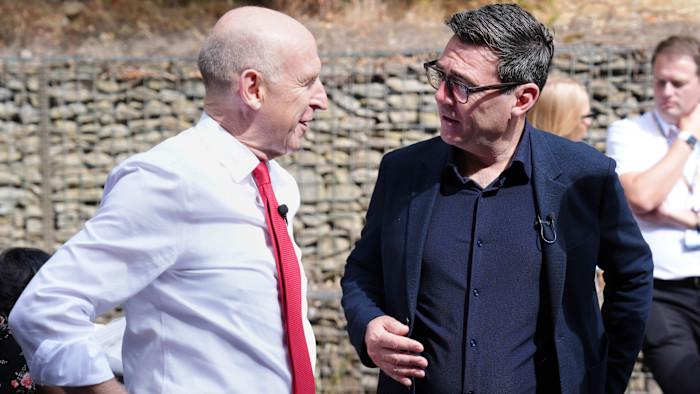
UK chancellor John Healey has been urged by senior figures in Sir Keir Starmer’s former government not to blow a “strong” economic inheritance by raising taxes and hitting business in his first Budget in October.
Healey on Thursday hailed healthy growth figures as showing that “the UK was the fastest-growing economy in the G7 in the first half of the year”, but there are concerns in Labour’s ancien regime that Andy Burnham’s new administration could put that in peril.
The economy grew by 0.4 per cent in the second quarter and 0.6 per cent in the first quarter. Former chancellor Rachel Reeves declared on X: “Strong growth numbers for the first half of the year. This was not inevitable.”
Some who served alongside Reeves in the Starmer administration are worried that Burnham, who has signalled plans for spending increases, could undermine growth with higher taxes — especially on wealth and business — and more borrowing.
One Labour figure said: “The government needs to start focusing on growth, not just on how to spend money that doesn’t exist. Borrowing costs are too high.
“Rachel Reeves did the tax-raising in her two Budgets and they shouldn’t do any more. The point was to fix the public finances and secure the money needed. That has been done. We have reached the limits on tax and now it’s about driving growth and reform.”
Former ministers who served under Starmer fear that Burnham’s continuing “listening” tour of the UK might result in the prime minister returning to Westminster with new spending ideas. “He’s in a world of tough choices,” one ex-minister said.
Burnham has signalled that he wants the Budget on October 28 to help people with the cost of living, while there are plans for increased council housing, more defence spending and a longer-term commitment to address the crisis in social care.
Reeves said: “It is because of the resilience of the British economy and the responsible action taken since the election to deliver stability, investment and reform. Lots done, more to do.”
Allies of Healey have attempted to reassure business and markets, telling the FT that he would stay “well within” Reeves’ self-imposed fiscal rules and was looking to deliver a “straightforward, well-managed Budget this autumn”.
One said Healey, who served in the Treasury under Sir Tony Blair, saw the fiscal event “as building on the foundations of Reeves’ Budgets of strong fiscal discipline, rising investment and public service improvement”.
“This government is giving people a little breathing space, strengthening resilience and bringing hope back,” the chancellor said on Thursday.
While Healey will need to find money to ease the cost of living crisis, he could postpone decisions on defence and social care. Some in Burnham’s circle hope robust growth will continue into the third quarter of 2026.
Treasury insiders argue that, unlike Reeves’ two Budgets in 2024 and 2025, there will be no need to carry out a major “fiscal repair job”.
“There won’t be a Tory black hole to deal with or a massive downgrade in productivity forecasts,” said one.
Nevertheless, Burnham’s supporters have advocated a range of tax rises in recent months targeting the wealthy, property owners and banks to help fund a more leftwing economic agenda.
Lord Jim O’Neill, former Goldman Sachs chief economist and ex-Treasury minister, who has provided Burnham with economic advice, has warned against any “wealth tax” and so far has not taken up any formal government role.
Burnham has already been forced to retreat on a suggested compensation package for women affected by a rise in the state pension age that might have cost billions of pounds.
The former Greater Manchester mayor also referenced concerns in his Makerfield constituency about the longstanding freeze in the personal income tax allowance.
But his allies played down any early move on that front after warnings that ending the freeze could cost more than £9bn a year by the end of the decade.
The GDP figures came as a relief within the Treasury, where officials were expecting a weaker June out-turn than the 0.3 per cent monthly increase to output.
The new numbers put the UK at the head of the G7 group of advanced economies for growth in the first half overall, although Japan has yet to report its second-quarter output.
Jobs market figures and inflation data will next week shed further light on the health of the economy, but some indicators point to sustained momentum.
The S&P Global UK Services PMI activity index returned to growth in July, for example, with a reading that exceeded the no-change value for the first time in three months.
But officials are also acutely aware of the risks that still lie ahead. Financial markets remain on edge because of the risks associated with the war in Iran, with the Bank of England predicting inflation will rise from 2.6 per cent to 3.2 per cent towards the end of the year, compared with the official 2 per cent target.
The BoE is expecting growth of 1.1 per cent this year and next, shy of 2025’s 1.3 per cent figure. But the Treasury’s own internal scenarios expose serious downside risks to that outcome if the Strait of Hormuz crisis continues for the remainder of the year.
GDP growth under such a scenario could fall to just 0.3 per cent in 2027, according to the Treasury’s internal modelling, people familiar with the numbers said.
While economists said the second-quarter growth figures were led by the private sector thanks to increases in both real household spending and business investment, the UK has an established pattern in recent years of growth fading after a strong start to the year.
This remained a possibility in 2026, they said, especially given continued pressures on households and businesses from rising commodity costs.
Business leaders warn that the challenge will be maintaining the current momentum with Budget-related speculation already beginning to swirl ahead of Healey’s October statement.
“Businesses have become somewhat less pessimistic recently, but uncertainty around the new government and the autumn Budget could encourage firms to keep plans on ice,” said Ben Jones, senior lead economist at the CBI lobby group.
“The priority must be to build on the economy’s recent resilience and deliver sustainable growth. Tackling the cost of doing business — from high industrial electricity and employment costs to business rates reform — will be critical to achieving this goal.”
Posted by Desperate_Wear_1866
1 Comment
Yes I know, the headline sounds absurd.
There is currently disagreement on the direction of the next budget between Andy Burnham’s supporters and former allies of Keir Starmer.
With the fiscal situation in a better place due to two taxes rises, former allies of Starmer have urged Chancellor John Healey not to raise taxes further and to focus on promoting growth.