
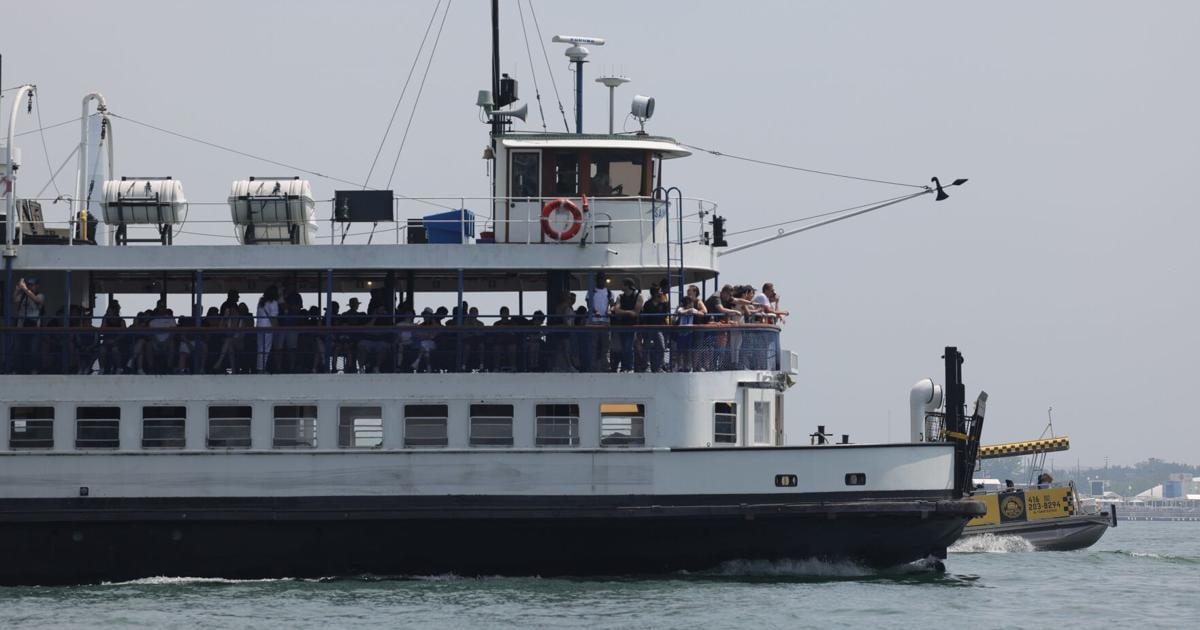
If you’re enjoying the free ferry rides in Toronto this month, remember to thank a homebuyer of the Pinnacle One Yonge project. They paid for your ticket.
This isn’t a criticism of the free fares, which are in place for the month of August for both kids and seniors. I myself am looking forward to taking my two kids onto the ferry for free.
However, the money for my free tickets should not come off the backs of new homebuyers. In this case, that’s who is footing the bill, thanks to what Councillor Vincent Crisanti described at the July 30 council meeting as a “very complicated accounting formula.”
In Ontario, municipal planning operates under a simple mantra: “growth pays for growth.” The theory is that existing taxpayers shouldn’t bear the cost of new infrastructure needed to accommodate newcomers to the neighbourhood.
Under Section 37 of Ontario’s Planning Act, until 2022 when it was revamped, developers negotiated “density bonuses” with the City. In exchange for added height and density beyond what the zoning allowed, developers paid millions into dedicated funds.
These funds were meant to follow two rules: first, they had to be used for capital expenses on new assets that improve the community’s livability, such as libraries, community centres, art installations, and new daycares — the things that make a neighbourhood feel like a community.
Second, they also had to be used to benefit the ward where the new development was located. The idea was that it should compensate immediate neighbours for living with the added density.
That money comes with a couple of problems: it adds to the cost of housing; and it isn’t always used appropriately.
Case in point: Recently, in the middle of a municipal election period, Mayor Olivia Chow wanted to celebrate the federal government kiboshing the expansion of Billy Bishop Toronto City Airports.
The federal government was initially on board with the premier’s plan, but changed its mind after a public consultation in which 87 per cent of responses were opposed to expanding the airport.
In celebration of this political win, Toronto City Council voted in favour of free ferry tickets for seniors and kids throughout the month of August.
To pay for it, the city, which is notoriously strapped for cash, couldn’t directly use Section 37 funds. Instead, they decided to play an accounting shell game.
City Council took almost $1.4 million from a local capital expense, the revitalization of the Jack Layton Ferry Terminal, and allocated it to the free ferry rides. It immediately replaced that money with the same amount of money from the Section 37 funds coming from 1-7 Yonge Street, better known as the Pinnacle One Yonge project.
On paper, the accounting looks clean, but in reality, it took money that was allocated for local amenities for a neighbourhood absorbing massive density and used it to throw a citywide celebration.
Even if you accept the argument that upgrading a city ferry terminal somehow counts as a local ward benefit, funding these operational freebies violates the spirit of the law.
More importantly, this accounting trick concealed the true payers of the ferry fares: the property owners at the SkyTower.
Ultimately, it exposes a troubling reality in municipal finance: community benefit charges don’t always fulfil their promises. Instead of delivering parks and daycares, these fees can be treated as flexible piggy banks used to finance citywide political gestures, which should really be paid for by general revenue.
At the council meeting that debated this motion, as city staff insisted this was an appropriate use of the funds, some councillors mused how they, too, could use Section 37 funds more flexibly in their wards through similar methods.
At a time when housing supply is stalled and the dream of home ownership has slipped out of reach for the middle class, City Hall needs to remember that taxes on homes increase the cost of homes. A little more respect for its homebuyers’ wallets would go a long way.
Posted by IHateTrains123
1 Comment
Growth paying for growth is such a classic perverse incentive for municipalities across Canada. If someone wants to plop a big condo development down on a street with insufficient water and sewer infrastructure or no sidewalks it’s reasonable for councils to ask the developer to pay for those upgrades. But in practice these contributions devolve into massive slush funds with a much larger scope for what counts as “growth”.
I live in a city that’s got billions in the bank due to this; it’s nice that we have lots of community centres under construction and park upgrades going on but it’s hard not to see the consequence of this when it comes to a complete lack of smaller scale developers building smaller scale developments in larger quantities. Instead all we seem get for new housing stock is massive towers that take years to build and with tiny shoebox units due to the difficulty in maintaining profitability with all these constraints.
The big condos have big community contributions. A wood-framed sixplex? Not so much.