
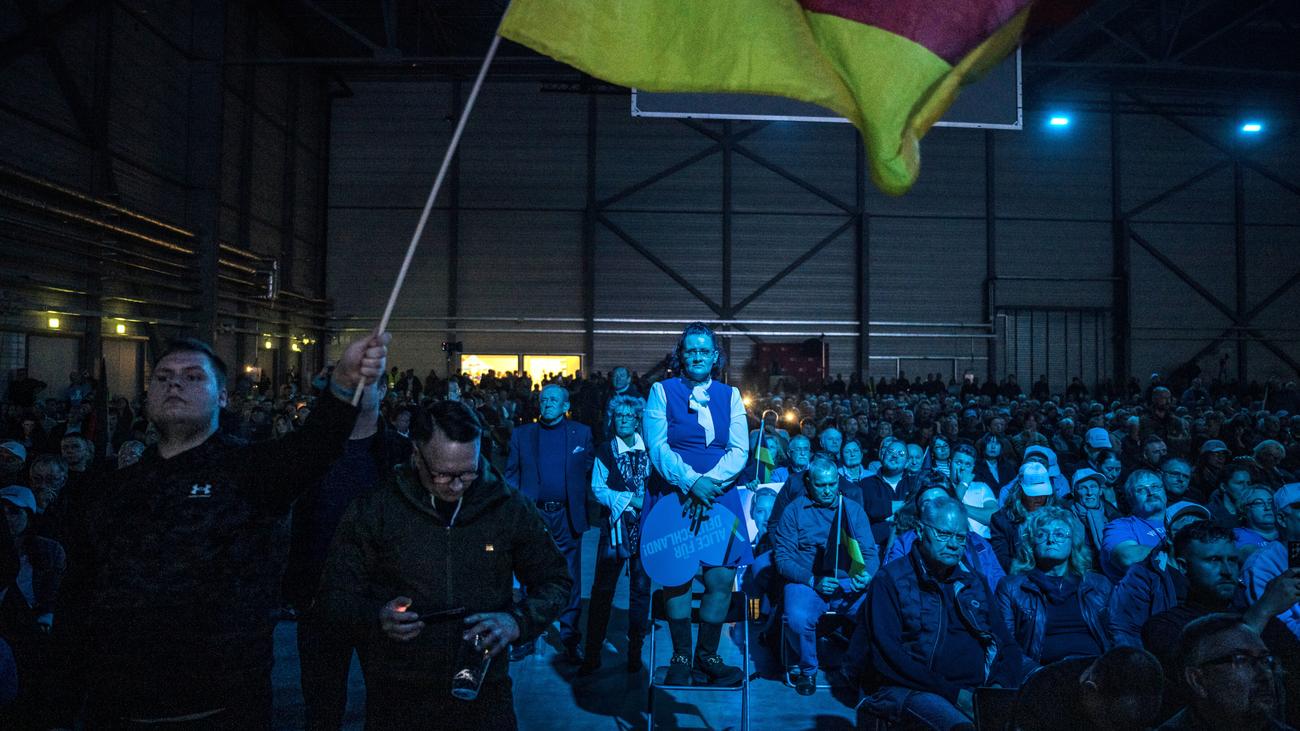
Why is the AfD so strong? A look at the latest research reveals who votes for the party—and which eight structural factors make the difference.
41 percent in Saxony-Anhalt, 36 percent in Mecklenburg-Western Pomerania, 16 percent in Berlin: according to polls, the AfD is set to perform very strongly in the state elections this September. This could alter the country's political landscape. It is a fitting moment to examine the current state of research, particularly regarding the party's electorate. Five key insights can be drawn from the latest studies that may help in understanding these elections.
Overview:
- The AfD electorate consists of three types
- The West is catching up—and is sometimes more radical
- Falling numbers—it doesn't matter: migration is the symbolic rallying issue
- Too old, too few women: demographics are decisive
- Experts seem at a loss
–
- The AfD electorate consists of three types
Who are the people intending to vote for the AfD despite its increasing radicalization? The composition of its electorate has shifted over the years. Continuously reassessing this makeup is crucial, as it determines which segments of the AfD’s supporter base remain within reach of other parties. A study by sociologist Céline Teney outlines the current situation. Drawing on data from the GLES panel collected last year, the Freie Universität Berlin professor demonstrates that AfD voters can be categorized into three groups: conservative hardliners, radical-right authoritarians, and moderate conservatives.
According to Teney, conservative hardliners make up the largest share of the AfD electorate, accounting for approximately 67 percent. These voters are typically middle-aged individuals from small and medium-sized towns. For them, migration remains the defining issue; they advocate for strictly limiting it—even as the number of asylum applications has steadily declined. Other issues, such as the economic situation or foreign policy, are of less importance to this group.
Conservative hardliners are certainly radical in their focus on immigration, yet they are more moderate in other respects—at least when compared to the second-largest group of AfD voters (accounting for about 20 percent): the far-right authoritarians. According to Teney’s analysis, members of this group tend to be older, have lower levels of education, and are more likely to live in rural areas. They, too, are extreme in their rejection of immigration and lean toward authoritarian leadership and antisemitic views. "This profile is the one furthest removed from fundamental democratic and pluralistic norms," writes Teney.
In Teney’s typology, the third group of AfD voters—comprising just under 13 percent—consists of moderate conservatives. "Compared to the other AfD profiles, they show the least inclination to exclude minorities or isolate Germany," states the study from June 2026. Furthermore, moderate conservatives within the AfD electorate are the least likely to endorse authoritarian and antisemitic positions. Economic and foreign policy issues are also relatively more important to them, making them more open to alternatives; the sociologist notes that this moderate group is the most receptive to overtures from other parties. This is also reflected in the fact that this segment of the party's supporters views the SPD in a comparatively positive light.
It is also helpful to examine the other characteristics of the three voter types. In terms of policy—such as the question of the size of the welfare state—they differ only slightly. The groups also share a similar pessimistic view regarding Germany’s trajectory. This perspective is particularly pronounced among radical-right authoritarians.
Thus, genuine differences lie less in specific policy issues than in the degree of radicalism. The AfD’s electorate is quite heterogeneous in this regard; there remains no single "typical" far-right supporter. The various attitudes span the entire right-wing spectrum, from moderate to extreme. However, there is a marked tendency toward radicalism regarding migration policy: those with generally moderate views are in the minority here, just as they are within the party as a whole. Consistent with this, a study by sociologist Julius Kölzer and his colleagues (PDF) shows that the AfD is particularly strong in areas where far-right parties have historically performed well.
- The West is catching up—and is sometimes more radical
Kölzer’s work suggests that regional differences play a role. Recent research reveals how the situation has changed of late. In 2025, sociologist Andreas Hövermann examined—on behalf of the Hans Böckler Foundation (PDF)—how the AfD’s electorate managed to double nationwide within just a few years. While the party has long been established in East Germany, it has recently attracted new voters primarily in the West—including, for the first time, more women.
Berlin-based sociologist Teney points to a key difference: whereas East Germany was once considered the stronghold of the party’s radical supporters, data analyzed by Teney now show that radical-right authoritarians make up a larger share of the base in West Germany. This suggests that support for the AfD in the East has broadened—effectively becoming normalized—whereas in the West, it remains concentrated among a core group of supporters.
- Falling numbers—it doesn’t matter: Migration as a symbolic rallying point
Beyond the makeup of the AfD electorate, it is worth examining the policy area that particularly preoccupies them: Why does immigration remain so important to the majority of AfD voters, even though the numbers have been steadily declining and the issue has recently played a less prominent role on the agenda?
While there are no specific new studies on this, a look across existing research over time reveals a shift: whereas immigration was a central policy issue for AfD supporters (as it was for the electorate at large) at the height of the so-called refugee crisis, it has since evolved into a symbolic meta-issue. Actively leveraged by the party, this topic encapsulates the full range of AfD voters' concerns and attitudes: fears regarding a loss of control and status, anxieties about perceived cultural transformation (e.g., the "Great Replacement" narrative), elements of racism and fear of "foreigners," and a fundamental distrust of state institutions. Viewed in this light, the actual volume of ongoing immigration is of little consequence. For other parties, this has a far-reaching implication: there is no policy outcome they could achieve that would satisfy a significant portion of the AfD’s support base.
- Too old, too few women: Demographics are the decisive factor
What structural conditions allow the AfD to flourish in this way? A study by the German Institute for Economic Research (DIW) identifies eight characteristics that determine whether or not a district leans toward the AfD: disposable income, youth unemployment, the density of skilled craft businesses, the share of employees in the manufacturing sector, the rate of university-entrance qualifications (Abitur), the proportion of the population over 60, the share of foreign nationals, and changes in the proportion of asylum seekers. Whether the party performs strongly or weakly in a given area is therefore no coincidence; rather, it depends systematically on regional factors—though the study does not specify the exact interplay between them. Instead, the DIW study identifies a key variable: the demographic situation within a district is the decisive factor for the AfD’s success.
This was already known. As early as 2019, sociologist Katja Salomo pointed out—based on a case study of Thuringia—that the East German combination of an aging population, a shortage of women, and low birth rates created a uniquely unfavorable environment for regional living conditions. The DIW now highlights this factor as crucial: "The AfD garners significantly more votes in areas where there is a particularly large number of people over the age of 60 and where young, well-educated people are moving away—a trend that also leads to a marked drop in the rate of university-entrance qualifications among those who remain," states the analysis from July 2026.
The link between demographics and support for the AfD is multifaceted and well-researched. A shrinking, aging population leaves regions increasingly structurally weak. Investments—in local public transport, daycare centers and schools, libraries, and swimming pools—decline in line with reduced demand. The result is the widely documented sense of being left behind, a feeling that fosters susceptibility to populism and extremism.
This dynamic creates a vicious circle. Structural weakness and rising AfD vote shares drive further out-migration, particularly among the young, the educated, and women. Research indicates a prevailing surplus of men, especially in rural East German areas—a factor the AfD deliberately exploits with narratives claiming that migrants are taking German women away from local men. Another consequence is reduced inward migration—including, and especially, among migrants themselves; they are barely represented in regional AfD strongholds.
- The scientific community appears at a loss
How should the other parties deal with these developments? Surprisingly, there are hardly any significant new recommendations from researchers on this matter. Political scientist Johannes Hillje, for instance, advocates trying a strategy based on greater emotion and a positive narrative about the future. This approach, he argues, could appeal to a substantial segment of the population. But does that include the many people intending to vote for the AfD?
At least there is solid evidence regarding what the other parties should *not* do: attempts to outflank the AfD on the right or to co-opt its issues are doomed to failure. The research findings on this point are quite clear.
Posted by IHateTrains123
1 Comment
I am really at a loss on what to do against the AfD rise. Because reducing migration numbers doesn’t work, having more deportations doesn’t work, as the article pointed out.
Migration has become an identity-symbolic issue where real facts dont matter anymore, and in a media landscape where AfD voters are algorithmically isolated from everyone else its tough to reach them.